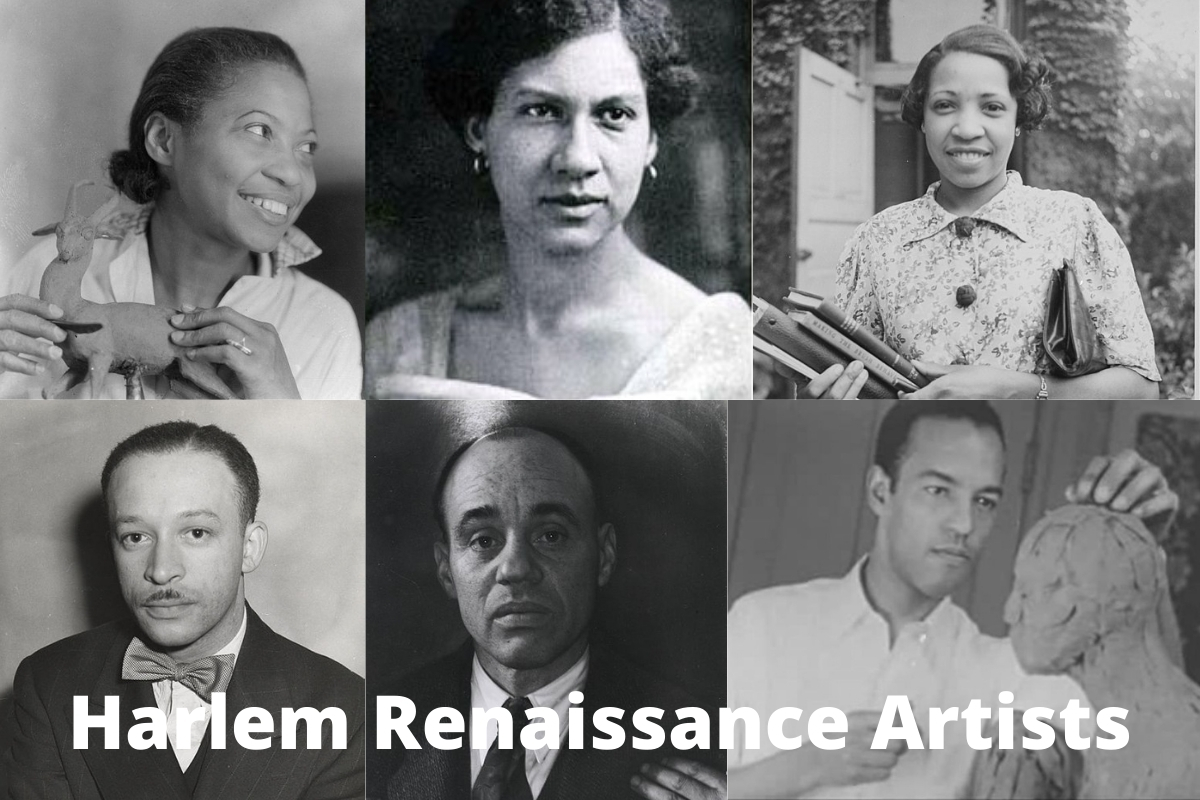
The Harlem Renaissance was a period of rich cross-disciplinary artistic and cultural activity among African Americans between the end of World War I (1919) lead up to World War II (the 1930s). Harlem Renaissance Artists associated with the movement asserted pride in Black life and identity, a rising consciousness of inequality and discrimination, and interest in the rapidly changing modern world—many experiencing a freedom of expression through the arts for the first time.
The Harlem Renaissance may be best known for its literary and entertainment. Pioneering figures such as Langston Hughes, Zora Neale Hurston, Duke Ellington, and Ma Rainey are familiar through out the pages of history. But sculptors, painters, ceramists, photographers and printmakers were key contributors to the first modern Afrocentric cultural movement. They formed a Black avant-garde in the visual arts.
Aaron Douglas (1899–1979) is known as the “Father of African American art.” He defined a modern visual language that represented Black Americans in a new light. Douglas began his artistic career as a landscape painter but was influenced by modern art movements such as cubism, in which subjects appear fragmented and fractured. He was also influenced by the graphic arts, which typically use bold colors and stylized forms. He and other artists also looked toward West Africa for inspiration, making personal connections to the stylized masks and sculpture from Benin, Congo, and Senegal.
They viewed this as a link to their African heritage. They also turned to the art of antiquity, such as Egyptian sculptural reliefs, of popular interest due to the 1922 discovery of King Tutankhamen’s tomb. Printmakers James Lesesne Wells (1902–1993) and Hale Woodruff (1900–1980) also explored a streamlined approach that drew from African and European artistic influences.
Sculptor Richmond Barthé (1901–1989) worked in a realistic style, representing his subjects in a nuanced and sympathetic light in which Black Americans had seldom been depicted before. Painter Archibald John Motley Jr. (1891–1981) began his career during the 1920s as one of the first Black graduates of the School of the Art Institute of Chicago. In the early part of his career, he created intimate and direct portraits, such as “Portrait of My Grandmother” of 1922.
James Van Der Zee (1886–1983), a photographer, became the unofficial chronicler of African American life in Harlem. Whether through formal, posed family photographs in his studio or through photo essays of Harlem’s cabarets, restaurants, barbershops, and church services, his large body of work documents a growing, diverse, and thriving community. He was known to have brought the spirit of Harlem to life. Works by Van Der Zee were artistic as well as technical.
The formation of new African American creative communities was engendered in part by the Great Migration—the largest resettlement of Americans in the history of the continental United States, mainly from rural Southern regions to more populous urban centers in the North. Pursuit of jobs, better education, and housing—as well as escape from Jim Crow laws and a life constrained by institutionalized racism—drove Black Americans to relocate.
The onset of the Great Depression in 1929 deflated the artistic energy of the period as many people became unemployed and focused on meeting basic needs. Yet the Harlem Renaissance planted artistic seeds that would germinate for decades. Many of the visual artists associated with the Harlem Renaissance came to participate in the Federal Art Project (1935–1943), an employment program for artists sponsored by President Franklin Delano Roosevelt’s Works Progress Administration. Further, a key legacy of the Harlem Renaissance was the creation of the Harlem Community Art Center (HCAC) in 1937, part of a cross-country network of arts centers.
The HCAC offered hands-on art making led by professional artists and maintained a printmaking workshop. The HCAC was critical in providing Black artists continued support and training that helped sustain the next generation of artists to emerge after the war. In subsequent decades, the Harlem Renaissance inspired new waves of artists and laid critical groundwork for the civil rights movement and the Black Arts Movement.
As a final note, women artists were a big part of the Harlem Renaissance and participated especially as singers, actors, dancers, and writers. Less well-known are the women visual artists of the period. Gaining access to the visual arts scene was more difficult than entry into the performing arts, as the practice of painting and sculpture in particular were not considered gender-appropriate or “feminine.” Lois Mailou Jones was a painter and educator whose works reflect a command of widely varied styles, from traditional landscape to African-themed abstraction. She was an important role model for other African-American artists, particularly those involved with her design and watercolor courses at Howard University from 1930 to 1977.
Two sculptors, Meta Vaux Warrick Fuller (1877–1968) and Augusta Savage (1892–1962), the latter an activist, artist, and director of the HCAC. They made their mark during the Harlem Renaissance period. Fuller has been described as one of the most imaginative Black artists of her generation. She created revolutionary sculptures throughout the 1910s and 1920s that elevated the African American experience as a subject worthy of depiction in art. Augusta Savage was one of America’s most influential twentieth-century artists. Her sculptures celebrate African American culture, and her work as an arts educator, activist, and Harlem Renaissance leader catalyzed social change.