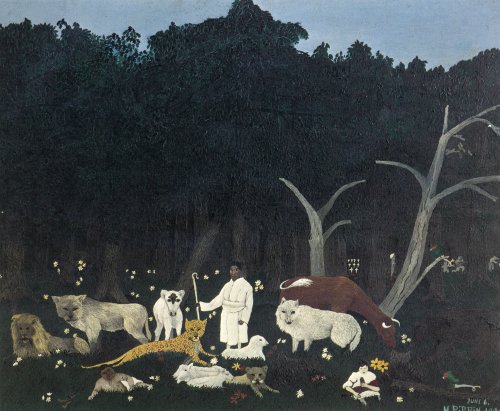
Self-taught and perhaps one of the most well-known artist of the Harlem Renaissance period was is Horace Pippin. He was an artist known for his primitivist depictions of Black life in America and the horrors of war. Horace Pippin was born in West Chester, Pennsylvania, on February 22, 1888. He was a descendant of slaves and domestic workers. When Pippin was two years old, his family moved to Goshen, New York and then to Middletown, NY where Horace’s mother worked as a maid. Pippin began to draw at an early age; however, since his parents were domestic workers, they could not afford basic art supplies. To find ways around his financial limitations, he participated in several drawing competitions.
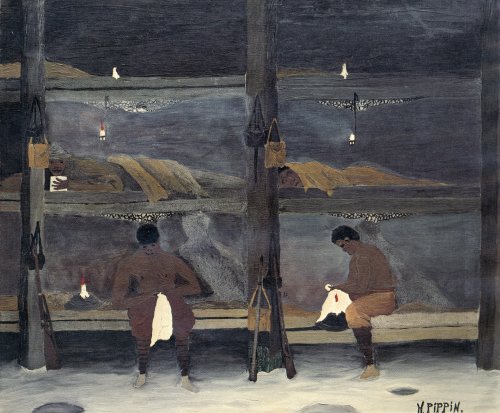
In 1898 at age 10, the artist won a box of crayons in a local competition with which he would draw religious subjects learned in the local African Methodist Episcopal Church regularly attended by him and his family. The young Pippin would attend racially segregated schools until the age of fifteen, after which he began working as a hotel porter first and in an iron smelting factory later to support his ailing mother. In June 1917, at almost 30 years of age, Pippin volunteered for the 15th New York National Guard, later renamed the 369th Infantry Regiment and nicknamed the Harlem Hellfighters or Black Rattlers. The 369th were composed mainly of African Americans and some Puerto Ricans. They remained on the front lines for longer than any other unit—191 days. Of those who survived, an unusual number went on to achieve fame in music and art.
They were assigned to the 16th division of the French army because many White American soldiers refused to serve with them. This was the Jim Crow era, with many state and local laws enforcing segregation; therefore, this response was not unexpected. At this time, U.S military leadership was predominantly White, and many officers doubted that Black people were intelligent or courageous enough to fight. It is estimated that of the almost 400,000 African Americans who served in World War I, only about 10 percent saw combat duty. However, the Harlem Hellfighters eventually became a highly-decorated infantry regiment in World War I.
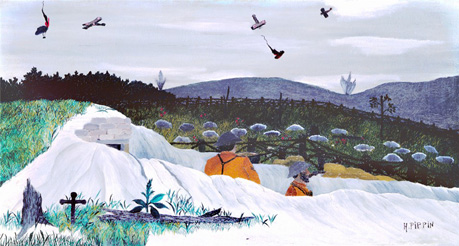
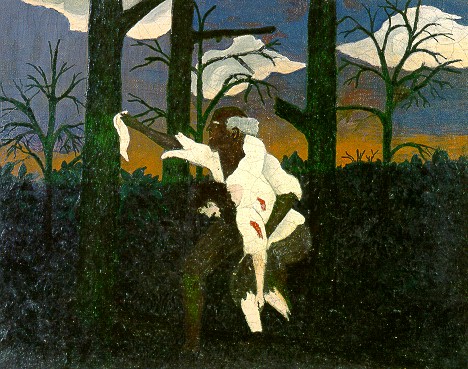
In September 1918, Pippin was shot in the right shoulder by a German sniper. He fell to the ground, bleeding profusely. A French soldier seeking to help was shot dead and fell on top of Pippin, who was unable to remove him. After spending hours in the rain, he was rescued, but he lay on a stretcher overnight, exposed to the elements, before being evacuated to a hospital. The bullet shattered his shoulder; as a result, he spent the rest of his time at war recovering in a French hospital. Pippin was awarded a Purple Heart after his service because of the injuries he sustained in battle. Pippen was discharged that year with a steel plate in his shoulder and his right arm virtually paralyzed. Immediately after the war he returned to the United States, to a civilian life shattered both psychologically, with a Purple Heart and an Honorable Discharge.
Yet, Pippin faced yet another battle—that of ongoing racism and segregation. A decorated veteran, he still was only able to get odd jobs. He returned to Goshen with his small pension, no house, no job, and in pain. Pippin moved to Bellville, New Jersey, with his brother and worked as a truck driver. The following year, 1920, he married Jennie Fetherstone Wade Giles, and they moved to West Chester, PA. Following his rehabilitation and discharge, Pippin’s path to a painting career began with a pastime decorating cigar boxes. In order to paint, the artist needed to support his right arm with the help of his left one, continuing to hold the brush with his right hand. Pippin worked at a segregated YMCA, started a Black boy scout troop, and organized an all-Black football team. He enjoyed attending meetings at the American Legion, a non-profit group working with veterans and their families.
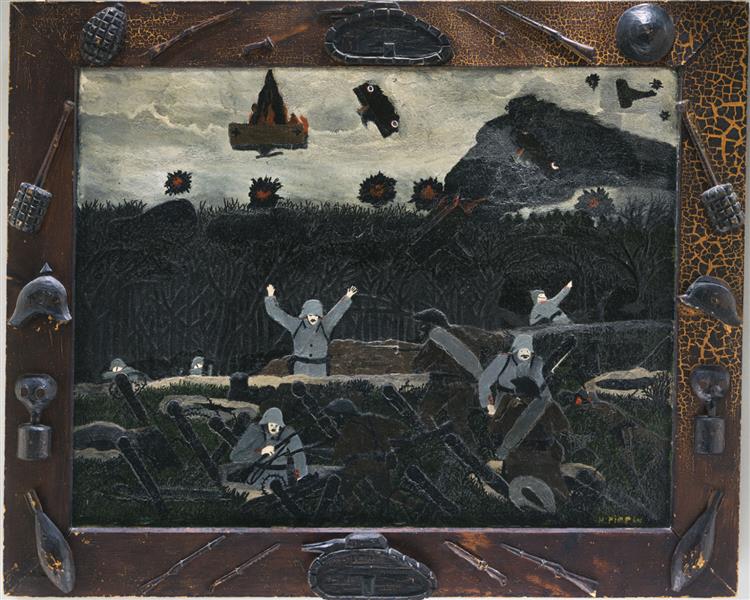
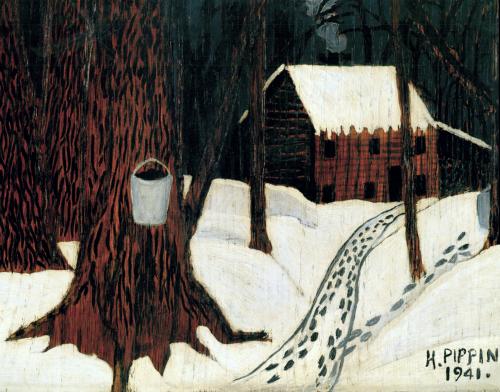
His love of music led him to create an American Legion drum corps, which he led. In the 1920s, he started burning designs into wood panels. Frequently, this shift in artistic method is regarded as therapy for his wounded arm. By 1930, he had begun to teach himself to paint with oils, first on discarded cigar boxes, or by burning images onto wood panels using a hot poker (a technique called pyrography), and then applying oils. Later that year he created his first oil painting, titled "The Ending of the War, Starting Home". In this painting, Pippin condenses the terrifying episodes of war documented in his journals, showing images of combat fear, battle, and most importantly, the surrender of German troops. He included images of tanks, guns, hand grenades, gas masks, and other tools of war, alluding to the technological advances that made the war more brutal than any before it.
In 1937, Horace Pippin entered two of his painting in a local art show the Chester County Art Association (CCAA) Annual Exhibition with the aid and encouragement co-founders art critic Christian Brinton and artist N.C. Wyeth. Pippin quickly began to gain attention. Brinton immediately organized a solo exhibition, cosponsored by the CCAA and the interracial West Chester Community Center. He then connected him with MoMA curators Dorothy Miller and Holger Cahill and, by 1940, the Philadelphia art dealer Robert Carlen and collector Albert C. Barnes. Pippin attended art appreciation classes at the Barnes Foundation in the spring 1940 semester.
In the eight years between his national debut in the Museum of Modern Art's traveling exhibition "Masters of Popular Painting" (1938) and his death in July of 1946, Pippin's recognition grew exponentially across the country and internationally. During this period, he had solo exhibitions in commercial galleries in Philadelphia and New York (1940, 1944), and at the Arts Club of Chicago (1941) and San Francisco Museum of Modern Art (1942). Private collections and institutions such as the Barnes Foundation, the Philadelphia Museum of Art and the Whitney Museum of American Art acquired his works. His paintings were featured in annual or biennials at the Art Institute of Chicago, the Carnegie Institute, and the Pennsylvania Academy of the Fine Arts.
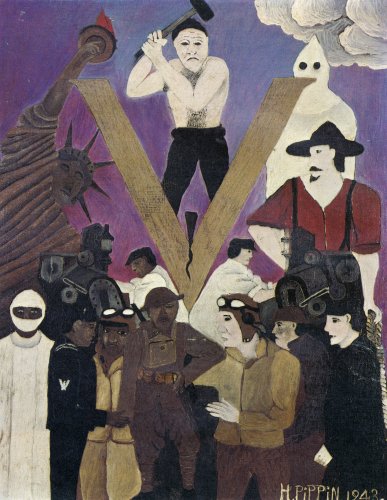
The painting Mr. Prejudice (1943), would become what is Horace Pippins’ strongest and loudest statement about racial inequality in the U.S. Deeply affected by his experiences as a soldier in a segregated troop during World War I, and the poor treatment he and other African American troops received after they returned home, Pippin was moved to make this painting when he noticed that this treatment of African American soldiers persisted into World War II. Pippin made this at the request of an unidentified patron, probably for use as a poster or illustration. At the top of the painting is a menacing white man with an axe above the “V.” The “V for victory” was a gesture and phrase coined by Winston Churchill during World War II that took root in the U.S.
But in the African American community, this became a double V, which represented victory in the military conflict abroad as well as over racism at home. The campaign emerged from the pages of the Black-owned newspaper the Pittsburgh Courier, one of the country’s preeminent Black publication. In the painting, the axe held by this menacing White man (Mr. Prejudice) has created a crack or a wedge in the V, which divides not just it, but the entire painting equally in two. To the left of the painting are African American symbols and to the right, the realities they faced due to racism. To the left of the painting is a Black Statue of Liberty, which signifies the freedom and liberty that African Americans and all people of color have been denied.
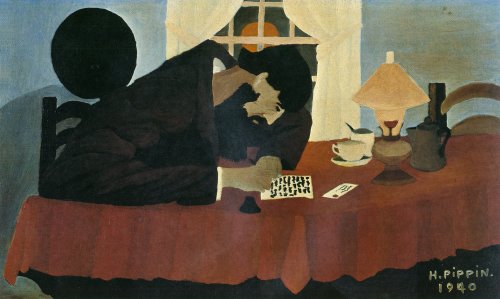
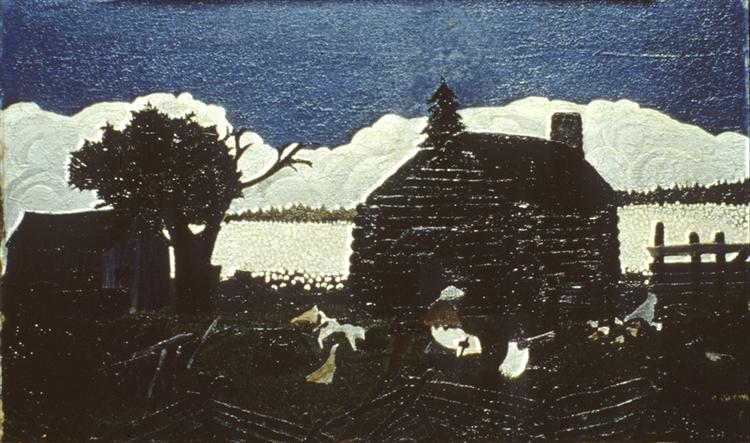
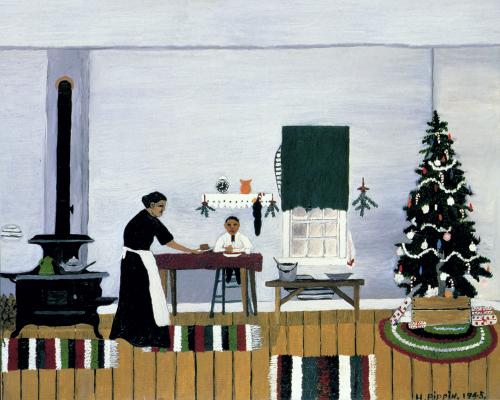
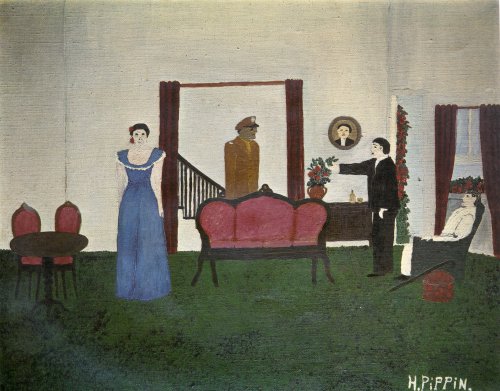
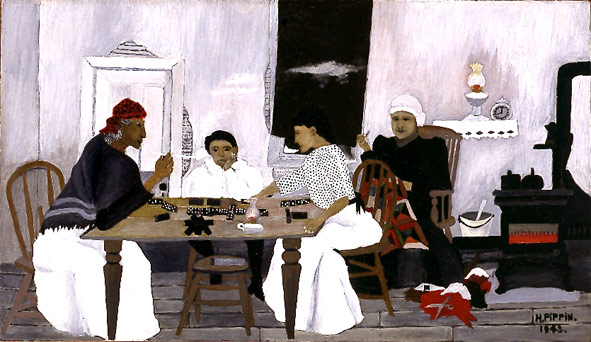
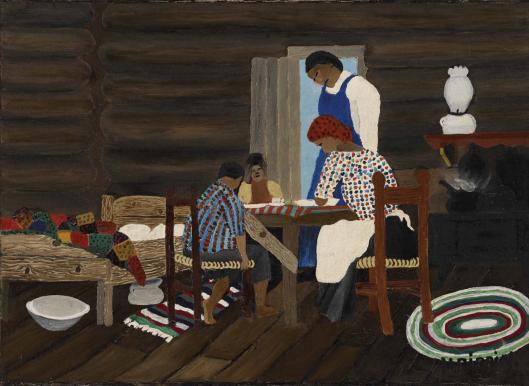
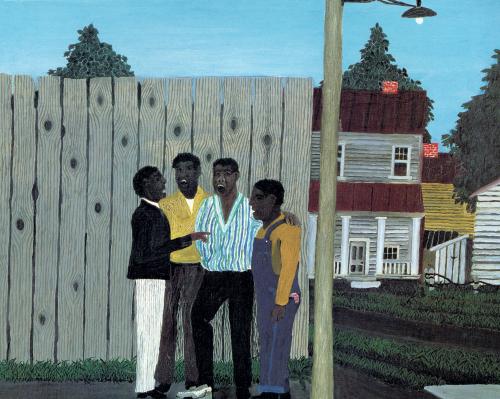
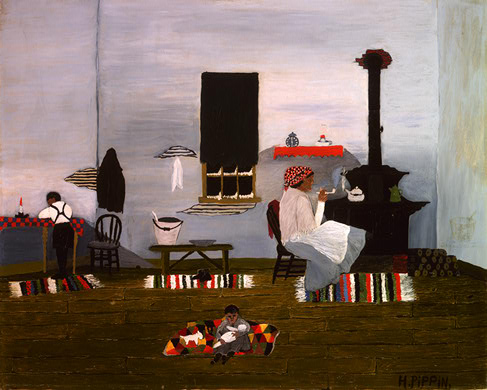
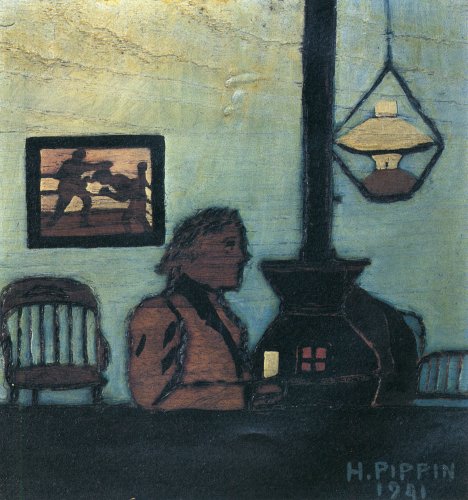
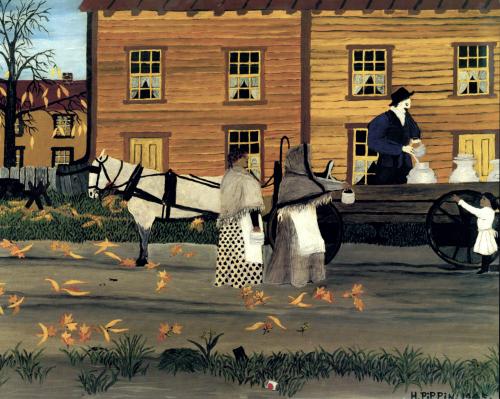
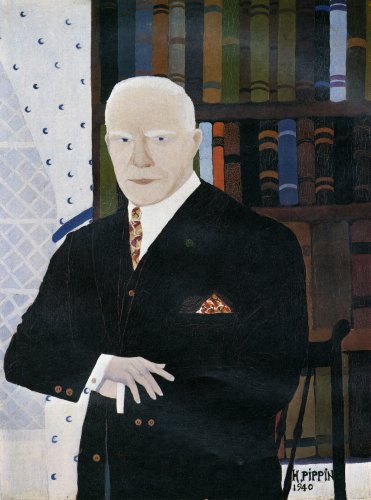
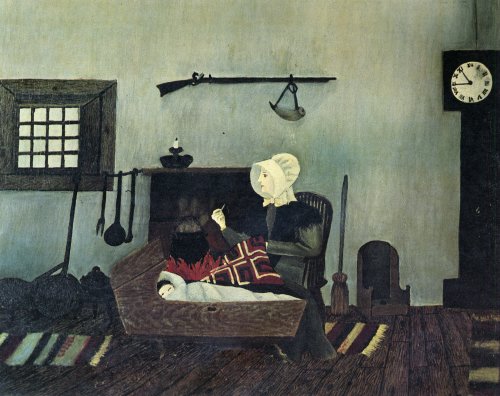
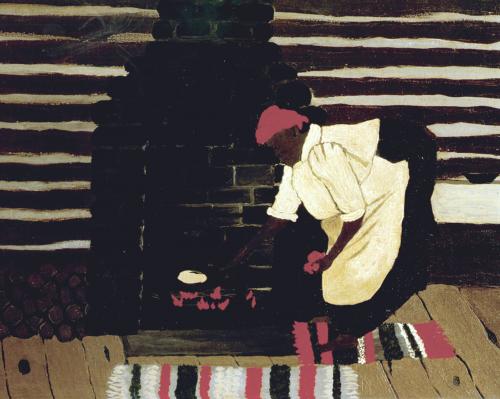
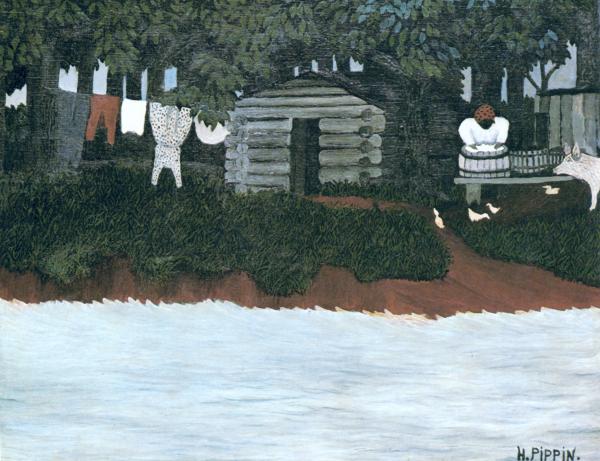
Pippin's genre paintings are among his most popular works. See, for example, the "Domino Players" (1943), and several versions of "Cabin in the Cotton". Some, including "After Supper" and "The Milkman of Goshen" (1945), which relate to his childhood in New York State. Views of the everyday activities of Black families "tended to be relatively invisible to the White masses" before the Great Migration, so Pippin's domestic scenes offered a privileged view. Pippin also created images related to popular culture, including Old Black Joe, based on the song "Old Black Joe". He made two portraits of the celebrated Black contralto Marian Anderson, not long after her famous 1939 concert on the steps of the Lincoln Memorial, and dedicated a painting to Paul Robeson.
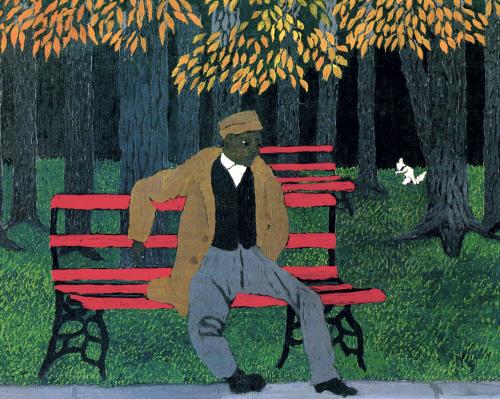
"The Park Bench" (1946) was Pippin’s last completed paintings. Here we see an older Black man sitting on a park bench with trees, animals, and natural scenery. The painting may have been inspired by Pippin’s observations of a resident who liked to sit at a park near his home in West Chester, Pennsylvania. One might imagine that this painting, done near the end of his life, reflects Pippin himself as the subject. He sits alone on the bench as he thinks about his challenging life, overcoming many struggles through his drive, perseverance, and hard work. The Park Bench depicts an elegantly-dressed older man who sits somewhat awkwardly with one arm pushing back on the bench supporting his back and his right leg and foot turned inward in an uncomfortable manner.
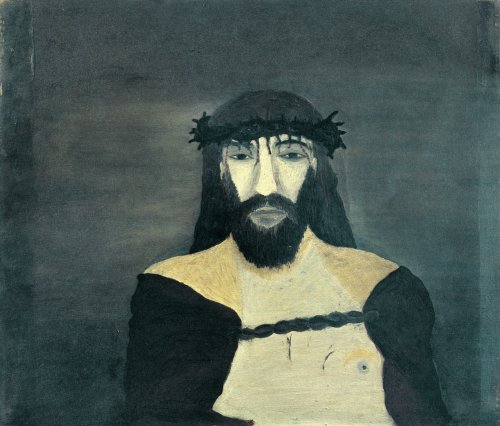
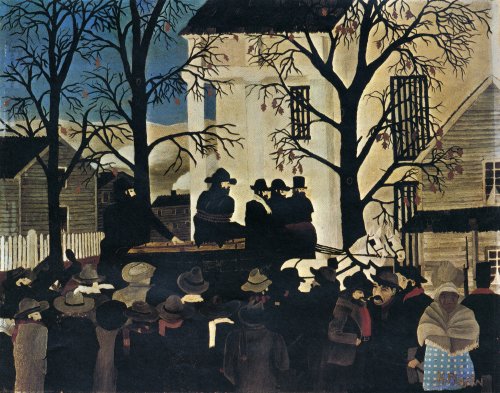
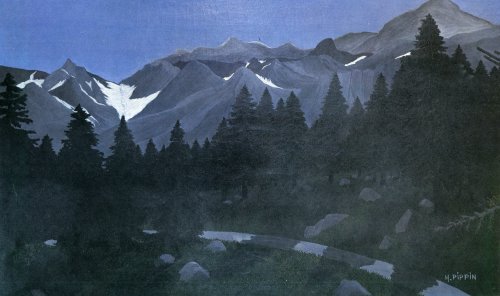
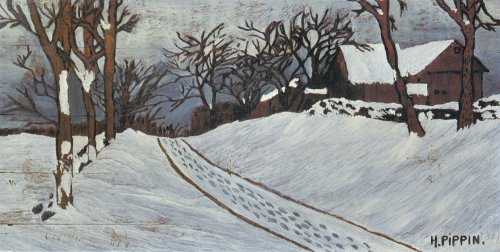
Pippin left The Park Bench unfinished in his studio at this death on July 6, 1946. Horace Pippin was the first Black artist to be the subject of a monograph, Selden Rodman's Horace Pippin, A Negro Painter in America (1947), and The New York Times eulogized him as the most important Negro painter" in American history. He painted a range of themes, including scenes inspired by his service in World War I, landscapes, portraits, and biblical subjects. Some of his best-known works address the U.S's history of slavery and racial segregation. Critic Alain Locke described Pippin as "a real and rare genius, combining folk quality with artistic maturity so uniquely as almost to defy classification."