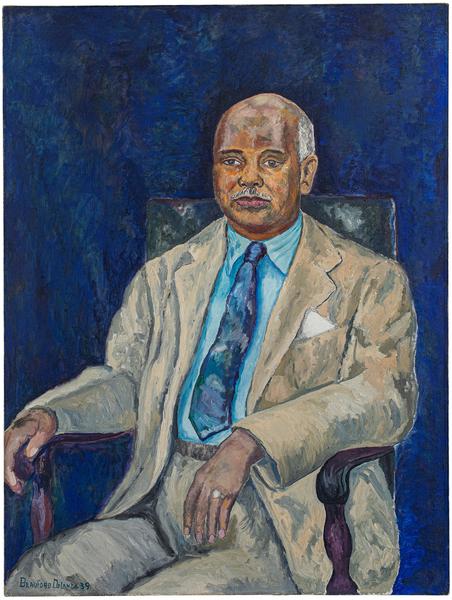
World-renowned painter Beauford Delaney was born on December 30, 1901, in Knoxville, Tennessee. His mother was a devout Christian who imparted her stringent religious beliefs on her children. His father, was a Methodist Episcopal preacher who spent much of his time traveling and ministering to Black communities in need of churches. Delaney attended Knoxville's Austin High School, where prominent attorney and educator Charles W. Cansler was principal. Cansler brought Delaney’s early artistic abilities to the attention of notable Knoxville artist Lloyd Branson, a White Knoxville artist who became Delaney’s mentor and offered to give him art lessons. In 1919, rioting broke out in Knoxville after a Black American man, Maurice Franklin Mays, was accused of murdering a white woman. These events later became known as Knoxville’s “Red Summer.”
In 1923, Branson sent Delaney to Boston with money and letters of introduction. Delaney stayed six years, haunting museums, attending three art schools and frequenting the salons of the city’s intelligentsia, which, given Boston’s long involvement with abolition, were integrated. Studying art at the the Massachusetts Normal School, the South Boston School of Art and the Copley Society, Delaney learned the basics of painting in the academic tradition. Delaney spent considerable time at local museums including the Museum of Fine Arts (MFA) and the Isabella Stewart Gardner Museum, where he became familiar with impressionist painting, especially the work of Claude Monet.
While in Boston, Delaney became acquainted with sophisticated political thinking around racial equality and found himself drawn to the energy of the Harlem Renaissance. Through letters of introduction from Knoxville, he also received what he referred to as a "crash course" in Black activist politics and ideas by associating socially during his years in Boston with some of the most sophisticated and radical African Americans of the time, such as James Weldon Johnson, writer, diplomat and civil rights activist; William Monroe Trotter, founder of the National Equal Rights League; and Butler Wilson, board member of the National Association for the Advancement of Colored People (NAACP).
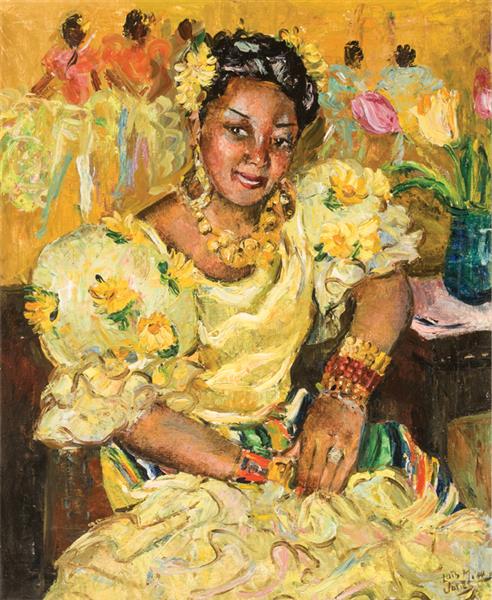
By 1929, his artistic education complete, Delaney moved to New York during the Harlem Renaissance, gaining a reputation as a pastel portraitist. He found work in the dance studio of Billy Pierce and “began rendering portraits of the studio's dancers and its socialite clientele (although he rarely received compensation for his artwork).” Delaney was one of the artists in the show “Four Sunday Painters,” held at the Whitney Studio Galleries shortly after his arrival to the city in 1930. In New York, Delaney studied at the Art Students League under Ash Can School artist John Sloan. Sloan was painting in an expressionistic manner with an Impressionist palette at that time. From Sloan, Delaney adapted fluid brushwork and bright color. He began to paint portraits and scenes of the cultural melting pot of Harlem, feeling an affinity with the minorities that gathered there.
Arriving just after the stock market crash that set off the Great Depression, he struggled financially. Delaney lived an unsettling life as an artist and constantly needed money to continue his work and studies. Known for his commanding high spirit and charm, Delaney attracted friends and patrons willing to support his free spirit as an expressive artist. Delaney found work with the mural division of the Federal Art Project (a New Deal program sponsored by the Works Progress Administration), and in 1936, he worked with artist Charles Alston on murals at Harlem Hospital Center. Delaney got to know Countee Cullen, W.E.B Du Bois, Louis Armstrong, Duke Ellington, Ethel Waters, James Baldwin, and Stuart Davis — his closest painter compatriot.
During this time, Delaney frequented the salons and exhibitions held in Charles Alston’s studio, located at 306 West 141 Street. Known simply as the “306, Group", the space served as a center for the most creative minds in Harlem, and regulars included Norman Lewis, Augusta Savage, Richard Wright, Robert Blackburn, Ralph Ellison, and Gwendolyn Knight. He was also a member of the Harlem Artists Guild, which encourage young talent, and provided a forum for discussing issues of general concern to Black artists. Delaney was consumed by his own artistic vision and, while he enjoyed participating in the Harlem art scene, the artist remained closely connected to the Greenwich Village avant-garde community, forming lasting friendships with writers and artists, such as Henry Miller, Alfred Stieglitz, Georgia O’Keeffe, and Al Hirschfeld.
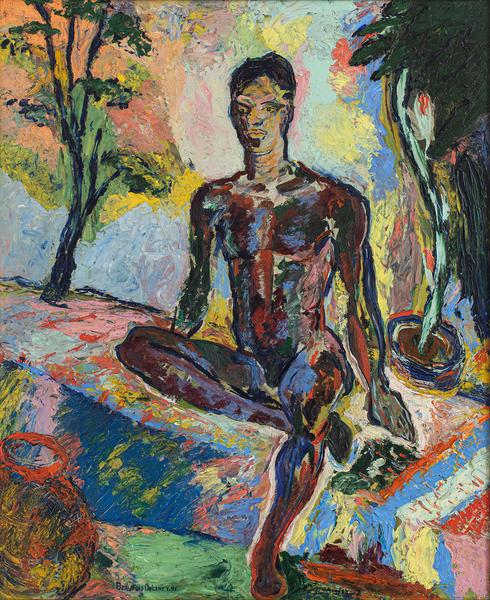
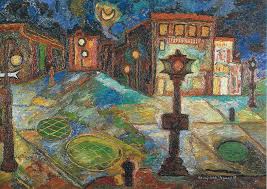
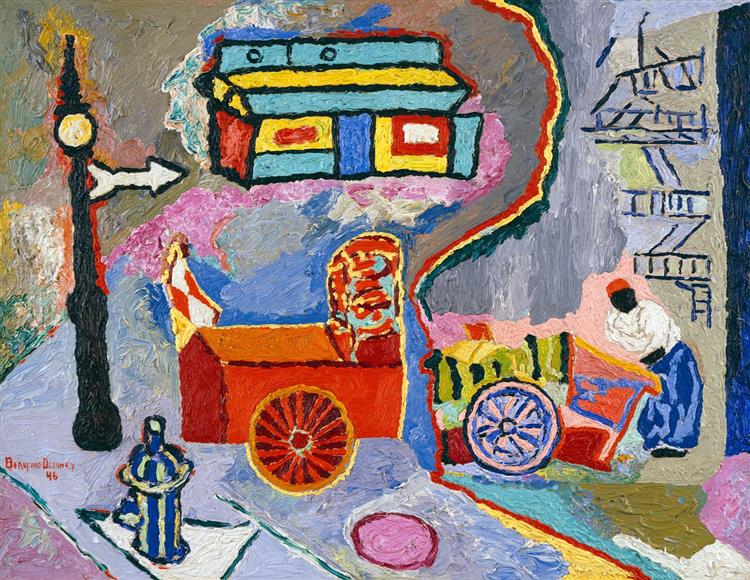
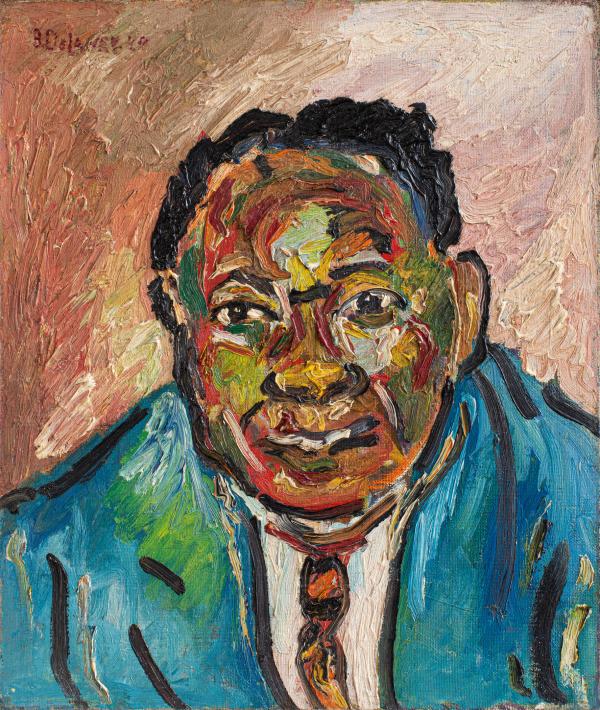
Life magazine picked up on Delaney's art buzz and profiled him in a 1938 article. The magazine featured Delaney, picturing him beatifically smiling at the Washington Square Outdoor Art Exhibit. The caption read, “One of the most talented Negro painters". Throughout the 1940s and into the early 1950s, Delaney created portraits, still life, street scenes, and modernist interiors executed with a dense impasto, undulating lines and bright colors reminiscent of the fauvist tradition. These vibrant paintings became known as Delaney’s Greene Street paintings. A 1945 essay about Delaney by Henry Miller also brought him attention. As Delaney entered into his mature period, he became a well-established part of both Harlem and Greenwich Village, where he kept his studio. Delaney's love of musical rhythms is on full demonstration in his 1946 painting Jazz Quartet.
In 1951, Delaney received a fellowship to the Yaddo Art Colony in Saratoga Springs, New York, a retreat for artists and writers in Saratoga Springs, New York. This experience was pivotal in Delaney’s personal and artistic growth. The next year, Delaney's interest in abstraction led him, at 52, to leave the United States for Paris, France. There he incorporated the techniques of Vincent Van Gogh and employed the design principles of abstract expressionism to further develop his style further. He settled in Paris, France, and worked there for many years and made Paris his permanent home. Abroad, his work transformed from the portraits, still life, and street scenes he made for much of the 1940s into expressionist studies of light. Much of his work was neglected until a retrospective in 1978 at the Studio Museum in Harlem.
In 1954, his work is included in the ninth Salon des Réalités Nouvelles in Paris and the following year, he had his first European solo show at Galería Clan in Madrid, Spain. Delaney moved to the Paris suburb of Clamart in December 1955 and supported himself through the occasional sale of his art as well as contributions from friends. Feeling a new sense of freedom from racial and sexual biases, he focused on creating non-objective abstractions. While his abstractions have clear ties to Monet’s studies of light, Delaney’s works are expressionist: the light Delaney sought to capture was not the actual light of day, but a transcendent, eternal, spiritual light. These works were first exhibited in a solo exhibition at the Galerie Paul Facchetti in 1960.
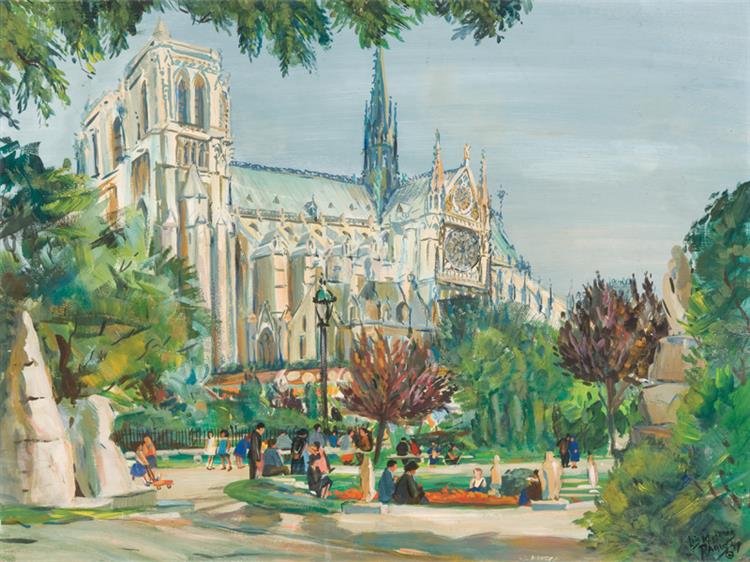
Delaney recovered from a suicide attempt in 1961 and the next year he moved to a studio at 53 Rue Vercingétorix in the Montparnasse district of Paris, where he continued to produce his luminous abstractions alongside stirring, intimate portraits and scenes of Paris and the French countryside he often visited. Despite financial and psychological hardship, Delaney continued to work, exhibit, and live in Paris, enjoying success in both group and solo exhibitions throughout the 1960s and early 1970s. He was honored with an evening event and exhibition at the Centre Culturel Américain in Paris in 1969, and in 1973 Galerie Darthea Speyer mounted a major solo exhibition of his portraits and abstractions.
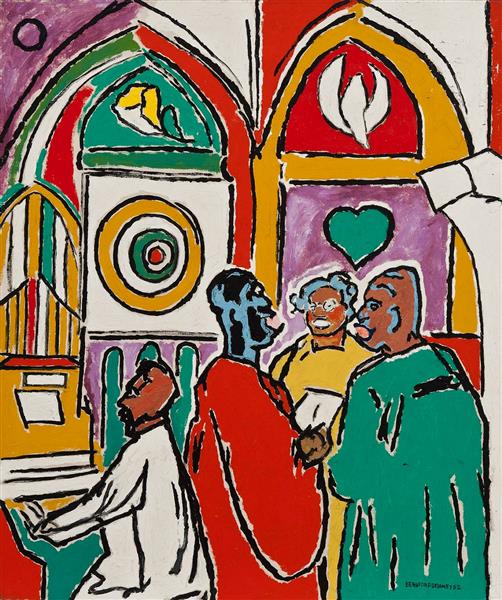
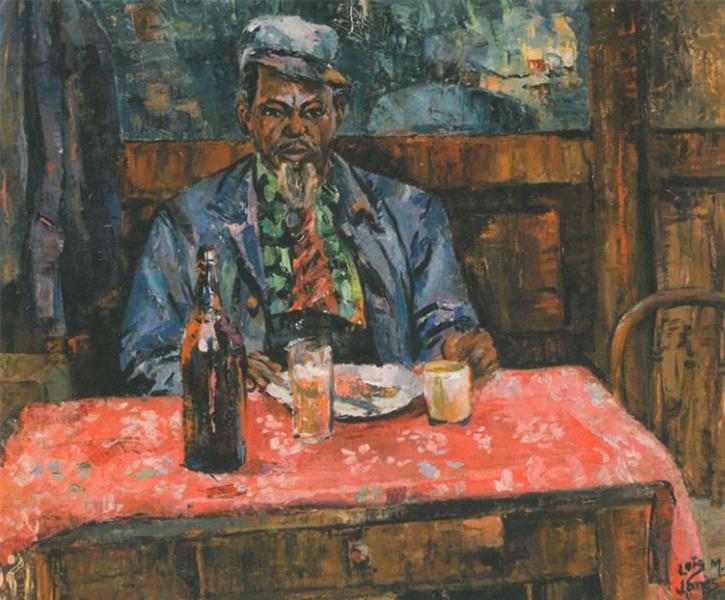
Delaney died on March 26, 1979 in Saint-Anne Hospital in Paris following years of hospitalization for mental illness. Beauford Delaney is revered internationally for his work as a 20th century. Never committed to a strict realism or abstraction, Delaney's best work hovers between the two tendencies. Early critics of Delaney's paintings lauded his wit and eye, yet tended to pigeon-hole him as a "Negro artist." He worked in realistic and abstract modes, both characterized by Expressionist freedom of drawing, paint-handling and composition. Beauford Delaney was a consummate artist and a warm-hearted man. He was a great teacher and a great listener. He was psychologically troubled, yet a profound inspiration to many. His life and his talent were gifts to the world.