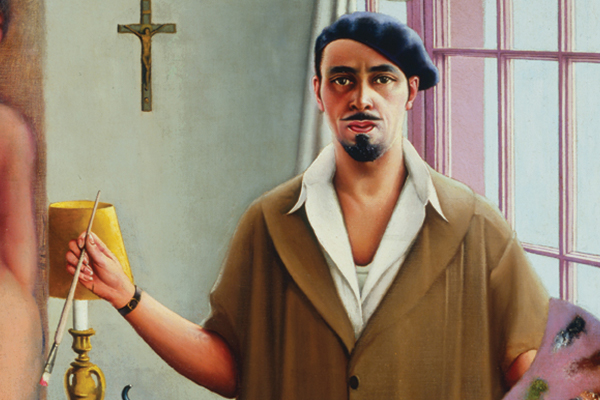
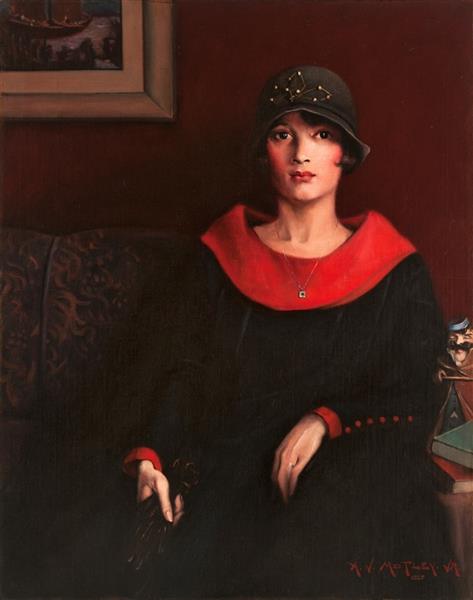
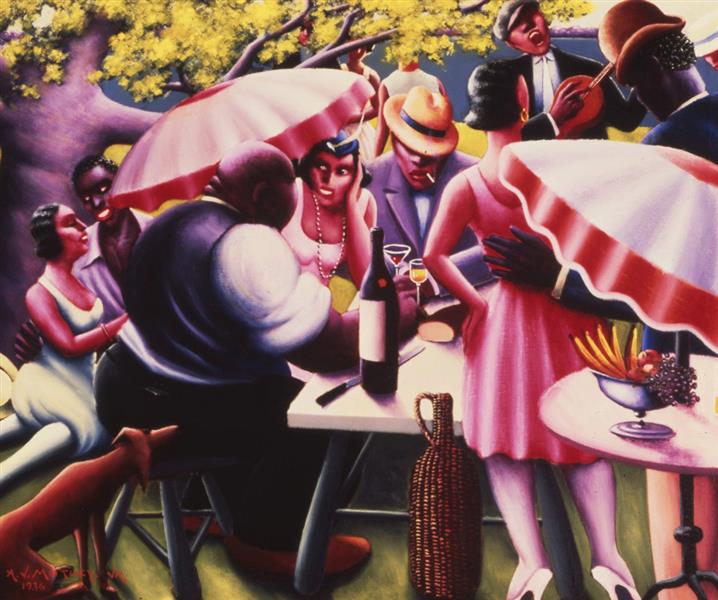
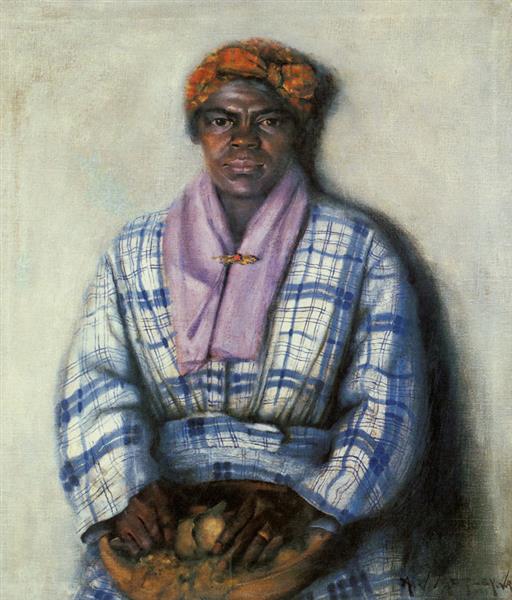
Artist and art educator Hale Aspacio Woodruff was born on August 26, 1900 in Cairo, Illinois. Woodruff showed an early interest in art and was the cartoonist for his high school newspaper. Woodruff grew up in Nashville, Tennessee, where he attended Pearl High School and was the school newspaper's cartoonist. In 1924 Woodruff entered the first of the Amy Spingarn Prize competitions sponsored by the Crisis magazine, the official publication of the N.A.A.C.P. He won a third place for illustration, which netted him ten dollars. It was not until he enrolled in the John Herron Art School in Indianapolis that he learned about African and African American art. It was at this school where he first learned about African and African-American art, which would greatly impact him for the rest of his life. This inspiration became more pronounced when he met African-American art legend, William Edouard Scott.
Woodruff also studied at the School of the Art Institute of Chicago before traveling to Paris in the 1920s.Woodruff won an award from the Harmon Foundation in 1926, which enabled him to spend four "crucial years studying in Paris from 1927-31". In Paris he lived among fellow Black American expat artists, which included Henry Ossawa Tanner, Augusta Savage, Alain Locke, and the recently arrived Josephine Baker. He enrolled at the Academie Scandinave and the Academie Moderne. He learned in the city's museums as well, while getting to know other expatriates. Economic uncertainty brought on by the Great Depression induced Woodruff to accept a teaching position at Atlanta University in 1931. He likened his return to the Southern United States to that of, again, being “home”.
In Atlanta, Woodruff was a one-person art department, and the first instructor to teach drawing and painting at the university. This meant teaching classes at the university's Laboratory High School as well as for students at Morehouse College, which was exclusively for men, and Spelman University, which was exclusively for women. It was his initial venture with art instruction and made him one of the first college professors of studio art in the state of Georgia. As a teacher, Woodruff stressed the elements of modern art as well as the importance of self-discipline. He showed how self-discipline helped organize the ideas, materials, and techniques in his own work, and encouraged his students to learn self-discipline as well. As an educator, Woodruff did much to improve educational opportunities for Black artists.
Hale Aspacio Woodruff taught at Atlanta University from 1931 until 1946. There, Woodruff founded the “Atlanta School”, the first university art department for Black students in the South. To expose his students to fine art, Woodruff frequently exhibited his own works and those of other artists in the library of Atlanta University. His landscapes touchingly captured life for African-Americans in Georgia. It was during his time in Atlanta that he discovered American Regionalism and set out to produce works of art that spoke to the Black experience. and set out to produce works of art that spoke to the Black experience. As he excelled as chairman of the art department at Atlanta University, his reputation also grew as one of the most talented African-American artists of the Depression era.”
Among some of the major exhibitions Woodruff succeeded in bringing to the Atlanta University Center campus were selections from the collection of the Whitney Museum of American Art and works by fifty-four contemporary Black artists sponsored by the Harmon Foundation. As his tenure progressed at Atlanta University, Woodruff grew increasingly distressed by the dearth of opportunities for African American artists on the national stage. Even with World War II raging, Woodruff was able to initiate the Atlanta University Art Annuals. They offered a forum for African American artists from across the nation to exhibit their work. They also enabled his local students to experience African American art in a way that they could not otherwise. This exclusively Black art exhibition continued until 1970.
Woodruff's figurative style of the 1930s was bold and muscular. Southern lynchings of Blacks stirred his conscience deeply, and inspired him to design a series of block prints that were as impressive as his oils and watercolors. He spent the summer of 1936 in Mexico mixing colors and preparing walls for the famous Mexican muralist Diego Rivera, drawing parallels between Mexican art and African art. He began traveling to Talladega College in Alabama to teach and work on a commission for a series of murals. Hale Woodruff was known for murals, paintings, and prints depicting the struggle and perseverance of Black Americans. During the 1940s Woodruff also completed a series of watercolors and block prints dealing with African American themes related to the state of Georgia.
He created several powerful murals, including his highly acclaimed "The Amistad Mutiny", that he painted between 1939 and 1942 at Talladega College and Art of the Negro in Atlanta University's Library. The murals are entitled: "The Revolt", "The Court Scene", and "Back to Africa", portraying events related to the 19th-century slave revolt on the Amistad. They depict events on the ship, the U.S. Supreme Court trial, and the Mende people's repatriation to Africa. Installed at Savery Library at Talladega College in Alabama., the murals were commissioned to honor the centennial anniversary of the Mende on board the Amistad. A centrally-located image of the ship is embedded in the lobby floor at Savery; walking on this tribute is prohibited. Also housed in the College’s library are three other murals, each dealing with aspects of African-American history.
After winning the Julius Rosenwald Fellowship, Woodruff and his family moved to New York to further his creative talents in 1943. The scholarship was renewed in 1944. Three years later he was offered a teaching position at New York University. Woodruff was promoted to professor of education at New York University in 1957, and in 1967, the university honored him with a retrospective exhibition of his paintings. He remained there until his retirement in 1968, and was named Professor Emeritus. Woodruff was in the city during the height of abstract expressionism, and while the work of the New York School had an influence on his art, equally important was his life-long interest in African art. His abstract paintings of the 1950s and 1960s, were inspired by the dynamic compositions of African sculpture, painting, and textile design.
Woodruff and artist Charles Alston received a commission in 1949 from the Los Angeles-based Golden State Mutual, Life Insurance Company to create "The Negro in California History". The occasion was the 100th anniversary of the 1849 California Gold Rush. Golden State Mutual, one of the West’s largest Black-owned businesses, had just completed its $1 million office building. Woodruff and Alston each created a mural depicting the history of African Americans in California for the lobby of the new building. Alston focused on the early Black history of the state, while Woodruff’s mural contained eight scenes ranging from the Gold Rush of 1849 to the 1940s.
Woodruff’s last major mural commission came in 1950 from Atlanta University and resulted in what Woodruff has called his most significant work. Housed in the university’s library, "The Art of the Negro" draws upon Woodruff’s knowledge of African art and its influence on modern art. The mural scenes are comprised of six oil painting panels. These panels are Native Forms, Interchange, Dissipation, Parallels, Influences and Muses. Undertaken in 1950 and 1951, the mural was completed in 1952. It was installed at Clark Atlanta University Art Galleries, where stated on its website page for the Art of the Negro that Woodruff “declared them to be the best of all his murals". The mural presents an international, historical account of persons of African descent in the Americas.
During the mid-1960's Hale Woodruff continued to create and collaborate with other African-American artists. With fellow artists and friends, including Alston and collage great Romare Bearden, Woodruff co-founded the Spiral Group. It was Woodruff who suggested the name, after by the spiral of Archimedes, “because, from a starting point, it moves outward embracing all directions, yet constantly forward". These artists sought to weave the visual arts into the fabric of the civil rights struggle. The artists met regularly to discuss the role art would play in the struggle for racial equality. While each member pursued his or her own vision, Spiral lived up to Woodruff’s artistic ideals about the relationship between local experience and universal humanity in art. He also found inspiration in other abstract artist friends, such as Franz Kline and Jackson Pollock.
Woodruff was a beloved teacher and respected artist throughout his career, although wide-scale success eluded him to some degree. In 1979, the year before he died, the Studio Museum in Harlem, New York mounted a retrospective survey of fifty years of his work. He also participated in group exhibitions held in prestigious venues such as New Bertha Schaffer Gallery in New York (1958); the Museum of Fine Arts in Boston, Howard University Gallery of Art in Washington, D.C., New York University and the San Diego Art Museum (all in 1967). Following a long and distinguished career that took him from Paris to New York via the Deep South, Woodruff died in New York in September of 1980.