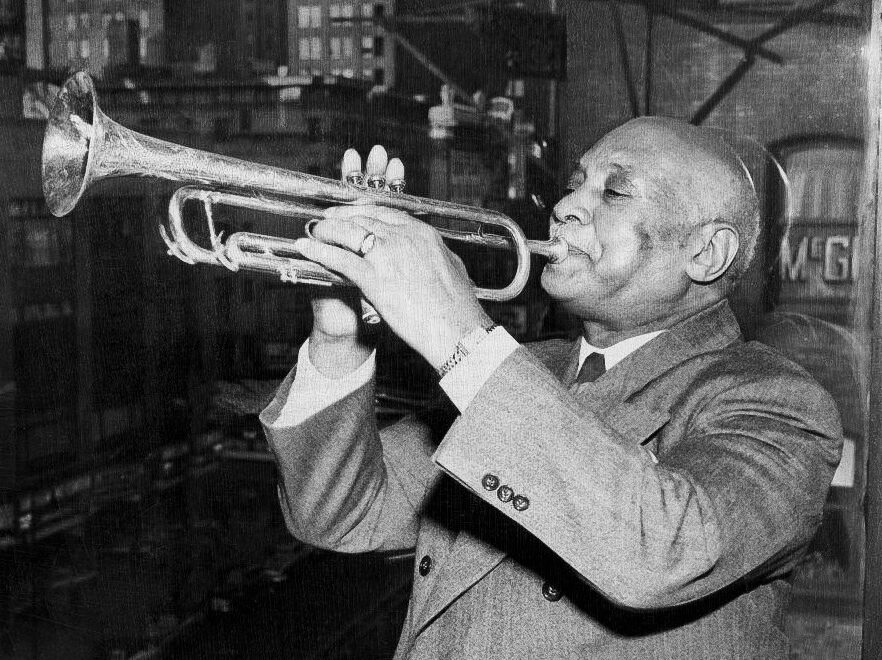
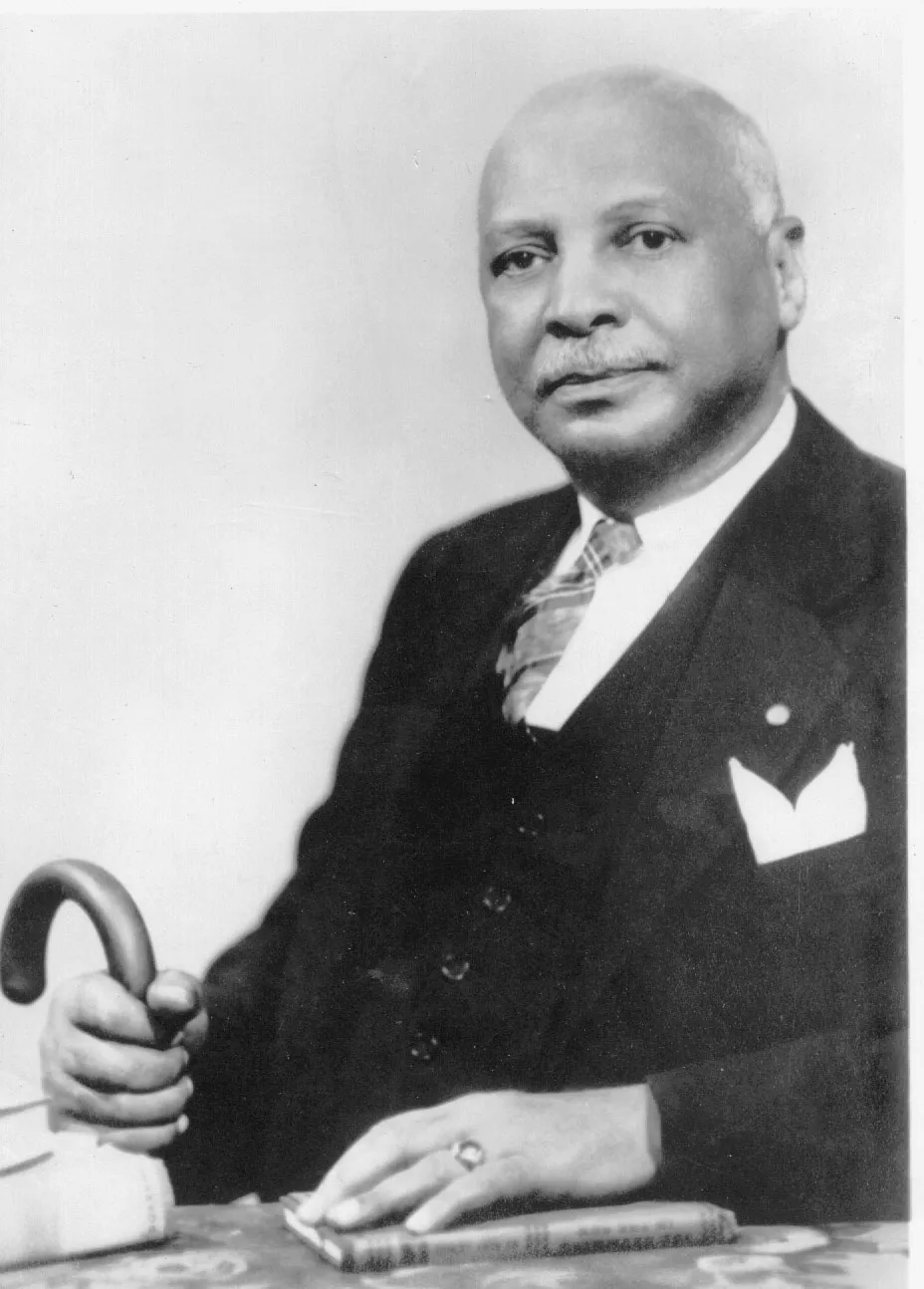
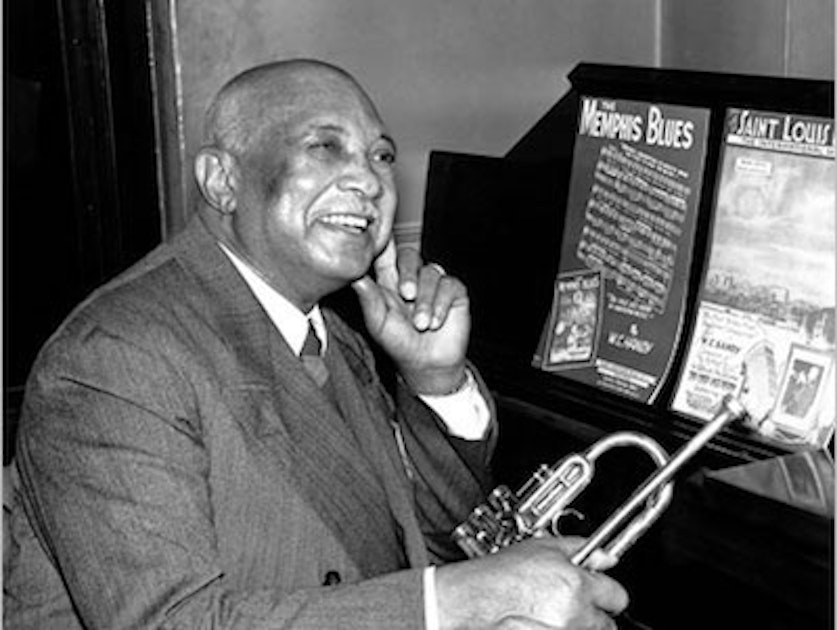
W.C. Handy known as "The Father of the Blues," but a more accurate name might be "The Formalizer of the Blues, was born William Christopher Handy, on November 16, 1873 in a two-room cabin in Florence, Alabama, to a family of former slaves. Handy’s parents and grandparents were among the four million slaves freed by President Abraham Lincoln’s Emancipation Proclamation of 1863. His grandfather, William Wise Handy, built their log cabin home and became a well-respected citizen of Florence and the Methodist minister of his own church. The young Handy showed his love of music at an early age, and was supported in his pursuits by his maternal grandmother, who played organ in his father’s church, Florence’s Greater St. Paul. Although spiritual music was encouraged in the Handy household, music of a secular nature was frowned upon by Handy’s father, who wanted his son to follow family tradition and become a minister.
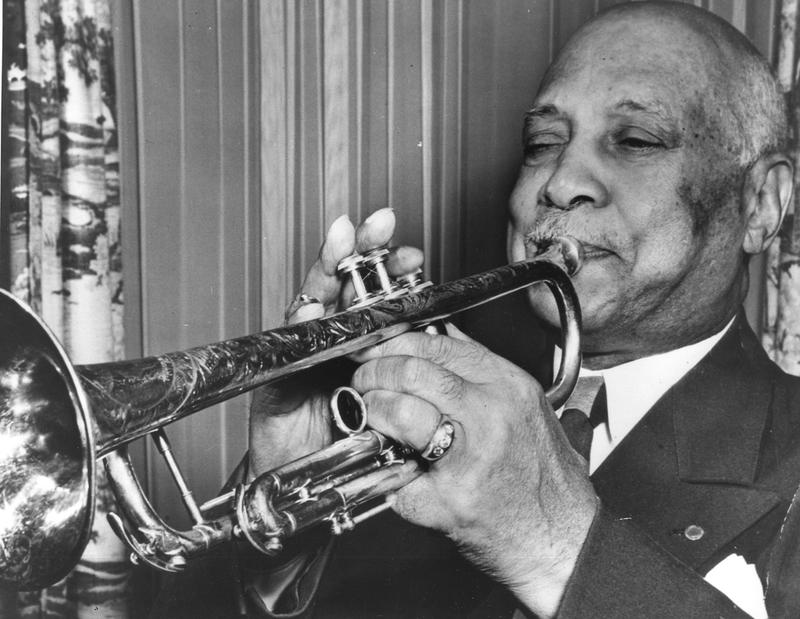
Going against family tradition, he began to cultivate his interest in music at a young age and learned to play several instruments, including the organ, piano, and guitar. He was a particularly skilled cornetist and trumpet player. At the age of 12, he fell in love with a guitar in a shop and saved his money from odd jobs to buy it. His parents were shocked and dismayed by his interest in the guitar. His outraged father apparently demanded that he return the “devil’s plaything” and exchange it for “something that ’ll do you some good.” Handy was an exceptional student and attended the Florence District School for Negroes. His teacher was a lover of vocal music and took time to give his students voice and music instructions that would enable them to sing religious material—without the accompaniment of instruments. The students were introduced to works by classical composers such as Richard Wagner, and Giuseppe Verdi.
At age 15, Handy joined a minstrel show and began his musical career, but he kept this fact a secret from his parents. He purchased a cornet from a fellow band member and spent every free minute practicing it. While growing up, he apprenticed in carpentry, shoemaking, and plastering. He was deeply religious. His musical style was influenced by the church music he sang and played in his youth and by the sounds of nature. He worked on a "shovel brigade" at the McNabb furnace, where he learned to use his shovel to make music with the other workers to pass the time. The workers would beat their shovels against hard surfaces in complex rhythms that Handy said were "better to us than the music of a martial drum corps". Handy would later recall this improvisational spirit as being a formative experience for him, musically. He reflected, "In this way, and from these materials, they set the mood for what we now call Blues."
After touring only a few towns, the troupe fell apart, and the teenager found himself walking the railroad tracks back to Florence. In 1892, after graduating from the Huntsville Teachers Agricultural and Mechanical College and squeezing in a summer of teaching experience, he arrived in Birmingham to take the teachers’ examination. But when he heard that he could expect a salary of $25 or less per month, it didn’t take him long to opt for a job at a pipe works company in the city of Bessemer instead. In his time off from his job, he organized a small string orchestra and taught musicians how to read music. He later organized the Lauzetta Quartet and taught the musicians how to read notes. When the group read about the upcoming World's Fair in Chicago, they decided to attend. To pay their way, group members performed odd jobs as they traveled to Chicago. Then they learned that the fair had been postponed for a year.
The band headed to St. Louis only to find that working conditions were really very bad. They could find no work. The Lauzetta Quartet disbanded and the broke Handy subsequently slept outdoors on the cobblestones, slumped in a poolroom chair, in a horse’s stall, and on the cobblestones of the levee of the Mississippi and faced other privations. Talk about "the Blues"... The St. Louis days would imprint themselves on W.C. Handy’s mind and music. They would bring the educated son of a minister closer to the experience of the downtrodden Negro. The musician continued to eke out a living playing his cornet and later noted that these down-and-out days would lead to the birth of his “St. Louis Blues". After the quartet disbanded, Handy went to Evansville, Indiana. In Evansville, he joined a successful band that performed throughout neighboring cities and states. The quartet toured and performed at Chicago’s World Fair in 1893.
It was in Evansville, Kentucky, that Handy first gained popular attention. While playing with several local brass bands, word about his talent spread to Henderson, Kentucky. In Henderson, Handy also found another opportunity to expand his music education. He angled a job as a janitor in a German singing society only to get close to its director, a professor who was an accomplished teacher, music director, and author of several successful operas. Handy pounced on his every word: “I obtained a post-graduate course in vocal music—and got paid for it,” he proclaimed. In 1896, while performing at a barbecue, Handy met Elizabeth Price. They married on July 19, 1896. In 1896, Handy was invited to join a traveling band, Mahara’s Minstrels, on cornet and as their musical director. With his wife, Handy joined a 3 year tour which took them throughout the states of Texas, Oklahoma, Tennessee, Georgia, and Florida and eventually to Cuba.
Minstrel shows, tent shows, medicine shows, and revivals introduced some notable Southern blues musicians to the country. The shows consisted of comic skits, variety acts, dancing, and music. The actors were generally White and performed in blackface. But after the Civil War, thousands of emancipated slaves performed in the shows with their newly gained freedom to travel and to make a living playing music. It showed that African Americans were capable musicians and entertainers, enabling them to achieve limited acceptance in society. Handy left Mahara's Minstrels briefly and spent time with his family in Florence. While in Florence, Elizabeth gave birth to the first of six children. Handy worked as a bandmaster and music teacher in 1900–02, at Alabama A&M, one of the two Black colleges in Alabama at the time. He was disheartened to discover that the college emphasized teaching European "classical" music.
After a dispute with the college President Councill, Handy resigned his teaching position to return to the Mahara Minstrels and tour the Midwest and Pacific Northwest. Drawing on the vocal blues melodies of Black folklore, he added harmonization to his orchestral arrangements. When the band had an engagement in Alabama, Handy, Sr. took in the show. The minister evidently had a change of heart: “Sonny,” he said, “I haven’t been in a show since I professed religion. I enjoyed it. I am very proud of you and forgive you for becoming a musician.” Welcome words from the man who once told his young son that he’d rather follow his hearse than see him follow music. He spent some time in Huntsville, Texas as a bandmaster. In 1903, he received an offer to direct a Black band called the the Colored Knights of Pythias in Clarksdale, Mississippi, which played for (segregated) audiences of all races.
During this time, he had several formative experiences that he later recalled as influential in his developing musical style. One day in the summer of 1903, while waiting for a train in Tutwiler, Mississippi in the Mississippi Delta, Handy overheard a Black man playing a steel guitar using a knife as a slide - Hawaiian style. Handy said "The effect was unforgettable and so was the song". "He sang the song, 'Goin’ where the Southern cross’ the Dog'. The man was singing about Morehead, Mississippi, where the north and south bound trains crossed the east and west bound trains. And he was totally absorbed in the music based on everyday life and places. Handy never forgot this. As his band, the Knights of Pythias played all over the Delta and Handy came to know it, the people, the influence from the square dances and the music intimately, he began to understand the blues. Ultimately, this would lead to his first hit song.
In 1909 Handy and the band relocated to the thriving music center of Memphis, Tennessee and established headquarters on Beale Street. His years of observing the reactions of White people to native Black music, as well as his own observations of the music, habits and attitudes of his race, had begun to influence his music more and more. Beale has been home to everything from bars and clubs to gamblers and musicians, as well as prostitutes to churches. During its early history, Beale was mostly occupied by white shop owners who traded along the Mississippi River. But after the Civil War, many Black traveling musicians began performing on Beale, and the street became a Mecca for Blacks from all over the South. In the early 1900's Beale was still filled with shops, restaurants, and clubs, but now, many of them were owned by African Americans. This is the Memphis that W.C. Handy would know.
1909 was also an election year and Edward H. “Boss” Crump was running for mayor of Memphis. He needed a campaign band. Handy’s group was hired, and “Mr. Crump,” the campaign song, came to be. Handy had written it without words but soon included lyrics based upon spontaneous comments from the disgruntled crowd. Crump was elected—perhaps in spite of the song, and the campaign tune was to meet its end. However, it became very popular so he changed the lyrics and renamed the song "Memphis Blues", which he published himself in 1912. It quickly caught on in the clubs due to its unique sound. Handy entered into an agreement with two White men, Theron C. Bennett and Loren Z. Phillips. One was to arrange the printing and the other, who owned a music publishing company and a record store, would take care of the distribution. They encouraged him to simply sell the piece outright, which confused Handy, who knew the piece had been popular, but still agreed for the sum of $100. They republish the song and it became a huge hit. Within months, Bennett sold the "Memphis Blues" rights to another publisher, Joe Morris for a rather substantial amount. Unfortunately, Handy never did reap the rewards of its success.
The 1912 publication of the sheet music of "The Memphis Blues" introduced his style of 12-bar blues. As the song became more of a hit in the East, particularly through performances by James Reese Europe and his Clef Club bands, Handy's reputation grew in that area. In 1912, he met Harry Pace at the Solvent Savings Bank in Memphis. Pace was the valedictorian of his graduating class at Atlanta University and a student of W.E.B Du Bois. The two soon began collaborating, and by 1913 they had established the Pace & Handy Music Company, which became one of the earliest successful Black-owned music publishing firms in the United States. "Memphis Blues" success helped establish W. C. Handy as a leading publisher and composer of blues music. Their first publication came in 1913–1914, called “Jogo Blues”. That was followed by “Yellow Dog Blues”, “Joe Turner Blues”, and “Beale Street Blues”. At age 40, he wrote and had published his most famous composition, “St. Louis Blues,” which would become one of the most-recorded tunes of all time. Handy and the blues were on their way.
Handy's St. Louis Blues quickly became the standard by which other blues were measured. “St. Louis Blues,” was the first published work to blend frank lyrics and blues harmonies with the syncopations of ragtime and a formal structure borrowed from the Tin Pan Alley style. He had created a revolution in music that resulted in the first uniquely American music style. The Memphis Gerber's Department Store became the first White owned store to sell sheet music from a Black composer (1914). Handy will say years later that the royalties create more money for him each year that any new salary. "St. Louis Blues" will become one of the most recorded songs in history. Bessie Smith recorded a version of ‘St. Louis Blues’ with Louis Armstrong in 1925, that fueled the blues sensation that swept the country during the 1920’s and into the next decade. In 1916, composer William Grant Still, early in his career, worked in Memphis for W.C. Handy's band. In 1918, Still joined the United States Navy to serve in World War I. After the war, he went to Harlem, where he continued to work for Handy.
Handy found that he could no longer endure the rising racial tensions in the South. In 1918, the year that saw the end of World War I, the Pace & Handy Music Company moved to Manhattan. But he continued his connection to Memphis. He and his band frequently returned to play engagements at the Robert Church Community Center Auditorium. In 1919, Handy signed a contract with Victor Talking Machine Company for a third recording of his unsuccessful 1915 song "Yellow Dog Blues". Handy tried to interest Black singers in his music but was unsuccessful; many musicians chose to play only the current hits, and did not want to take risks with new music. According to Handy, he had better luck with White bandleaders, who "were on the alert for novelties. They were therefore the ones most ready to introduce our numbers. In 1920, Pace amicably dissolved his partnership with Handy, with whom he also collaborated as lyricist.
Pace formed Pace Phonograph Company and Black Swan Records, and many of the employees went with him. Pace & Handy was renamed Handy Brothers Music Company. Handy continued to operate the publishing company as a family-owned business. He published works of other Black composers as well as his own, which included more than 150 sacred compositions and folk song arrangements and about 60 blues compositions. Now living in New York city and riding high on the growing success of "St. Louis Blues", Handy focused much of his effort on trying to tell the story of the origins of the blues in addition to writing more of them. The importance of Handy's work as a musician and musicologist crossed the boundaries of genre, coming to influence European composers. The blues genre with which he was synonymous rose to ever greater prominence and influence, ignited by Mamie Smith’s 1920 recording of “Crazy Blues".
Handy became a leading figure in the Harlem Renaissance after 1924, curtailing his own performing activities in favor of promoting African American music. In 1924 Handy joined ASCAP, formed a decade earlier to help further the cause of music composers and artists. Throughout the '20s and 1930s he continued to produce hugely popular songs despite problems with his vision. Handy became a leading figure in the Harlem Renaissance after 1924, curtailing his own performing activities in favor of promoting African American music. In 1926 Handy wrote "Blues: An Anthology—Complete Words and Music of 53 Great Songs". It is an early attempt to record, analyze, and describe the blues as an integral part of the South and the history of the United States. This is considered the first analytical look at the genre, and a groundbreaking effort. The next few years saw diminishing releases of new material mixed with revived spirituals.
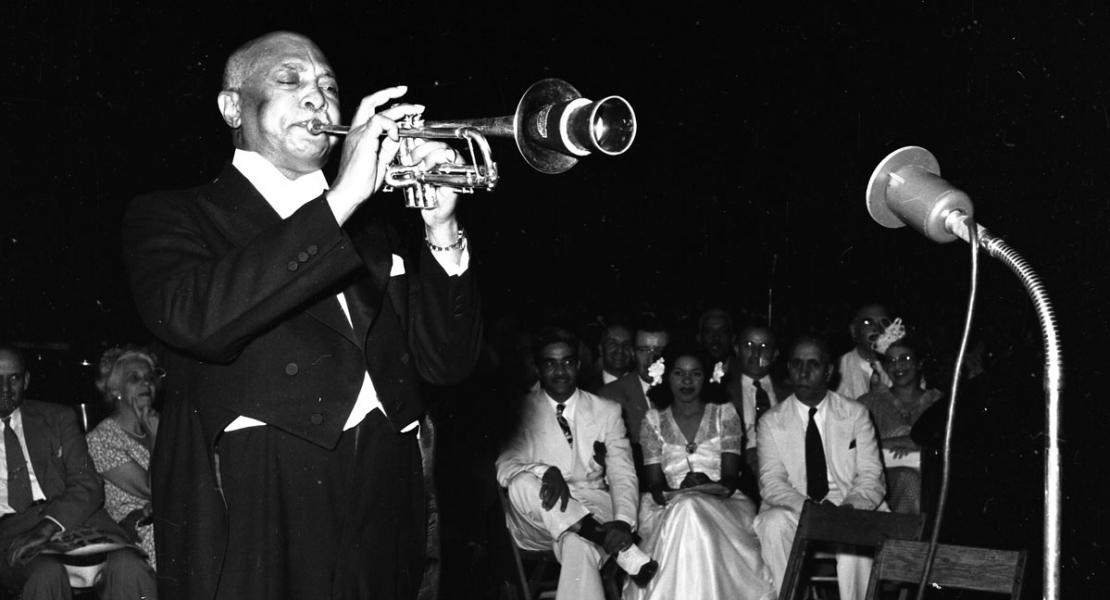
W.C Handy received was an invitation to play with an orchestra and a group of Jubilee Singers at no less than Carnegie Hall in May 1928, becoming the first Black band to perform there. Also participating in the program were composer James P. Johnson who was represented by his "Negro Rhapsody" Yamecraw, and the soon-to-be-established pianist and composer Thomas "Fats" Waller who performed the solos of the work in Johnson's absence. The first evening of Black music presented in this bastion of White classical music. On this occasion, Handy's daughter, Katherine, sang "St. Louis Blues". The following year he co-produced a film of Bessie Smith performing ‘St. Louis Blues’. This was one of the first ‘talkies’ and it is a fantastic document of the ‘Harlem Renaissance’ as Black culture became available to America and the world. The Great Depression cut into Handy's business, but with the royalties from his early hits, the business survived, and by the end of the 1930s, a new wave of swing arrangements was making Handy money again. The late 1930s brought tumultuous developments in Handy's life. Handy’s wife, Elizabeth, died in 1937, as did one of his three grown daughters.
The World War II years brought increased fame to Handy. He even managed to heal an old disappointment by being honored at the 1940 New York World’s Fair. A year later the composer told his story in his autobiography, "Father of the Blues". After the publication of his autobiography, Handy published a book on Black musicians, titled "Unsung Americans Sung". After experiencing vision problems for many years, Handy fell from a subway station platform which caused him to go totally blind. He continued to appear frequently at public and charity events and always spoke on behalf of the integrity of folk music and blues. He appeared repeatedly on television's Ed Sullivan Show and fronted a band at Pres. Dwight D. Eisenhower's first inaugural ball. In 1954, at age 80, he married his long-time secretary, Irma Louise Logan who he frequently said had become his eyes. He died after suffering acute bronchial pneumonia in 1958 at the age of eighty-four.
Revered as the "Father of the Blues", Handy’s legacy permeates modern music. He copyrighted over 150 spiritual and folk songs and 60 blues compositions. Together with Harry Pace he established a music publishing company which was the first of its kind. Although not the founder of the blues, Handy took the genre from its folk roots in the Mississippi Delta and transformed it into one of the most important forces in American music. W. C. Handy did more to carry the blues into the mainstream of music than any other man. His contribution is a legacy that has exerted a profound and lasting influence on twentieth-century music—a legacy that includes rock ’n roll, which was an offshoot of Chicago’s electrified blues. At a time when blues was considered a southern and rural Black folk style, Handy realized its significance and its potential appeal to a wide, racially mixed American and international audience. His street in Memphis has been renamed W.C. Handy Park, and the annual W.C. Handy Blues Awards are the highest honor bestowed in the genre.