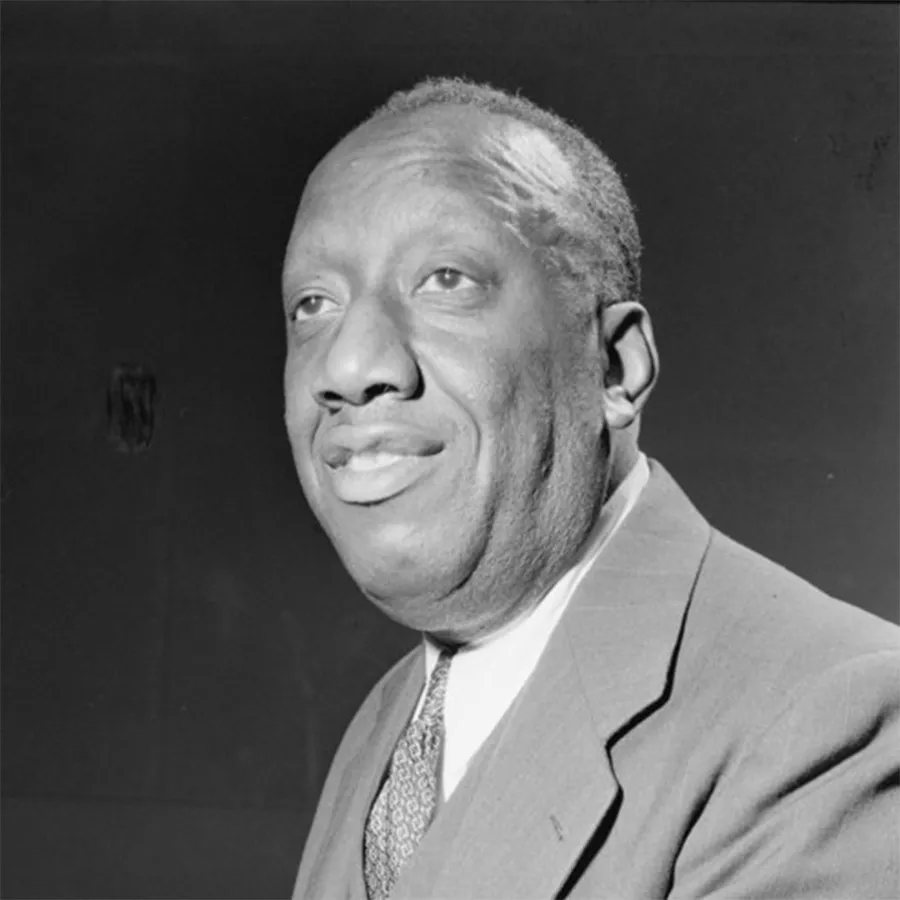
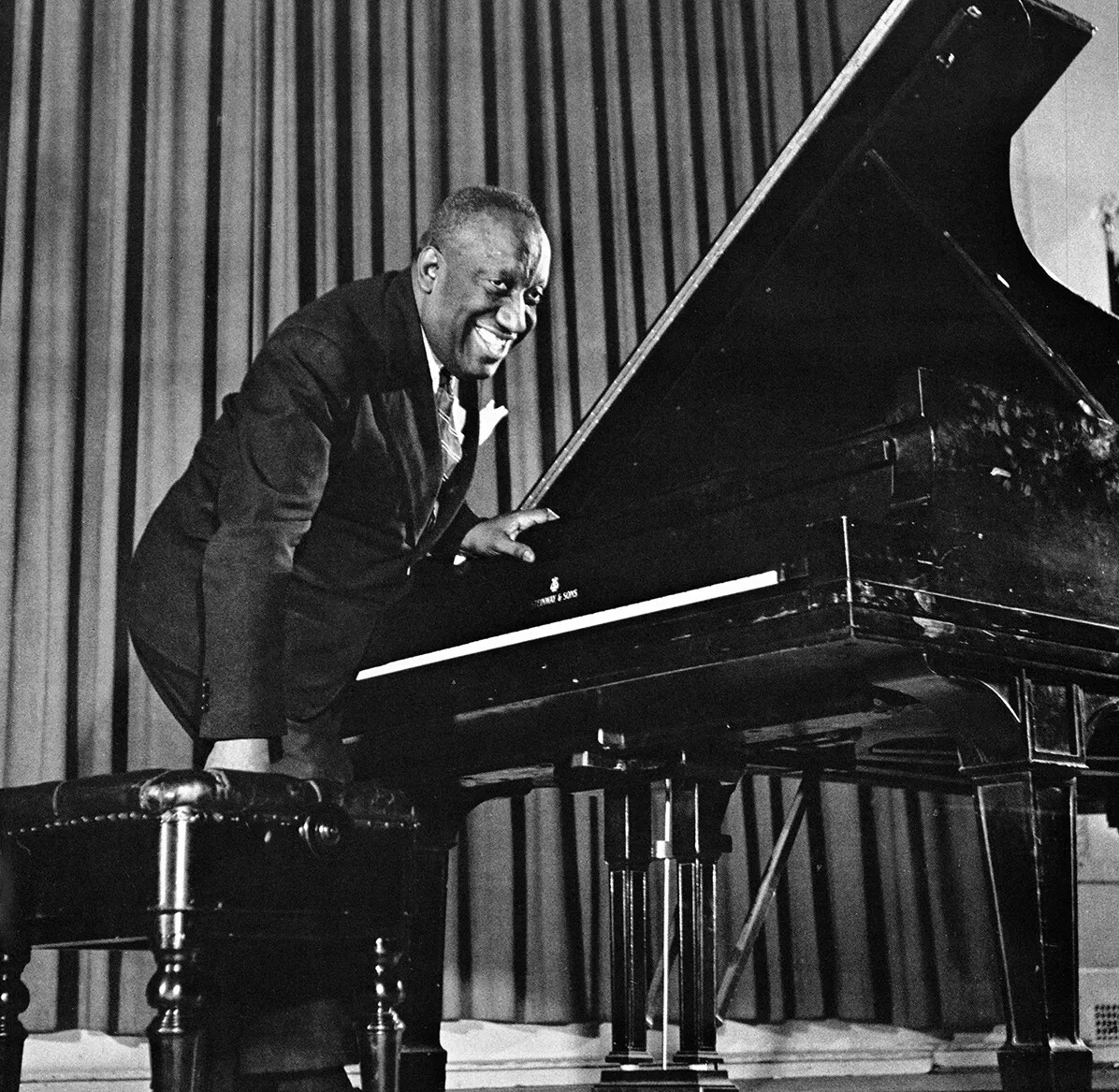
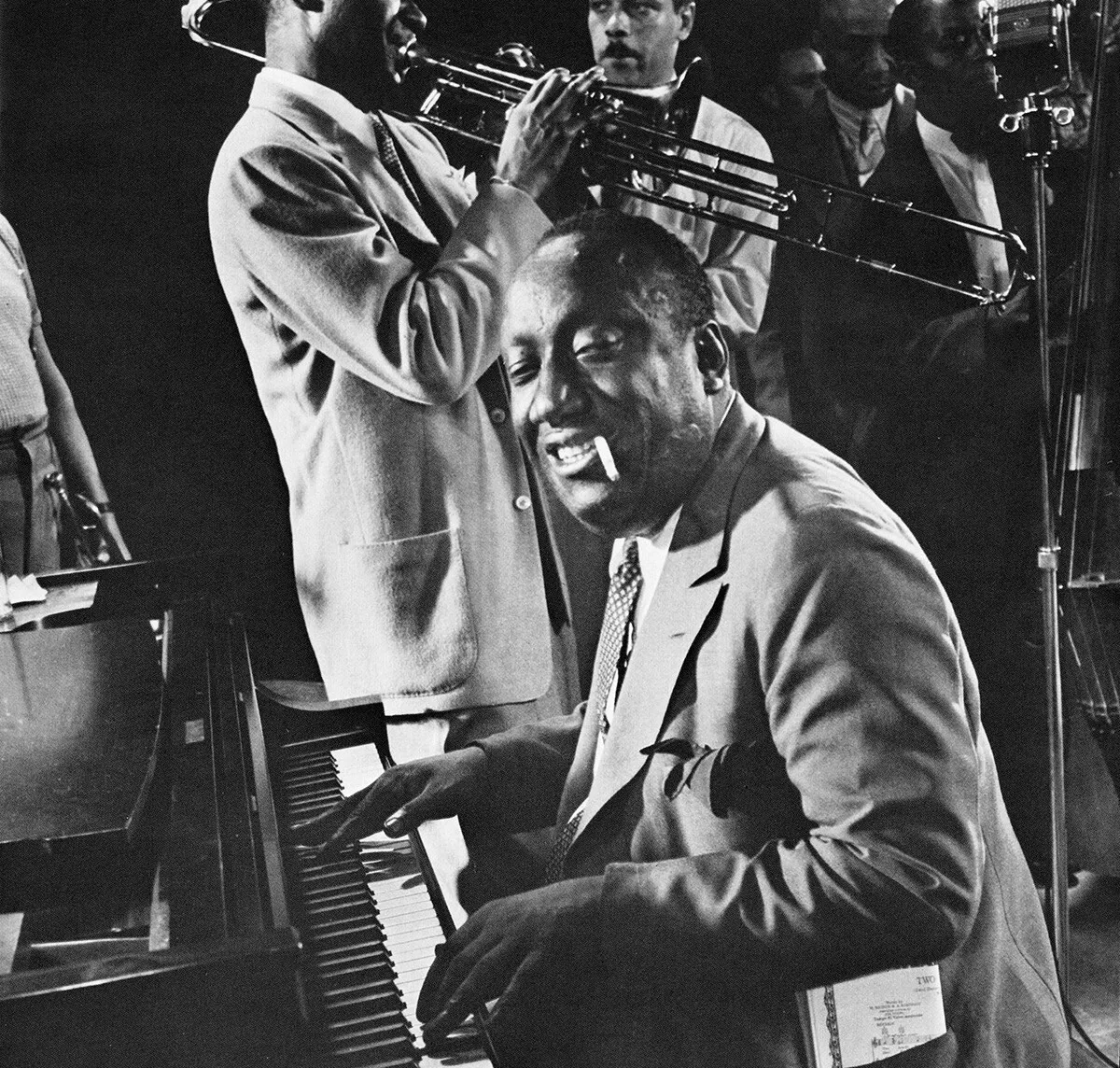
Often referred to as the "Father of Stride Piano," James P. Johnson was the dominant figure that served as the transition from ragtime to jazz. A key figure in the evolution from ragtime to jazz, Johnson was a major influence on Count Basie, Duke Ellington, Art Tatum, Thelonious Monk and Fats Waller. Johnson was born in New Brunswick, New Jersey, February 1st 1894. His family moved to New York City in 1908 to the San Juan Hill district, the pre-Harlem Black community in New York City. Johnson studied classical music as a child and performed as a boy soprano. He also studied ragtime, the music form that would lead to the stride style he was to champion. Johnson was exposed to more musical genres including symphonies, classical, while trained under a mentor, Charlie Cherry, who was a ragtime pianist. Johnson cited the popular Black songs and dances he heard at home and around the city as early influences on his musical taste.
In 1911, the Johnsons moved further uptown, he got a full experience of the diverse musical spectrum, from symphonies to bars and cabarets. In his teens, he listed to the ragtime music of the legendary Scott Joplin, creating his very own bond with the ragtime era, playing and recording Joplin's "Maple Leaf Rag. Johnson continued to grow as a musician, moving up the job ladder from performing in brothels and saloons to more respectable venues including restaurants and private parties. Jimmy's first outside professional engagement other than a brothel or dive was reportedly at Coney Island when he was around 18. There was another possible professional debut playing at the Nickellete Theater in lower Manhattan, an early movie house.
Also during 1912, he decided to quit school and pursue a musical career after landing the job of a pianist. Johnson spent the next few years listening and analyzing other pianists, developing his own ragtime piano skills, and even composing his initial rags. As it happened, Jimmy's reputation started to grow, and by 1914 it prompted certain introductions to other established performers. Among these were James Hubert "Eubie" Blake, Willie Smith (later Willie "The Lion" Smith), and Charles "Luckey" Roberts. A friend of Roberts, Ernest Green, saw to it that Johnson got some classical training to improve his skills. He ended up training with Bruto Giannini. Bruto instilled a great deal of musical discipline in the youth through the insistence that a regiment of scales and performance certain classical pieces be followed. Johnson continued to develop his ragtime piano skills by studying other pianists and composing his own rags.
In 1914, Johnson met Lillie Mae Wright, who was five years older than he was, at a performance in Newark, New Jersey. They collaborated for that show and instantly formed a bond that lasted a lifetime. The couple tied the knot in 1917. The Newark show was also the stage where James met World War I veteran Willie “The Lion” Smith, with him he forged an instant friendship. Their ideas regarding stage appearance and entertainment further complemented their beliefs and gave birth to a harmonious partnership. By 1916 Johnson had taken his place within the vanguard of New York's finest piano men. Upon America's entry into World War I in 1917, Johnson contributed to President Woodrow Wilson's preparedness campaign by composing the march fantasia Liberty. Starting in 1918, Johnson and his wife began touring together before settling back in New York in 1919. Before 1920, Johnson was known as a top pianist on the East Coast.
From about 1915 to the early '20s, James P. Johnson made many piano rolls for the Aeolian Company and then became the first Black staff artist for the QRS piano roll firm in 1921. It was in this connection that he met and became friendly with the late George Gershwin, who was also a young piano-roll artist, and ultimately helped him write the music for several shows. It was through some piano rolls cut in 1921 and 1922 on the QRS label that Johnson established himself as a stride pianist and composer. He cut a number of rolls for them over the next five years. He was as good as Eubie Blake and Luckey Roberts. After the Allied victory, he performed in a band led by Happy Rhone and in the ensembles assembled by the Clef Club, the prestigious New York-based African American musician's union. In 1918 Johnson and his wife, Lillie Mae Wright, worked with the all-Black touring show Dudley's Smart Set. Sparked by the Harlem Renaissance and the popularity of Black music, Johnson's career took off. He earned great praise within New York's musical world.
Johnson became well established in the relatively small world of Harlem Stride Piano by the 1920s, when he took a talented teenager by the name of Thomas "Fats" Waller under his wing, gave him piano lessons and a home away from home. Fats Waller's bubbling show-biz personality captured the imagination of the nation, and he soon became swept up in the bright light of fame and fortune. Some of his other songs included “If I Could Be with You One Hour Tonight” and “A Porter’s Love Song to a Chambermaid”. Along with "Carolina Shout", and "Harlem Strut" these were among the earliest jazz piano solos that were recorded. The initial recordings were produced by Columbia and Black Swan Records (started by his friend W.C. Handy). In the same period, James P. Johnson recorded with the greatest Blues singers and became Bessie Smith's favorite accompanist. From 1921, he recorded his first stride piano compositions where he mingled syncopations with blues notes. "Carolina Shout" is considered as the first recording of Jazz on a piano. It was a standard test for every pianist of his time.
In 1923 Johnson traveled to England as musical director for the production of Plantation Days for four months. During the summer of '23, he composed the score for a George White produced Broadway show, "Runnin' Wild", which debuted at the Colonial Theater on October 29, to generally favorable reviews. In the original incarnation and a re-tooled edition it ran for 228 performances through June 28, 1924, a great achievement during a time when Broadway was at time cluttered with weekly openings. Two hit tunes came out of this show: The title tune, "Runnin' Wild," is often widely played by jazz and string bands today, and the"Charleston." Johnson's tune, "Charleston", became one of the most popular tunes and arguably the definitive dance number of the Roaring 1920s. Due to its “provocative” movements it was particularly popular with “Flappers” and many dance halls across the country banned the dance.
When he wasn't writing, recording or playing on Broadway, Jimmy was playing for rent parties, and even ad hoc gatherings. Without a frame of reference, such as constant exposure to the feel of stride, translating the notes on the page into the correct swing rhythm was a challenge unto itself. In the end, all but a few earnest followers of Jimmy preferred to pay to hear him play rather than try to do it themselves. As his piano style continued to evolve, some of his works were published, including "Jingles", "Snowy Morning Blues", "Keep Off the Grass", and "Scoutin' Around". THese were among the first jazz piano solos to be put on record. As a result of his published work, Johnson was able to gain admission to ASCAP in 1926, twelve years after it was founded. That was also the year of the release and piano roll of one of his biggest hits composed with Henry Creamer, "If I Could Be With One (One Hour Tonight)".
After several years in jazz, Johnson felt he needed to expand his horizons. Inspired by the works of composers George Gershwin and Ferdé Grofé, he started combining jazz and classical music, also calling on Negro folk music and spirituals at times for effect. Among his best known symphonic works were "
Yamekraw - A Negro Rhapsody", a mix of spirituals and folk pieces compiled/composed in 1927 and named after a Black community in Savannah, Georgia.
William Grant Still was orchestrator and Fats Waller the pianist. First performed at Carnegie Hall in 1928, Yamekraw is in many ways reminiscent of Gershwin’s rhapsody. Returning to the stage in 1928, he contributed some songs to and helped to direct "IU", largely a collaborative effort of many Harlem musicians trying to follow the success of the Noble Sissle and Eubie Blake's musical, "Shuffle Along". This was followed by "
Harlem Symphony" (1932) and "
Symphony in Brown" (1935). He also collaborated with lyricist Andy Razaf to compose the stage show
Harlem Hotcha, featuring the piece “
Drums—A Symphonic Poem”.
When the producers of Keep Shufflin' refused to allow Johnson to leave the show to perform his work Yamekraw, he had his young understudy, Fats Waller, take his place at the Carnegie Hall concert. During the Great Depression, Johnson's career slowed down. As the swing music era became popular, Johnson found it hard to change his style. His music became less popular for a while. But he had a steady income from his song royalties. This allowed him to spend time on his education and write "serious" orchestral music. Johnson started writing for musical shows and composed many orchestral pieces that are now forgotten. Even though he was a well-known composer and a member of ASCAP, he couldn't get financial help from foundations. In the late 1930s, people became interested in traditional jazz again. Johnson slowly started to become popular once more. He began recording with his own groups and other bands.
In 1938, he appeared at the Spirituals to Swing concert held at Manhattan’s Carnegie Hall by Columbia Records. He also made several solo recordings for John Hammond, along with band sides. As Hammond had been facilitating more recordings by Johnson, some of them unissued until after his death, he also included James P. Johnson and his music in these epic events. Piano rolls and records were difficult commodities to sell in the early to mid-1930s as much of the public simply did not have the funds to purchase them. His hit songs "Charleston" and "If I Could Be With You" helped to sustain the family with performance royalties. One was "The Policy Kings" at the tail end of 1938 which collapsed after three performances, even before the copyrights were secure. Johnson even experimented with light blues opera in 1938 composing De Organizer, a socially relevant opera about labor organization with a libretto by Langston Hughes.
It was also in the late 1930s through 1940 that Johnson suffered a series of partial strokes that set him back for a short time. He spent the rest of the year relaxing with his family. Returning to music after his recuperation, he became musical director for "Pinkard’s Fantasies". In 1942, he re-appeared on the stage, embarking on several recording, composing, and performance sessions with multiple small groups. He recorded for the Blue Note label with a core group, the “Blue Note Jazzmen”. Johnson also did some works on V-Discs which were used to entertain the troops overseas. In 1944, he again teamed up with his friend Willie “The Lion” Smith to participate in stride piano competitions held at Greenwich Village. In the mid-1940s, Johnson performed at guitarist Eddie Condon’s New York Town Hall concerts. He later returned to scoring the music for theater productions, including the California production of his revue Sugar Hill.
In 1945, he was performing regularly with Louis Armstrong at the Town Hall and Carnegie Hall in New York City. He was made frequent guest appearances as a soloist on Rudi Blesh's legendary program “This is Jazz broadcasts". In his lifetime, Johnson composed and recorded jazz tunes, show music, movie scores and major symphonic works. Johnson was the first African American artist to break through the color barrier and cut his own piano rolls for a major label. The great singer Ethel Waters said of him, "All the licks you hear now originated with James P. Johnson — and I mean all the hot licks that ever came out of Fats Waller and the rest of the hot piano boys; they're all faithful followers and protégées of that great man, Jimmy Johnson ."
In 1951, Johnson suffered a debilitating full stroke that ostensibly ended his musical career as it left him bedridden throughout the next four years. He died in 1955 while residing at a convalescent home in Jamaica, New York. James P. Johnson may be thought of as both the last major pianist of the classic ragtime era and the first major jazz pianist. As such, he is considered an indispensable bridge between ragtime and jazz. Not as well-known today as major pianist-composers before him, such as Scott Joplin, or the many who have come after him, the music of James P. Johnson should be of particular interest to piano students. Johnson's legacy as a composer in many genres has only recently started to receive the full recognition it deserves. Together with fellow Harlem pianists Eubie Blake, Willie "The Lion" Smith and Thomas "Fats" Waller, Johnson's experiments blazed a trail for future pianists. His story illustrates the importance of adaptability, proven by his ability to succeed as a musician across multiple decades and to even pioneer his own style along the way.