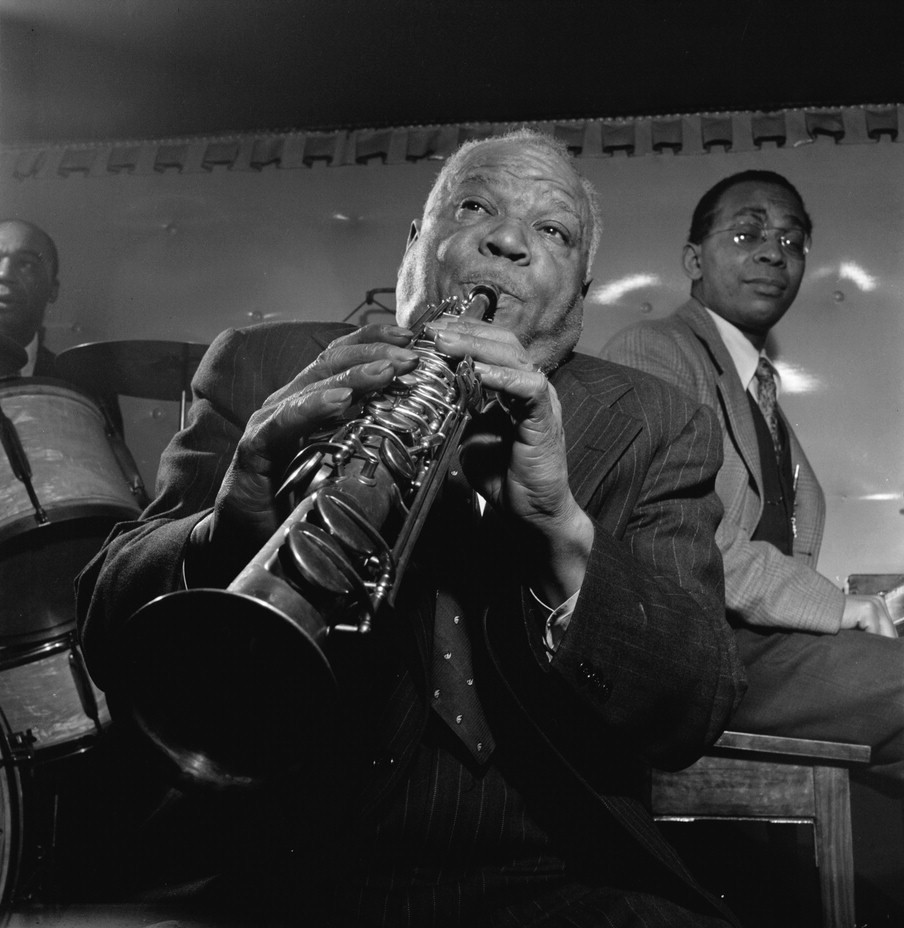
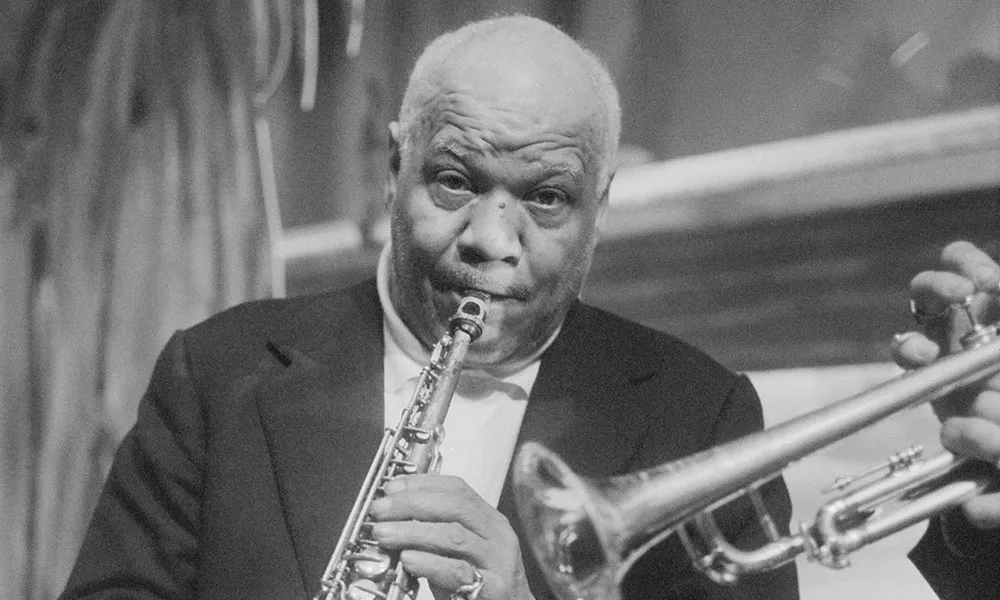
Sidney Joseph Bechet was the first important jazz soloist on records in history. A brilliant soprano saxophonist and clarinetist with a wide vibrato that listeners either loved or hated. Along with King Oliver and Louis Armstrong, Bechet is part of the pantheon of New Orleans' greatest jazz musicians. Sidney Bechet was born May 14, 1897, one of ten children, into a New Orleans Creole family. As African American Creoles, the Bechets spoke French at home, and they had aspirations of social advancement, reflected in their love of music. The Bechet family owned one clarinet, which was initially given to one of Sidney’s brothers. When Sidney began to steal his brother’s clarinet to play out on the porch at night at age six, his talent was enough to convince his parents to ask his older brother to let Sidney take the instrument. Sidney Bechet was a child prodigy with a tremendous natural talent for music.
After acquiring his own instrument, Bechet practiced diligently, although mostly without traditional instruction, he even started performing with his brother's band at a family birthday party. Possessing a remarkable ear, he learned by listening to established clarinetists in the New Orleans idiom, such as Lorenzo Tio, Jr., and George Baquet. It was in the playing of Louis “Big Eye” Nelson, however, that Bechet found his inspiration. Nelson was also self-taught, and he played with a more bluesy, vocalized style than did other clarinetists. At this time, Bechet began playing cornet, earning renown for his range and volume, although he shortly ceased playing the instrument. By the early 1910’s, Bechet was playing in top-tier bands, and he was a fixture on the musical landscape of New Orleans. By the age of 13, Bechet was not only a professional musician, but — much to his family's dismay — a jazz musician.
Even as a boy, Sidney's fiery determination challenged authority and disheartened his parents who wanted Sidney to learn a respectable trade like masonry, shoe making, or carpentry, as was the custom in most Creole households. He seemed to grow from a boy to a man overnight, and in doing so began to establish himself as a brilliant soloist with a fondness for the night life and all its trappings. From 1911 to 1912, he performed with Bunk Johnson in the Eagle Band of New Orleans. From 1914 to 1917, he was touring and traveling, going as far north as Chicago and frequently performing with Freddie Keppard. At 16, Bechet began touring through the deep south with jazz artists such as Buddy Petit, Joe “King” Oliver in the Olympia Band, Clarence Williams, and perhaps most notably John Robichaux’s orchestra. By the spring of 1919, Bechet was in New York where he joined Will Marion Cook’s Southern Syncopated Orchestra for their groundbreaking tour of Europe. This large group, which played little jazz, was more along the lines of a pops orchestra.
During Bechet’s second year with the group, he toured Europe and became the first known jazz musician to receive praise from a classicist, Swiss conductor Ernest Ansermet, who called him “an artist of genius". This catalyzed the beginning of a new era of Bechet on the soprano saxophone, an instrument for which he would eventually become very well-known. The Original Dixieland Jazz Band had recently introduced jazz to London, where they performed at the Royal Philharmonic Hall, causing a sensation. Bechet was showcased on a clarinet feature during “Characteristic Blues” that consistently brought down the house. Even though Bechet started out on clarinet, in the early 1920s, he discovered the soprano saxophone — an instrument rarely heard in jazz at that time.
Bechet was the first influential soprano saxophonist, leading to its rising popularity as a jazz instrument. He mastered the rather difficult instrument, and succeeded in giving the soprano saxophone a prominent place as a solo instrument in jazz. His saxophone sound could be described as emotional, reckless, and all-encompassing. He often used a broad vibrato, similar to some New Orleans clarinetists at the time. Other than a short trip to Paris in 1921, Bechet remained in London until he was convicted of assault in November, 1922, and he was deported back to New York. Once in New York, Bechet was almost immediately engaged to play and to act in a Black stage show called "How Come?", with which he toured until April, 1923. Several other shows followed, suggesting Bechet was valued for his acting as well as his musical abilities. In Washington D.C. he met singer Bessie Smith. During his brief relationship and musical association with the talented blues woman, Bechet took Smith to Okeh Records and recorded “Sister Kate,” a side that was never released.
Bechet made his first recordings in 1923 and 1924 with Clarence Williams’ Blue Five, which also featured Louis Armstrong and are among the most remarkable recordings in early jazz. He worked for three months in 1924 with Duke Ellington, making a powerful impression that had important impact on the early Ellington style. Through the 1920s he gradually concentrated on the soprano saxophone, before touring Europe again. As Bechet continued to cement his reputation as jazz's finest clarinet and soprano saxophone player, he spent extended amounts of time performing and living in Europe, eventually rising to hero status in France. On September 15, 1925, Bechet and other members of the Revue Nègre, including Josephine Baker, sailed to Europe. The revue opened at the Théâtre des Champs-Élysées in Paris on October 2nd. He toured Europe with multiple bands, reaching as far as Russia in mid-1926.
In 1928, he led his small band at Chez Bricktop. Following this was an extended period of travel around Europe as a soloist. In Paris, Bechet again ran afoul of the law, and he was jailed after a gun battle in December, 1928. He stayed in prison for a year, moving to Berlin in December, 1929, to play and to appear in several films. After his release, he was deported to New York, arriving soon after the stock market crash of 1929. Returning to the United States, Bechet began working with bandleader Noble Sissle, for a brief period. Sissle used him as a soloist on clarinet and soprano saxophone and as a member of the rhythm section, playing bass saxophone. Rejoining Noble Sissle in New York, Bechet embarked, along with trumpeter Tommy Ladnier, on a tour of Europe. They made some memorable recordings including a hit record of “Summertime“ in 1938 with the trumpeter under the name of the New Orleans Feetwarmers for a few months.
Bechet remained with Sissle until October, 1938, before deciding to become a leader himself. After a series of short engagements, he freelanced on numerous recordings, and he performed at various establishments in the New York and the Philadelphia area for the rest of the decade. In the Forties Bechet worked regularly in New York with Eddie Condon and tried to start a band with Bunk Johnson. Condon used him frequently on his radio and early television broadcasts. Bechet was also a regular visitor to jazz clubs in both Philadelphia and Boston, and his efforts are well preserved by location recordings. In 1945 he was briefly reunited with Louis Armstrong at the Jazz Foundation Concert in New Orleans, and soon after he made several sides for the Blue Note label with another famous New Orleans trumpeter, Bunk Johnson. Bechet was a popular figure of the Dixieland revival of the late Forties often recording with Mezz Mezzrow.
By the late 1940’s, Bechet was looking beyond New York. In November, 1947, he began a long engagement as featured artist at Jazz Ltd. in Chicago, extending with some interruptions through January, 1949. By the end of the 1940s, Bechet had tired of struggling to make music in the United States. His contract with Jazz Limited, a Chicago-based record label, was limiting the events at which he could perform. He believed the jazz scene in the United States had little left to offer him and was getting stale. In 1951, he migrated to France permanently, after his performance as a soloist at the Paris Jazz Fair caused a surge in his popularity in that country, where he easily found well-paid work. While in France he recorded hit records that rivaled the sales of pop stars. After Bechet repatriated to France, he began featuring his own compositions more, including "Promenade aux Champs-Élysées", and the international hit "Petite Fleur".
It was in Europe that he achieved his greatest success and where he eventually made his home, but he never forgot the New Orleans tradition that nurtured and inspired him. In 1953, he signed a recording contract with Disques Vogue that lasted for the rest of his life. He spent extended amounts of time performing and living in Europe, eventually rising to hero status in France. Parisians were especially enthralled with his passionate and sentimental playing and found his New Orleans Creole accent charming. His signature sound resonates in classic recordings of "Summertime," "St. Louis Blues," or his famous composition, "Petit Fleur”. The relaxed racial atmosphere and artistic recognition he received in France was a welcome break from long years of traveling and economic hardship in America. His musical association with French musician Claude Luter’s band provided Bechet with steady work until 1955.
In 1958 Bechet experienced stomach pains while playing a job in Boston, and was taken to Boston General Hospital. More trustful of the French, he waited to returned to his home outside Paris before undergoing the diagnosed operation. Bechet passed away on his birthday in 1959. He was often referred to as an instrumental peer to Louis Armstrong and considered among the four most influential jazz musicians during the music's first fifty years along with Buddy Bolden, Armstrong and Jelly Roll Morton. Ellington was generous in praising Bechet for helping to develop the “jungle” style of his early band, with which he played briefly in 1925. Bechet was a great improviser, with a passion for life as well as music. However unlike Armstrong, whom he had known growing up in New Orleans, Bechet never achieved great popularity in the United States. Bechet becoming a cultural hero in France was not separate from the Harlem Renaissance world — it was partly an extension of the international Black cultural influence that the movement helped create. Bechet was not one of the symbolic central faces of the Harlem Renaissance, but absolutely one of its important musical figures and part of the larger Black artistic explosion of the era.