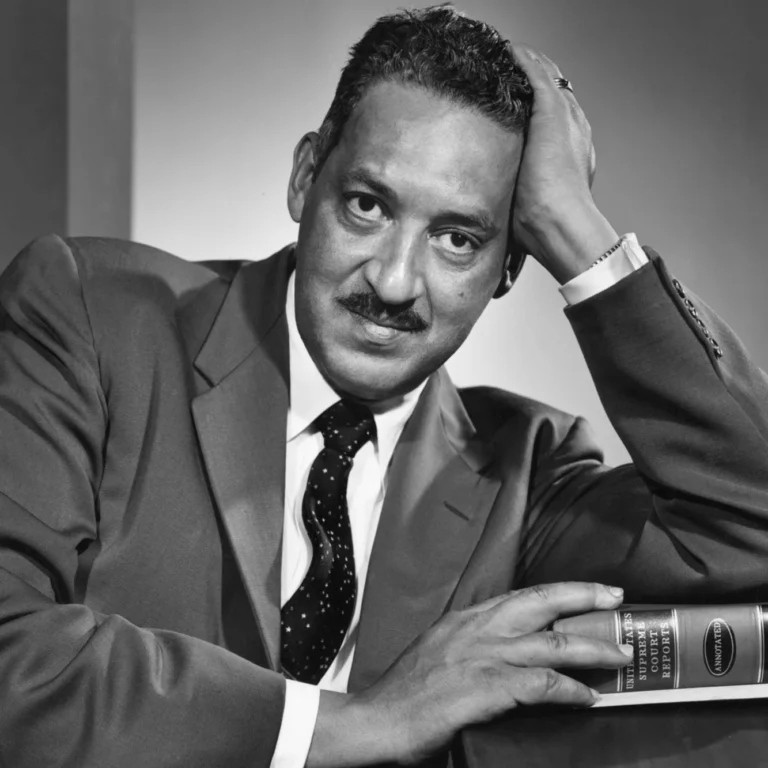
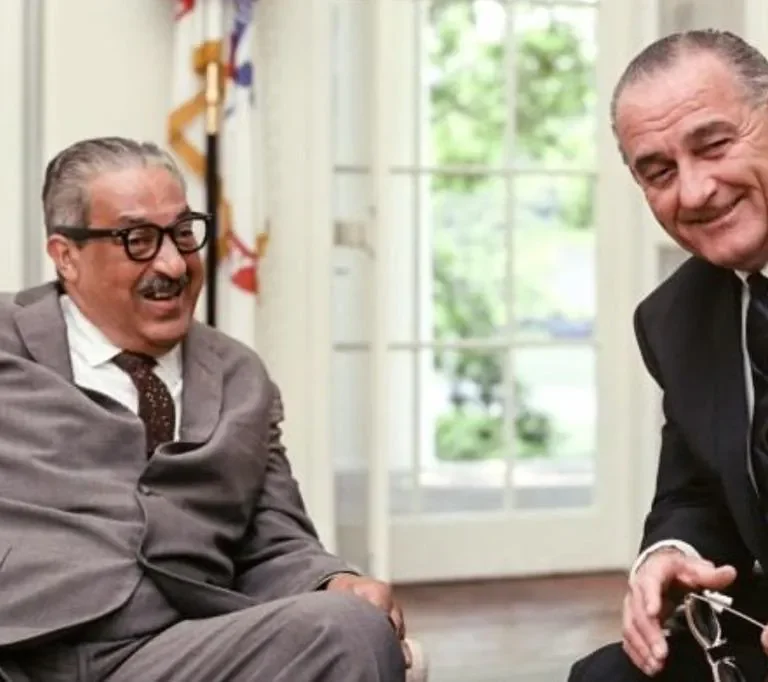
As an attorney, he successfully argued before the Court the case of Brown v. Board of Education of Topeka (1954), which declared unconstitutional racial segregation in American public schools. Thurgood Marshall was the U.S. Supreme Court's first Black associate justice. He was born Thoroughgood Marshall on July 2, 1908, in Baltimore, Maryland. His mother was a school teacher and his father was a railroad porter who later worked as a staff member of the White-only club Gibson Island Club. The family to New York shortly after Thurgood’s birth in search of more work opportunities. They returned to Baltimore in 1914. In second grade, Thoroughgood shortened his name to Thurgood because he did not like writing such a long name. Growing up in Baltimore, Thurgood was exposed to more than his fair share of segregation and racism which contributed to his passion for fighting for equality.
These early life experiences helped produce one of the most significant figures in the Civil Rights Movement, as well as in African American history. He memorized the United States Constitution as a child. His teacher had made him read it when he was being punished. Marshall attended Baltimore's Colored High and Training School (later renamed Frederick Douglass High School) where he was an above-average student and put his finely honed skills of argument to use as a star member of the debate team. The teenage Marshall was also something of a mischievous troublemaker. After graduating from high school in 1926, Marshall attended Lincoln University, in Oxford, Pennsylvania, the oldest college for African Americans in the United States. There, he joined a remarkably distinguished student body that included Kwame Nkrumah, the future president of Ghana, author, poet Langston Hughes and jazz singer Cab Calloway.
At first, Thurgood did not take his studies seriously, even getting suspended twice. It was not until he met Vivian Buster Burey that he began to apply himself and improve his school habits. By the end of his sophomore year, the two were married. Marshall went on to graduate in 1930, cum laude with a BA in American Literature and Philosophy. He graduated with honors from Lincoln University (Pennsylvania) in 1930. After being rejected by the University of Maryland Law School because he was not White, Marshall attended Howard University Law School. There he was mentored by the dean, Charles Hamilton Houston, a notorious disciplinarian and extraordinarily demanding professor. This relationship established the trajectory for the rest of Thurgood’s life.
In 1933, he graduated from Howard with an LL.B. magna cum laude and first in his class. After graduating from law school, Marshall started a private law practice in Baltimore, but without experience, he failed to land any significant cases. In 1936, he began his 25-year affiliation with the National Association for the Advancement of Colored People (NAACP) by representing the organization in the law school discrimination suit when Donald Murray's application was denied, to the University of Maryland Law School (Murray v. Pearson). Marshall and Houston won Murray v. Pearson in January 1936, the first in a long string of cases designed to undermine the legal basis for de jure racial segregation in the United States. Later that year, Marshall became part of the national staff of the NAACP. As Chief Counsel for its Legal Defense and Educational Fund, he fought through the United States courts the idea of "separate but equal" facilities.
In 1940, Marshall established the NAACP’s Legal Defense Fund to continue the fight for racial justice. Throughout the 1940s and ’50s Marshall distinguished himself as one of the country’s top lawyers, winning 29 of the 32 cases that he argued before the Supreme Court. Marshall was victorious in a little-known case, "State of Connecticut vs. Joseph Spell" in 1941. This case involved an African-American chauffeur who was accused of raping his White female employer multiple times. After hours of interrogation, the chauffeur Joseph Spell confessed to the rapes he did not commit. The press believed that this was an open and shut case after Spell confession. However, Marshall was able to prove Joseph Spell’s innocence by highlighting inconsistencies and discrepancies in the testimony of his accuser. During cross-examination, the accuser’s story continued to change, leading the jury to doubt her credibility. Marshall was able to get a not-guilty verdict from an all-White jury, which deliberated for nearly 13 hours, when such an outcome was unheard of in a case like this.
Charles Houston, Thurgood Marshall and the NAACP crafted a strategy of attacking Jim Crow by focusing on what was mandated by Plessy v. Ferguson (1896), "separate but equal," rather than by attacking the doctrine laid out by Plessy. After establishing the inequality faced by Blacks in America, the NAACP began to attack the Plessy doctrine in 1945. They initially directed their attention at areas where Southern states made no provision for African Americans. Areas such as the systematic exclusion of Blacks from professional schools, juries, and primary elections. From 1939 to 1947, Marshall was a member of the Board of Directors of the American Civil Liberties Union. During that period, he aligned with the faction which favored a more absolutist defense of civil liberties.
Most notably, unlike the majority of the Board, he was consistent in his opposition to Roosevelt's Executive Order 9066, which put Japanese Americans into concentration camps. Also, in contrast to most of the Board, Marshall charged that the prosecution of thirty-two right wing opponents of Roosevelt's pre-war foreign policy in the Sedition Trial of 1944 violated the First Amendment. In the years after 1945, Marshall resumed his offensive against racial segregation in schools. In 1950, Marshall brought two cases involving education to the Court: McLaurin v. Oklahoma State Regents, and Sweatt v. Painter. The Supreme Court ruled in favor of both McLaurin and Sweatt on the same day. Although the justices did not overrule the separate but equal doctrine, they rejected discrimination against African-American students and the provisions of schools for Blacks that were inferior to those provided for White folks.
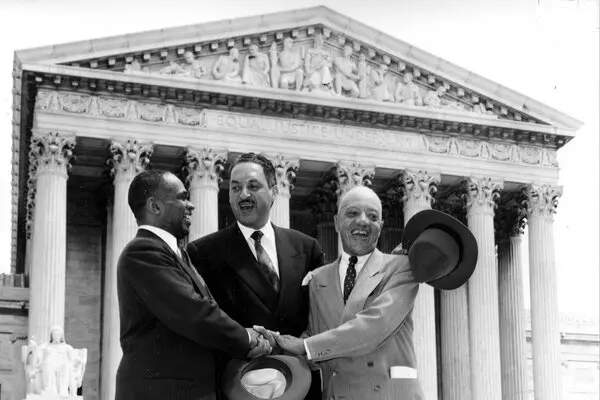
Only when he had won these path-breaking cases did he move on to attack segregation outright. Marshall’s victory before the Supreme Court in Brown v. Board of Education of Topeka established his reputation as a formidable and creative legal opponent and an advocate of social change. In that case, Marshall argued that the ‘separate but equal’ principle was unconstitutional, and designed to keep Black people “as near [slavery] as possible.” Marshall argued that segregation in public education produced unequal schools for African Americans and Whites. But it was Marshall’s reliance on psychological, sociological, and historical data that presumably sensitized the Court to the deleterious effects of institutionalized segregation on the self-image of African American children.
Marshall used several resources, such as documents from Pauli Murray, Inez Prosser and Kenneth and Mamie Clark to argue the social impact that segregation had on school children. Marshall used Kenneth and Mamie Clarks' doll experiment study to challenge state-mandated segregation for public school children. He argued that the study confirmed that segregated education inflicted harm and caused self-hatred among African-American children. As a result of the doll experiment, and the aforementioned resources, the Supreme court ruled in a 9-0 decision that state laws of racial segregation in public schools was unconstitutional. They concluded that it violated the equal protection clause of the 14th Amendment. The Supreme Court declared that separate but equal in education was unconstitutional because it resulted in Black children having "a feeling of inferiority as to their status in the community."
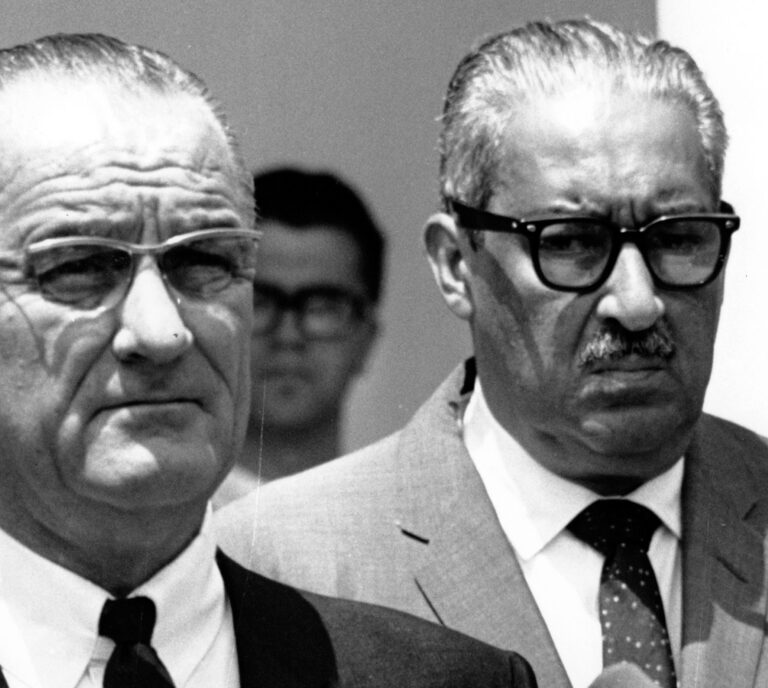
In 1961, Marshall was nominated to the United States Court of Appeals for the Second Circuit by President John F. Kennedy, making him the second African American to serve as a federal appellate judge (William H. Hastie was the first, appointed by President Harry Truman). Serving as a circuit court judge over the next four years, Marshall issued more than 100 decisions, none of which was overturned by the Supreme Court. He remained on that court for four years. In 1965, President Lyndon B. Johnson appointed him to the post of solicitor general, the attorney designated to argue on behalf of the federal government before the Supreme Court, the first man of color to attained this position. But opposition from Southern senators delayed his confirmation for several months. He would remained there until 1967. During his two years as solicitor general, Marshall won 14 of the 19 cases that he argued before the Supreme Court.
When Tom Clark resigned from the Supreme Court to avoid a conflict of interest with his son as the Attorney General, this created an opening in the Court. President Johnson nominated Marshall, the first African American to sit on the Court. On October 2, 1967, Marshall was sworn in as a Supreme Court justice, becoming the first African American to serve on the nation's highest court. The public received the nomination favorably, and Marshall was praised by prominent senators from both parties. The Senate Judiciary Committee held hearings for five days in July. Marshall faced harsh criticism from such senators as Mississippi's James O. Eastland, North Carolina's Sam Ervin Jr., Arkansas's John McClellan, and South Carolina's Strom Thurmond, all of whom opposed the nominee's liberal jurisprudence. Marshall’s stellar resume didn’t impress those Southerners. They were determined to make life difficult for Marshall. These same senators had previously voted against Marshall’s confirmation to the appeals court and tried to block adoption of the 1964 Civil Rights Act.
In what Time magazine characterized as a "Yahoo-type hazing", Thurmond asked Marshall over sixty questions about various minor aspects of the history of certain constitutional provisions. By an 11–5 vote on August 3, the committee recommended that Marshall be confirmed. On August 30, after six hours of debate, with the discussion focused on Marshall’s character and the conservative Senators’ concerns over Marshall as a liberal jurist and attorney, senators voted 69–11 to confirm Marshall to the Supreme Court, but only a couple of votes beyond what was needed to overcome a filibuster at the time. Marshall joined a liberal Supreme Court headed by Chief Justice Earl Warren, which aligned with Marshall's views on politics and the Constitution. As a Supreme Court justice, Marshall consistently supported rulings upholding strong protection of individual rights and liberal interpretations of controversial social issues.
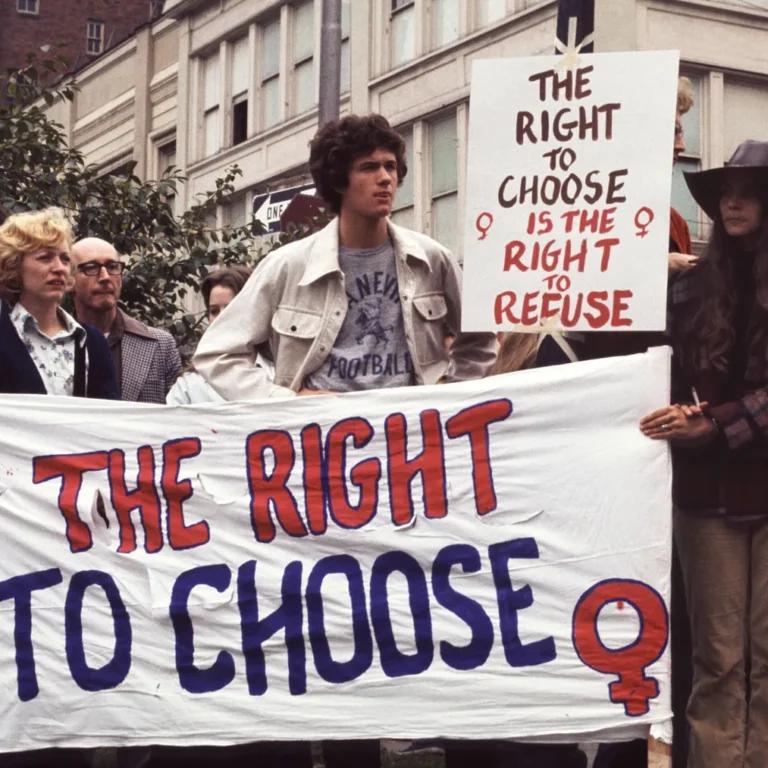
Marshal was one of the three judges that dissented in favor of the Curt Flood v Bowie Kuhn case which upheld baseball's reserve clause in 1970. He was a member of the unanimous majority in United States v. Nixon that rejected President Nixon's claims of absolute executive privilege. He was part of the majority that ruled in favor of the right to abortion in the landmark 1973 case Roe v. Wade, among several other cases. Marshall felt strongly that the Miranda doctrine should be expanded and fully enforced. In cases involving the Sixth Amendment, he argued that defendants must have competent attorneys. For the latter part of his time on the bench, Marshall was largely relegated to issuing strongly-worded dissents, as the Court reinstated the death penalty and limited affirmative action measures and abortion rights. During his service on the Supreme Court, Marshall participated in over 3,400 cases and authored 322 majority opinions.
Marshall consistently sided with the Supreme Court's liberal bloc. He was often in the majority during the consistently liberal Warren Court period, but after appointments by President Richard Nixon made the Court more conservative, Marshall frequently found himself in dissent. His closest ally on the Court was Justice William J. Brennan Jr., and the two voted the same way in most cases. By the time he retired in 1991, he was known as “the Great Dissenter,” one of the last remaining liberal members of a Supreme Court dominated by a conservative majority. Marshall served on the Court for the next 24 years, compiling a liberal record that included strong support for Constitutional protection of individual rights, especially the rights of criminal suspects. In 1991, Marshall retired from the Supreme Court because of his declining health. President George H. W. Bush appointed his replacement, Justice Clarence Thomas. Marshall served as a visiting judge on the Second Circuit for a week in January 1992, and he received the American Bar Association's highest award in August of that year. His health continued to deteriorate, and, on January 24, 1993, at the Bethesda Naval Medical Center, he died of heart failure. He was 84 years old.
Some of Marshall’s notable cases included:
▶ Chambers v. Florida (1940): Marshall successfully defended four convicted Black men who were coerced by police into confessing to murder.
▶ State of Connecticut v. Joseph Spell (1941): A Black man confessed to raping a White woman after a 16-hour police interrogation, which was obtained under duress
▶ Smith v. Allwright (1944): In this decision, the Supreme Court overturned a Texas state law that authorized the use of whites-only primary elections in certain Southern states.
▶ Shelley v. Kraemer (1948): The Supreme Court struck down the legality of racially restrictive housing covenants.
▶ Sweatt v. Painter (1950): The case involved a black man, Heman Marion Sweatt, who was refused admission to the School of Law of the University of Texas, This case challenged the “separate but equal” doctrine of racial segregation that was put in place in the Plessy v. Ferguson (1896) case and set the stage for future legislation. The court sided with Heman Marion Sweatt, a Black man who was denied admission to the University of Texas School of Law due to his race even though he had the option of “separate but equal” facilities.
▶ Brown v. Board of Education of Topeka (1954): This landmark case was considered Marshall’s greatest victory as a civil-rights lawyer. A group of Black parents whose children were required to attend segregated schools filed a class-action lawsuit. The Supreme Court unanimously ruled that “separate educational facilities are inherently unequal.”