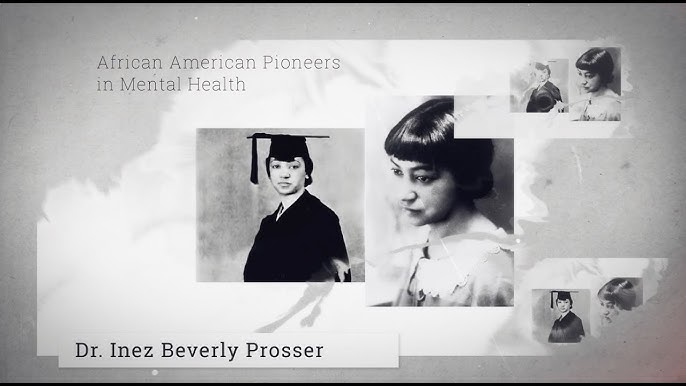
A teacher, administrator and noted psychologist, Inez Beverly Prosser was born Inez Beverly on December 30th 1895 or 1897 in Yoakum, Texas. Both the location and year of Inez's birth are not completely clear. When it comes to birth location, family recollections point to Inez being born in San Marcos, Texas, a small town between Austin and San Antonio. The family was believed to not move to Yoakum until 1900. She was the second of eleven siblings. There were few educational opportunities for Blacks during her youth, and her family moved many times to seek the best education they could find for their children. In 1907, Beverly and her family left Yoakum for Corpus Christi, Texas, but Corpus Christi did not have a high school for African American students.
She and her brother, Leon, returned to Yoakum, staying with a family relative until graduating from Yoakum Colored School in 1910, where Beverly was valedictorian. She almost did not get her family's support to go to college. Inez expressed great interest in furthering her education, but her family could only afford to send one of their children to college. To contribute to the household, she started a college fund to support her younger siblings' education. Her parents planned for it to be Leon, but since he wasn't as eager to study as Inez was, they decided to support her instead. After graduating with a degree in teacher training from Prairie View Normal College, she spent time teaching at different segregated schools.
Prosser became an assistant principal at Clayton Industrial School in Manor, Texas, before accepting a job as an English teacher at Anderson High School. Her assignment as a teacher was long-term and during that time, she met and married her husband Allen Rufus Prosser who worked as an elevator operator at a department store in Austin, and the two were married in 1916. She also coached for the spelling competitions of the Interscholastic League, which sponsored events for Black high school students in athletic and academic contests throughout the state. Inez gained a B.S degree from Samuel Huston College in 1926 minoring in English and psychology and graduating with distinction. Because of the segregated schools in Texas, she was unable to attend a program that offered masters degrees.
She received her Master's degree in Educational Psychology from the University of Colorado with a thesis focusing on different types of English grammar tests. She had begun this work two years prior in the summer of 1924, taking four undergraduate courses to make up for what Colorado thought she lacked in her record at Samuel Huston College. At Colorado, Prosser took several courses particularly relevant to her master's thesis, whose subject areas included mental tests, tests and measurements, and research methods. Her thesis, "The Comparative Reliability of Objective Tests in English Grammar," examined four kinds of English grammar tests, true-false, multiple-choice, completion, and matching questions. All tests covered the same subject areas, difficulty levels, and comparable numbers of factual and reasoning questions.
Upon earning her master’s degree, Inez Prosser utilized her education to serve as the dean of Tillotson College, a Black women’s college in Austin, Texas (now Huston-Tillotson University). Working as a dean, registrar, and professor of education, she largely contributed to the educational and psychological development of Black students. She sought to grow the university while partnering with other African American leaders to increase opportunities for hopeful students. She was allowed to organize a series of lectures from 1929 to 1930, including a lecture by George Washington Carver. Aside from the president, Prosser was second in terms of administrative authority. Her influences extended well beyond the classroom walls or administrative offices.
Overall, Prosser was at Tillotson College from 1921 to 1930. After nine years there, Inez left Tillotson for Tougaloo College, Mississippi, again occupying both teaching and administrative positions while also becoming the principal at Tougaloo High School. In 1931, Dr. Prosser was awarded a fellowship by the General Education Board, that enabled her to pursue doctoral studies in Educational Psychology at the University of Cincinnati. In her fellowship application, she noted that she wanted to contribute to research that would improve teacher training and, subsequently, the quality of education in elementary and high schools. Inez undoubtedly faced great prejudice and hardship at the racially segregated University of Cincinnati.
Inez got to spend the 1931-1932 academic school year in residence at the University of Cincinnati, Ohio, coming back to Tougaloo College for the next year while still working on her dissertation. In 1933, Inez's dissertation got accepted, making her the first African-American woman to earn a Ph.D in psychology. Dr. Prosser earned her Ph.D. in Educational Psychology. Her groundbreaking dissertation, "Non-Academic Development of Negro Children in Mixed and Segregated Schools", investigated the impact of segregation on the social-emotional and academic development of Black students. It was a "companion study" to Mary Crowley's 1931 dissertation, "A Comparison of the Academic Achievement of Cincinnati Negroes in Segregated and Mixed Schools"
In the racially segregated landscape of the 1930s, Dr. Prosser’s work explored the impact of the school environment on the well-being and adjustment of African American children. When Prosser began collecting data for her study in November 1931, Crowley, the Assistant Superintendent of Schools for Hamilton County, was able to aid Prosser in getting the same institutions to co-operate in her research. Crowley’s research concluded that there were no differences in students’ academic achievement regardless of the type of schools they attended. Prosser’s conclusions were different. She created a survey of seven questions on personality and character. They were:
●What are the social and cultural backgrounds of the children in the two groups?
●What are the occupational and activity interests of the two groups?
●To what extent do Black children participate in after school activities?
●What racial attitudes are each group exhibiting?
●What are the emotional responses of the two groups towards being discriminated against?
●To what degree is aggressiveness and submission fostered in the two groups?
●What is the effect of the school type on the children’s personality?
Inez worked with 32 pairs of Black students from integrated and segregated middle schools to determine which type of school has a better effect on their psychological development. She believed that the racism Black students faced at integrated schools caused irreversible damage to their personalities. Inez acknowledged the distinction between detrimental mandatory segregation and voluntary segregation, stating that the latter can benefit Black students because the school caters specifically to them. From her study, she concluded that segregated schools provide a safer, more welcoming environment for Black students, which tends to result in greater confidence and better relationships.
Even though she voiced her support for segregated schools and why they benefited students and staff, she also provided reasons this segregation was detrimental to all students and individuals involved. She also pointed out that segregated schools did not offer the level of educational excellence needed in order to really improve the lives of all Black students. These schools marred by the racist policies of the educational system had harmful psychological effects on African American students. She looked at this question from many different sides. People used her work selectively to argue for and against integration.
In 1954, Brown vs. the Board of Education came before the Supreme Court. Inez Beverly Prosser’s work was presented as a critical part of the argument that integrating schools and offering supports for African American students was important to provide all American children access to good education. Many were not in support of segregated schools since educational institutions were microcosms of the racist society that existed outside the school's walls. Though the topic was highly debated, The Association of Afro-American Educators displayed continued support for segregated schools for decades. Like Prosser, they concur that if resources are properly allocated, the benefits of segregated schools are tremendous to the Black child's psyche.
She examined the influence of racial prejudice on the development of Black children and thoughtfully weighed the potential risks of exposure to such prejudice versus the benefits of access to potentially higher-quality education offered by integrated schools. Dr. Prosser spent her year in 1934 improving teacher training in Mississippi's Black schools. She planned a summer program for the teachers at Jackson College and often guided workshops in teacher programs. After finishing the Jackson summer school program, Prosser, her husband, and her sister Katharine Beverly were involved in a head-on collision near Shreveport, Louisiana. After the accident, she was transported to the Tri-State Sanitarium in Shreveport, where she died on September 5, 1934, only a year after earning her Ph.D.
Dr. Inez Beverly Prosser spent her life teaching and helping Black students to reach their potential. In her short life, she was a tenacious advocate for the education of women and Black people. She was a critical voice for the Black community when women's academics were scarce. As a Black female psychologist, Prosser's voice was crucial during her time and now because the voices and this histories of Black Psychology and Black Psychologist has been absent from the narratives of mainstream American psychology. Being a Black woman herself, having to overcome many obstacles, racism and sexism, she managed to hold many powerful academic positions. Prosser posted a powerful argument regarding the effects of racial inequality on the mental health of African American children.