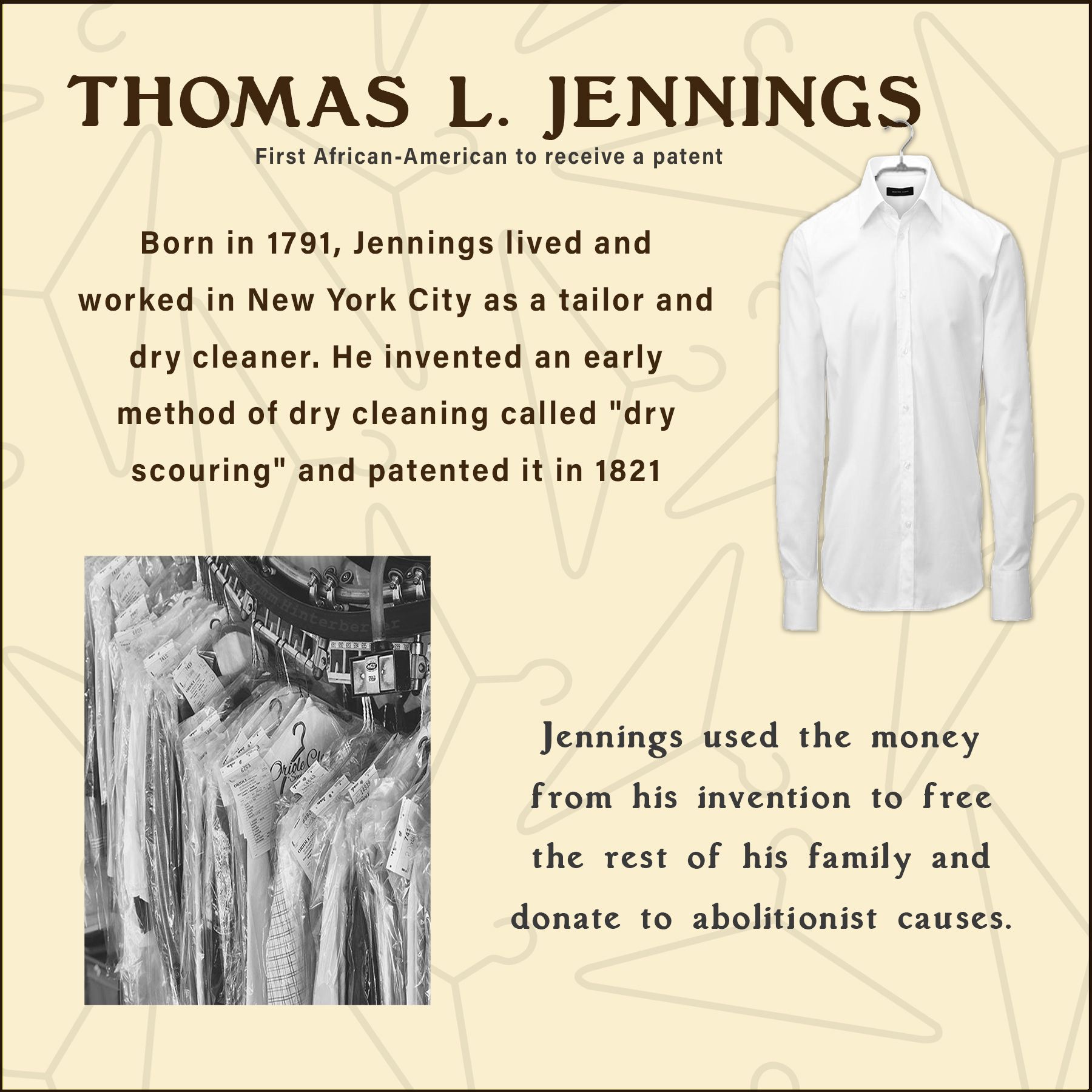
Thomas Jennings invented a process he called “dry-scouring,” receiving a patent in 1821 and becoming the first Black American to be granted a patent. Thomas L. Jennings was born on January 1, 1791 to a free Black family in New York City. Scant information is available about Jennings upbringing. In his early 20s, Thomas Jennings became a tailor, and later opened a dry cleaning business in the city. He later married a woman named Elizabeth, who was born a slave in Delaware. Jennings and his wife had three children. Under New York’s gradual abolition law of 1799, she was converted to the status of an indentured servant and was not eligible for full emancipation until 1827. Jennings made clothes such as pants, shirts and suits for men, and became very successful.
Thomas opened a clothing shop that grew into one of the city’s largest. In those days, men’s suits were made of wool and other fabrics that were not easy to clean. When his customers asked Thomas for advice on removing stains on their clothes, he tried out various cleaners and methods.He was 30 years old when he was granted a patent for a dry cleaning process. In his early 20s Thomas Jennings became a tailor, and later opened a dry cleaning business in the city. While running his business Jennings developed dry-scouring. Dry scouring got rid of grease and dirt and returned clothing to its original appearance.
His dry scouring process was a predecessor to today’s dry cleaning methods. His invention made him a fortune for the time. In 1820, he applied for a patent. Under the Patent Act of 1793, an individual had to sign an oath declaring that he was a citizen of the United States. Besides all the other indignities and cruelties slaves had to face, they were also ineligible to hold a patent. Their effort was the property of their master. Jennings, being a freeman, was a citizen and so was awarded the patent. Later, in 1858, the patent office changed the laws, stating that since slaves were not citizens, they could not hold a patent.
Furthermore, the court said that the slave owner, not being the true inventor could not apply for a patent either. In 1821 he was the first Black man to be granted a patent for his method of dry cleaning. With the proceeds of his invention, he bought his wife and children’s freedom, then continued his civil rights work. He was active on issues related to emigration to other countries; opposing colonization in Africa, as proposed by the American Colonization Society. He also supported the expansion of suffrage for African Americans. Jennings became active in working for civil rights for the Black community. In 1831, Thomas Jennings became the assistant secretary for the First Annual Convention of the People of Color in Philadelphia, PA.
It was July 16, 1854, when his daughter, Elizabeth Jennings, was forcibly removed from a “Whites only” section of the Third Avenue Railroad Company in New York City. Elizabeth Jennings was on her way to the First Colored American Congregational Church, when she got on a horse-drawn streetcar. Upon getting on, the streetcar’s conductor ordered Elizabeth and her friend, Sarah Adams, to get off. Elizabeth chastised the conductor, saying that it was insulting that he should balk at anyone on their way to church. Ignoring this, he forcefully removed Sarah Adams, but Elizabeth resisted—she clung to the window frame and his coat throughout the struggle. The conductor found a police officer and he threw Elizabeth off, not knowing that his actions would result in a severe backlash.
Elizabeth shared her story to her family and local community, who urged her to write about the incident in detail. Her writing quickly made its way to The New York Daily Tribune, which was run by abolitionist Horace Greeley. It was also publicized by Frederick Douglass, in his abolitionist newspaper “The North Star“. Her father filed a lawsuit and helped arrange her legal defense. She was represented by the law firm of Culver, Parker, and Arthur, which included, Chester A. Arthur, who was in his 20s and recently admitted to the bar. The young attorney, would go on to become the vice-president and the 21st President of the United States. Arthur won the case. In 1855, the court ruled in her favor, with Brooklyn Circuit Court Judge William Rockwell stating, “Colored persons if sober, well-behaved and free from disease, have the same rights as others and could neither be excluded by any rules of the company, nor by force or violence.”
Elizabeth was awarded $250 in damages and the Third Avenue Railroad Company desegregated its cars the day after the ruling. Although the ruling did not integrate the city’s transit system as a whole, it paved the way for city’s transit system’s complete integration in 1859 five years later. In 1865, a decade after Elizabeth Jennings won her case, all New York City streetcar companies stopped practicing segregation. After her case was won, Lizzie largely retreated into ordinary life, but she didn’t stop being an extraordinary person. Jennings continued to teach, first at the private African Free School and later in the public schools. She also founded the city’s first kindergarten for Black children, operating it from her home just south of Longacre Square (now Times Square).
Thomas Jennings then organized a movement against racial segregation in public transit in the city. Along with James McCune Smith and Rev. James W.C. Pennington, Jennings created the Legal Rights Association later in that year, a pioneering minority-rights organization. Its members organized additional challenges to discrimination and segregation and gained legal representation to take cases to court. With the success of his business and patent, he became a leader in the abolitionist and civil rights movement in New York City. When Thomas Jennings died in 1859, (some sources say that Jennings died in 1856 while others say 1859), Frederick Douglass wrote about his death. He noted the importance of the patent Jennings received and that the patent recognized him as a “citizen of the United States,” a designation at the time that shocked many. In 1870, the U.S. government passed a patent law giving all American men including Black Americans the rights to their inventions. Jennings’ invention has stood the test of time as dry cleaning is now one of the most common businesses run by people around the United States. Thanks to Thomas Jennings’ innovative thinking, the dry-cleaning process has exponentially grown over the years.