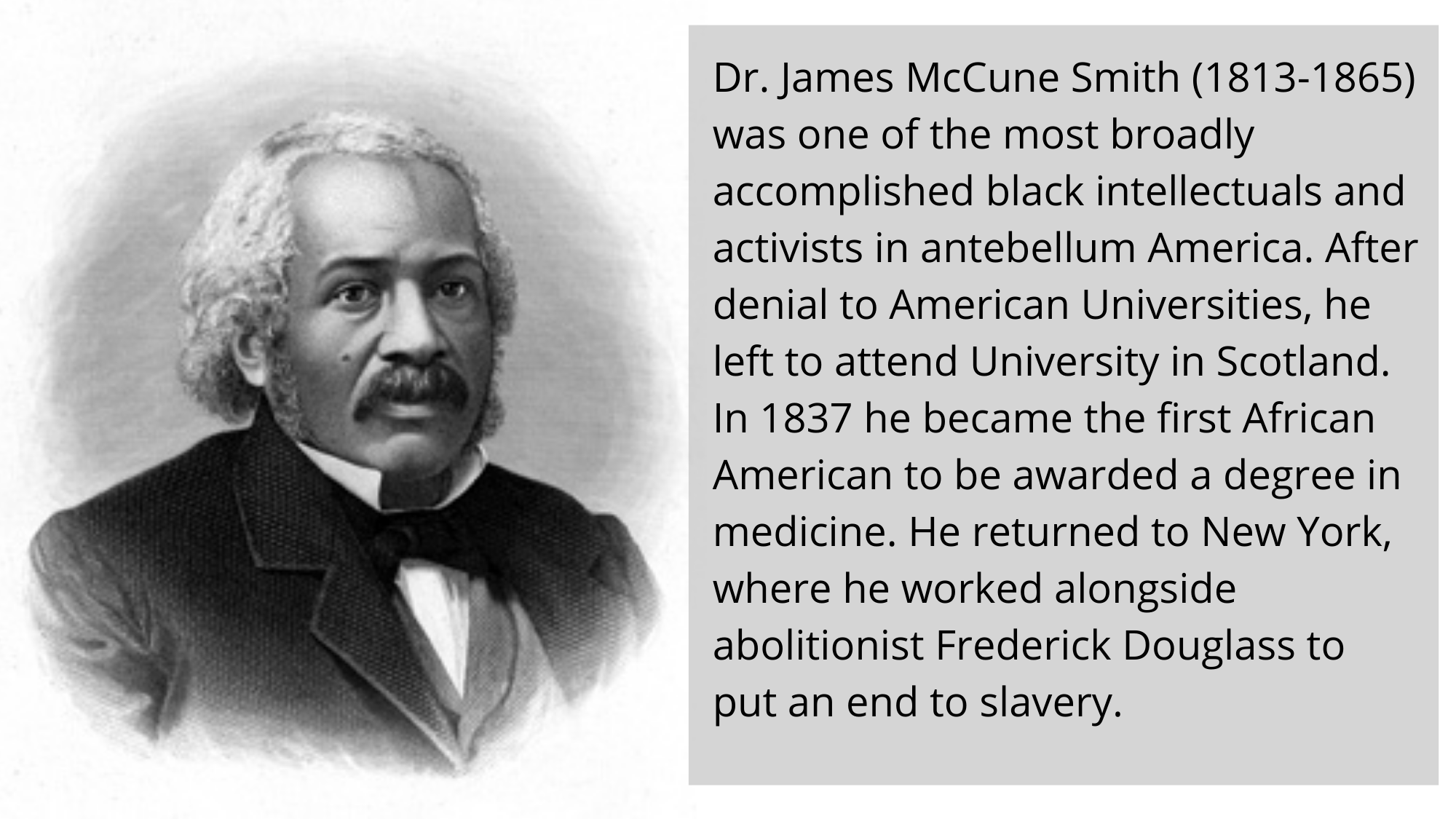
Many African Americans have faced hardships, especially in the medical field. They were not allowed to attend certain schools due to the color of their skin, but still managed to make a way. That was the case for the first African American to earn a medical degree. In addition to being a first-rate physician, James McCune Smith was a leading abolitionist and preeminent essayist, drawing on his training in medicine and statistics to debunk common misconceptions about race, intelligence, medicine, and myriad social constructs. Smith was born into slavery in New York on April 18, 1813. His mother was a former slave who purchased her own freedom, while his father is believed to have been either a White merchant or freed slave. In personal letters, McCune Smith states he came from “doubtful parentage” and acknowledges having “kindred in a southern state, some of them slaveholders, others slaves,” suggesting his father owned slaves.
Though technically “free”, the lives of African Americans in New York during the 1820s and 1830s were marred by the legacy of slavery and discrimination. Runaway slaves were openly hunted in the city’s alleys, streets and wharves. Growing up, James attended the African Free School in New York City, that schooled Henry Highland Garnet, Samuel Ringgold Ward, Alexander Crummell, and Ira Aldridge. The school’s mission was to provide education to children of slaves and free people of color. From the sparse records of his work, James was described as a brilliant student, and samples of his performance show his exceptional talent in both writing and drawing. In 1824, eleven years old, Smith was chosen to deliver the welcoming address to General Marquis de Lafayette, the French war hero was also a member of the New York Manumission Society, during the general’s visit to the school, while touring the United States for his final time.
At the age of 14 he was set free by the Emancipation Act of New York of 1799 granted freedom to all male children born to slave mothers after July 4, 1799, but only after serving their masters until the age of 28 years. A subsequent abolition law passed in 1817 effectively terminated slavery among State residents on July 4, 1827. On this occasion, McCune Smith felt instantly transformed, having lived in the “gloom of midnight, dark and seemingly hopeless, dark and seemingly rayless,” and suddenly facing the “joyful light of day.” Under the tutelage of the headmaster, McCune Smith learned spelling, penmanship, grammar, geography, and astronomy, but, perhaps most invaluably, the conviction that Blacks were as smart and capable as everyone else, and that the higher walks of life were within their reach. Smith labored as a bonded blacksmith 6 days a week, studying Greek and Latin on nights and weekends to prepare for college.
Upon graduation from the African Free School with honors in 1828, James McCune Smith was tutored further by Rev. Peter Williams Jr., also a graduate of the African Free School who had been ordained in 1826. Williams, who is widely recognized as having helped hundreds of Black students during his life, taught Latin to McCune Smith and encouraged him to apply to medical school. However, McCune Smith was denied entry to U.S. medical schools solely based on his race. Drawing on his ties in Scotland, Rev. Williams encouraged Smith to attend the University of Glasgow in Scotland. His pastor raised funds to send him to Scotland. McCune Smith’s arrival in the United Kingdom shortly preceded the Parliamentary Slavery Abolition Act of 1833, outlawed the purchase or ownership of slaves throughout the British Empire. McCune Smith’s departure from New York City proved to be timely, as racial tensions were running high there, culminating in a three-day riot in July 1834, in which mobs fearful of racial equality destroyed the home and church of Rev. Williams and set fire to the African Free School.
McCune Smith earned three degrees over five years: his Bachelor’s in 1835, his Master’s in 1836, and finally his medical degree in 1837. Thus he became, the first Black American to be awarded a degree in medicine. While in Scotland, Smith joined the Glasgow Emancipation Society, an organization that helped to fund his education. After graduating at the top of his class in 1837 and completing a medical internship in Paris, France, he returned to New York City better educated than most White doctors. During his years in the University, he experienced an unparalleled sense of academic and social equality, and the only documented instance in which he faced differential treatment on the basis of his skin color came upon the return voyage to New York. The Captain of the ship "The Canonicus" initially insisted that he travel in steerage. After the intercession of his colleagues from the Emancipation Society he was allowed to sail home as a cabin passenger.
Within a few years of his return to the U.S., McCune Smith married Malvina Barnet, who was a recent graduate of Rutgers Female Institute. By virtue of his education and literary abilities, he quickly became an exceptional figure in New York’s African American community. He is the first certified African American surgeon in the United States. He made history as the first ever pharmacy run by an African American when he opened a pharmacy and medical office that served both Black and White patients, located on 93 West Broadway. These services included “Bleeding, Tooth-drawing, Cupping, and Leeching.” His reputation as an outstanding physician spread quickly, earning him the respect of leading White physicians and scientists of the metropolitan community. Smith joined the four-year-old American Abolition Society before the end of the year and quickly emerged as a powerful anti-slavery and anti-racism organizer, orator, and writer.
In the following spring, at the annual meeting of the Society, Smith was one of five featured speakers and the only Black speaker. The ultimate goal was abolition, but Smith and other African American leaders were at least equally concerned with discrimination in the North, a matter of little concern to William Lloyd Garrison and other White abolition leaders. Nevertheless, Smith supported the abolition cause with, among other things, a regular column in Frederick Douglass' Paper. In 1839, he followed Samuel Cornish as editor of The Colored American, which was the first venue for free Black people to express opinions for a broad readership. In 1840, Smith wrote the earliest known case report by a Black physician, entitled "Case of Ptyalism with fatal termination". Because of his race, he was not allowed to present the case before the New York Medical and Surgical Society, so Dr. John Watson, who consulted with him on the case, did so instead.
Having established a highly successful clinical practice, McCune Smith was “not content with obtaining personal financial security, [and] devoted a considerable portion of his time to the cause of his people.” In the same year he returned from Scotland, he joined William Lloyd Garrison’s American Anti-Slavery Society, a precursor to the Liberty Party, which was the first political party specifically committed to ending slavery through nonviolent means. However, by the mid-1840s, he became disillusioned with the Liberty Party, whose members advocated for “disunion” from the federal government. McCune Smith believed they did not share his definition of freedom or his vision of true racial equality. He coined the term “Garrisonism” to describe the disparaging paternalism displayed by wealthy Whites who expected Blacks to feel grateful to them while doing very little to actually champion their rights or improve their condition.
In 1844 Smith authored the first case report ever written by a Black physician in the United States. It was entitled "On the Influence of Opium upon the Catamenial Functions" in the "New York Journal of Medicine", the earliest known contribution to the medical literature by a Black physician. He drew from his medical training to discredit popular misconceptions about differences among the races. He also reviewed and re-analyzed the primary medical records of New York orphanages and published an article refuting an earlier report, which claimed that homeopathic treatments improved childhood mortality. Intellectually erudite and passionate, Smith wrote prolifically about medicine, science, education, racism, and literature. He argued that organs of the brain were adaptable regardless of “race” in their efforts to debunk the claims of racist ethnologist. James efforts were notable given that some other Black academics accepted the “utility” of phrenology. He used scientific reasoning to counter racist notions and refute the argument of slave owners and prominent thought leaders that Blacks were mentally inferior to Whites. His pioneering work debunked doubts about the ability of African Americans to transition into free society.
One of the earliest advocates of the use of "black" instead of "colored," McCune Smith treated racial identities as social constructions, arguing that American literature, music, and dance would be shaped and defined by Blacks. Smith went as far as to challenge proslavery John C. Calhoun, a former U.S vice president and South Carolina senator who favored secession. Calhoun used the 1840 Census to criticize abolition, that Black people were better off under slavery, and that Blacks were prone to insanity. Smith's response, showing the information to be false, was called, "The Influence of Climate upon Longevity" published in 1846. Smith analyzed the census both to refute Calhoun's conclusions and to show the correct way to analyze data. Smith also provided statistics to show that the death rate among slaves was higher than among free Blacks. McCune Smith pointed out that annual mortality rates do not reflect longevity without correcting for age, and proved it by constructing statistical tables. "What mockery is it," Smith exclaimed, "for men to talk of the kindness of the masters in taking care of aged slaves, when death has relieved them of so large a share of the burden!" It was the first publication from a Black physician known to debunk medical racism.
In 1846, the New York City Colored Orphan Asylum hired Smith to care for nearly 200 children in residence. Despite his best efforts to improve the health of these children by administering vaccinations against smallpox, reducing overcrowding, and improving ventilation, roughly one in every 20 children died from measles, smallpox, and tuberculosis during that period. He served the as chief physician at the Asylum. Early in his time there he debunked claims that homeopathic treatments reduced children's death rates in New York City orphanages. In addition to caring for orphans, the home sometimes boarded children temporarily when their parents were unable to support them, as jobs were scarce for free Blacks in New York. A transportation company refused him passage on its streetcars because he was Black, so Smith walked nearly 7 miles daily until the Asylum provided him with a private conveyance. He remained on staff there until his death.
The political events of the 1850s served to radicalize McCune Smith along with many of his fellow abolitionists, and they officially adopted the use of force to achieve their desired reforms. James McCune Smith, along with George Downing and others was one of the "Committee of Thirteen", who organized in 1850 in Manhattan to resist the newly passed Fugitive Slave Law by aiding refugee slaves through the Underground Railroad. His Manhattan pharmacy served as a vital, secretive station where escaping slaves received medical attention and supplies on their journey to freedom. The law as part of the Compromise of 1850, brokered by Senator Henry Clay to reconcile the interests of Southern slave-holders with those of Northern Free-Soilers. Designed to appease the growing secessionist sentiment in the South, the law sanctioned the kidnapping and enslavement of free Blacks, sparking a decline in New York City’s Black population.
A prominent abolitionist, Smith worked with Frederick Douglass to establish the National Council of the Colored People in 1853. This was one of the first permanent Black national organizations, beginning with a three-day convention in Rochester, New York. At the convention in Rochester, he and Douglass emphasized the importance of education for their race and urged the founding of more schools for Black youth. Smith wanted choices available for both industrial and classical education. James McCune Smith was dedicated to doing all he could to support African American emancipation and equality, in any way he could. For McCune Smith, the emancipation of slaves was only a first step toward his ideal of the “eternal equality of the Human race.” In order for Blacks to achieve equal social status to Whites, he believed first “the heart of the whites must be changed, thoroughly, entirely, permanently changed.” According to him, this change of heart could only come about if Whites understood what it was like to be Black, and this formed the motivation for much of his subsequent writing.
He was elected as a member in 1854 of the recently founded American Geographic Society. The Society recognized him by giving him an award for one of his articles. Douglass valued Smith's rational approach and said that Smith was "the single most important influence on his life". Douglass asked him to write the Introduction to his book, "My Bondage and My Freedom", published in 1855. It expressed the new independence in African American accounts of slavery, compared to earlier works that had to seek approval for authentication from white abolitionists, as readers rejected some harsh accounts of conditions under slavery. In addition, Douglass invited McCune Smith to become the New York correspondent of his new newspaper, "Frederick Douglass’ Paper". Smith's commentaries on Black culture, local and national politics, and literature made him one of the earliest Black public intellectuals to gain popularity in the U.S.
He also maintained close ties to classmate Henry Highland Garnet, praising his incendiary speech urging slaves to rebel, even when other members of the abolitionist community, especially his friend Frederick Douglass, objected strongly to Garnet's sentiments. Smith later cemented Garnet's legacy by writing the biographical introduction to his published Memorial Discourse. Smith tempered the more radical people in the abolitionist movement and insisted on arguing from facts and analysis. Smith wrote against the 1857 Supreme Court’s decision in the Dred Scott case denying Black individuals citizenship. The Court ruled 7-2 against Scott, who had brought forth a law suit for his family’s freedom on the grounds that they had lived for four years in the free state of Illinois and the Wisconsin Territory, with the justices declaring that Blacks did not share citizenship rights, and therefore could not sue in federal court. He was never admitted to the American Medical Association or local medical associations, very likely as a result of the systemic racism that Smith confronted throughout his medical career.
Smith’s thinking reflected the diversity of his interests and the breadth of his training. He took strong stands against Black migration to another country, for Black education of all sorts. Smith believed that native-born Americans had the right to live in the United States and a claim by their labor and birth to their land. He was against racial theories that declared people of African descent were a separate, inferior part of creation. His approach to racial activism was often two-sided. On the one hand, he strongly advocated a program of self-help and racial uplift that promised to “elevate” Blacks in the eyes of Whites and roll back the tide of prejudice. On the other hand, he argued that only an independent Black movement could vindicate the “manhood” of the race and achieve meaningful equality.
In the mid-1850s, Smith joined James W.C. Pennington and other Black leaders in establishing the Legal Rights Association (LRA) in Manhattan. A pioneering minority-rights association, the LRA waged a nearly ten-year campaign against segregated public transportation in the city. This organization successfully defeated segregation in New York and served as a model for later rights organizations, When the Civil War broke out, Smith saw, as did his colleagues, unparalleled opportunities for African Americans to enact this philosophy. Along with notables such as Frederick Douglass and Martin Delany, he lobbied relentlessly for the chance for Blacks to demonstrate their loyalty to liberty and their capacity for civic participation through military service. In 1863, Smith was appointed as professor of anthropology at Wilberforce College, but declined the offer. Both Smith and his wife were of mixed African and European descent.
As he became economically successful, Smith built a house in a mostly White neighborhood. In the 1860 census he and his family were classified as White, along with their neighbors. Despite his trailblazing work in social justice for Black people, Smith’s descendants viewed themselves as White. To escape racial discrimination and have more opportunities, his children passed into White society, and found societal acceptance as educators and real estate agents. His sons married White spouses and his unmarried daughter lived with a brother. They worked as teachers, a lawyer, and as business people. In July 1863, during the New York City Draft Riots in Manhattan, Irish rioters attacked Blacks throughout the city and burned down the orphan asylum. After the riots, Smith moved his family and business out of Manhattan to Brooklyn, as did other prominent Blacks. Numerous buildings had been destroyed in their old neighborhoods, and estimates were that some 100 Blacks were killed in the rioting. No longer feeling safe in the lower 4th Ward, the Smiths moved to Williamsburg, Brooklyn.
His essay, “The Destiny of the People of Color,” McCune Smith anticipated the profound influence that Blacks would have on American culture in the 20th century, including in music, literature, and the performing arts. Although he became less active in his medical profession in the early 1860s due to his heart condition, McCune Smith remained the heart and soul of New York’s African American community. Until his death, McCune Smith vigorously advocated for African American rights, and continued to organize conventions to promote the education of Blacks. Smith died on November 17, 1865, at the age of 52, only nineteen days before ratification of the 13th Amendment to the United States Constitution that abolished slavery. James McCune Smith was the first full-fledged Black polymath (a person of great learning in several fields of study) as well as the preeminent African American intellectual of the 19th century. He was fluent in French, German, Greek, Hebrew, Italian, Latin, and Spanish and the author of more than 100 articles in ethnology, geography, and medicine. McCune Smith’s activism showed aspiring African Americans that becoming a professional Black physician could be more than simply treating patients. His analytical writing and public lectures had a profound impact on the abolitionist movement and his contributions to medicine opened the door for Black Americans in the medical field.