


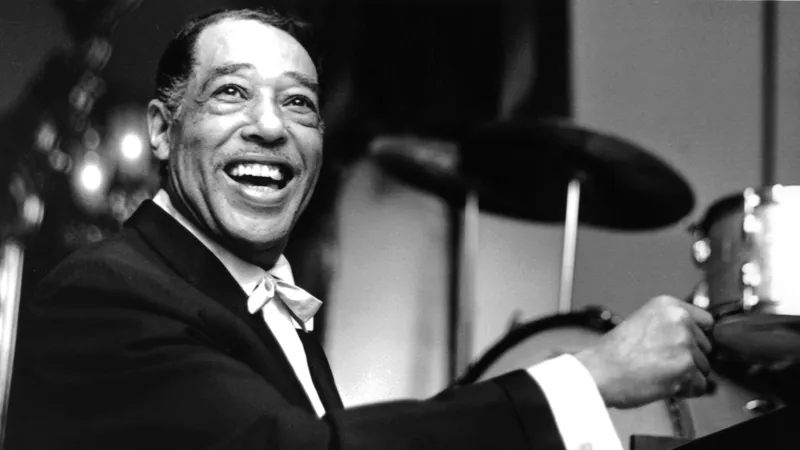

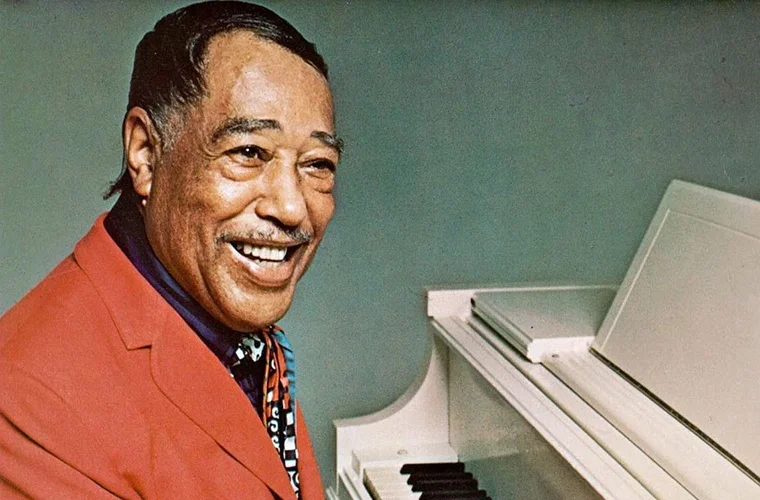


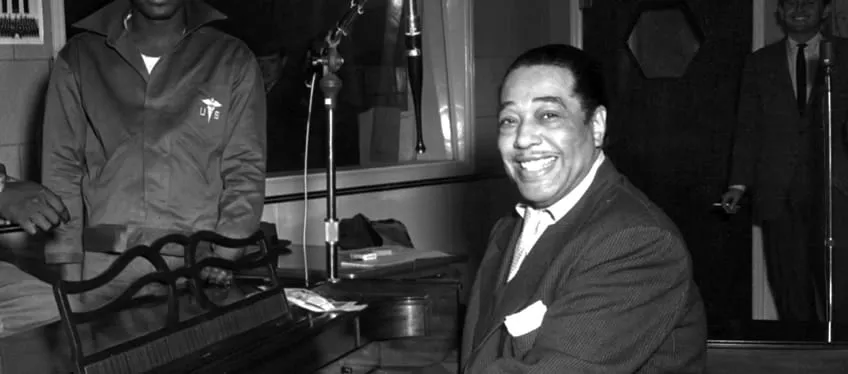
Edward Kennedy ‘Duke’ Ellington was without doubt one of the most remarkable musicians of the 20th century. Ellington was born April 29, 1899 in Washington D.C. When Ellington was a child, his family showed racial pride and support in their home, as did many other families. Black parents worked to protect their children from the era's Jim Crow laws. While he had some piano lessons when he was seven, he did not take the music seriously until he was a teenager. Ellington went to Armstrong Technical High School in Washington, D.C. Young Duke was more inclined to baseball at a young age. His first job was selling peanuts at Washington Senators baseball games. This was the first time Duke was placed as a "performer" for a crowd and had to first get over his stage fright.
Ellington started sneaking into Frank Holiday's Poolroom at age fourteen. His experiences from the pool room taught him to appreciate the value in mixing with a wide range of people. Hearing the music of the poolroom pianists ignited Ellington's love for the instrument, and he began to take his piano studies seriously. Attracted to popular music rather than classical, Ellington did his best to learn from watching closely other more proficient pianists perform. As Ellington’s piano lessons faded into the past, Duke began to show a flare for the artistic, by doing some painting. He did this to make money, but also involved his music. After he painted a sign for a musical event, he would offer his services as a pianist. Ellington credited his friend Edgar McEntee who admired his regal air for his nickname. The name stuck and became indelibly associated with the finest creations in big band and vocal jazz. "I think he felt that in order for me to be eligible for his constant companionship, I should have a title. So he called me Duke". There are a few variations in retellings—some say he acquired the nickname in childhood, others place it in his early teen years—but they all point to the same reason: his refined manners, dignified bearing, and sharp dress.
By 1914 Ellington was playing occasional jobs and working as a soda jerk at the Poodle Dog Café, he composed his first two pieces: “Soda Fountain Rag” and “What You Going To Do When The Bed Breaks Down?” He created the piece by ear, as he had not yet learned to read and write music. In Washington and, during the summers, in Philadelphia or Atlantic City, where he and his mother vacationed, Duke would seek out and listen to ragtime pianists. While vacationing in Asbury Park, Duke heard of a hot pianist named Harvey Brooks. At the end of his vacation, Duke sought Harvey out in Philadelphia where Harvey showed Duke some pianistic tricks and shortcuts. Duke later recounted that, "When I got home I had a real yearning to play. I hadn’t been able to get off the ground before, but after hearing him I said to myself, ‘Man you’re going to have to do it.’" Thus the music career of Duke Ellington was born.
Duke found piano playing jobs at clubs and cafes throughout the Washington area. With the additional guidance of Washington pianist and band leader Oliver "Doc" Perry, Ellington learned to project a professional style, and improve his technique. It took being fired from several bands, however, for Ellington to finally learn how to read music! He dropped out of high school in his junior year in 1917 to pursue a career in music. Although Ellington was a skilled artist, his attachment to music was so strong that in 1916 he turned down an art scholarship to the Pratt Institute in Brooklyn, because he decided that playing music was what he really wanted out of life. During World War I he became expert at putting together bands and getting them jobs in the Washington D.C. area. By 1917, he was slowing down James P. Johnson piano rolls and copying Johnson’s playing as best he could. During this time, Ellington formed “The Duke’s Serenaders.”
He was also the group's booking agent. His first play date was at the True Reformer's Hall, where he took home 75 cents. The band consisted of Ellington, Otto Hardwick (bass/sax), Arthur Whetsol (trumpet), Elmer Snowden (banjo), and Sonny Greer (drums). Between 1918 and 1919, Duke made three significant steps towards independence. First, he moved out of his parents’ home and into a home he bought for himself. Second, Duke became his own booking agent for his band. By doing so, Ellington’s band was able to play throughout the Washington area and into Virginia for private society balls and embassy parties. Finally, Duke married Edna Thompson in July of 1918. Edna gave birth to their only child, Mercer Kennedy Ellington. Despite his lucrative work in Washington D.C., Duke was attracted by the glamour of New York. Eventually, Wilber Sweatman offered Greer a job in New York City and Ellington went with him, eventually settling in Harlem. After a rocky start, he found work playing in both theater orchestras and jazz bands. He soon became the bandleader of a small jazz band.
Ellington became a staple in the Harlem Renaissance. New dance crazes such as the Charleston emerged in Harlem, as well as Black musical theater. Ellington and Greer left Sweatman, trying to make it on their own. They found that New York was a tough city and were met with stiff competition. While in New York, he took advice from Fats Waller, and joined Elmer Snowden’s band. In September of 1923 Elmer Snowden's Washington Black Sox Orchestra landed a six month gig at the Hollywood Club in Manhattan. After about three months the name of the group was shortened to the Washingtonians and because of a disagreement over money, banjoist Snowden was forced out of the band and Duke Ellington was elected as the new leader. Soon the Duke was working up more complicated arrangements as well as experimenting with his own material. By early 1924 Ellington began a four-year engagement with the Hollywood Club, later known as the Kentucky Club. Ellington then made eight records in 1924, receiving composing credit on three including "Choo Choo".
In 1925, Ellington contributed four songs to Chocolate Kiddies starring Lottie Gee and Adelaide Hall, an all–Black revue which introduced European audiences to African-American styles and performers. Duke Ellington and his Kentucky Club Orchestra grew to a group of ten players. They developed their own sound via the non-traditional expression of Ellington's arrangements, the street rhythms of Harlem, and the exotic-sounding trombone growls, and saxophone blues licks of the band members. For a short time, soprano saxophonist and clarinetist Sidney Bechet played with them. It was mainly Bechet's unreliability—he was absent for three days in succession—which made his association with Ellington short-lived. In October 1926, Ellington made an agreement with agent and publisher Irving Mills, who had worked with Hoagy Carmichael, Dorothy Fields, and Harold Arien. This was a big step, signing with Mills allowed him to record prolifically.
Mills regularly took a co-composer credit. From the beginning of their relationship, Mills arranged recording sessions on nearly every label. Sometime, in 1927, King Oliver turned down a regular booking at the Cotton Club. This opened the door for Ellington as an artist. He increased his band to eleven people, meeting the Club’s requirements. He began a weekly radio broadcast, increasing his exposure, especially to the White and wealthy clients of the Cotton Club. This was a major turning point in Ellington’s career, as Cotton Club performances were broadcast almost nightly, bringing his music to wider audiences. The residency earned them considerable international attention, but the venue catered for an exclusively White audience, watching stage routines by Black performers that portrayed stereotypically exotic scenarios. The Black performers had to enter the club through its back doors and couldn’t interact with White customers.
Thanks to the rise in radio receivers and the industry itself, Duke’s band was broadcast across the nation live on "From the Cotton Club." The band’s music, along with their popularity, spread rapidly. The 28-year old Ellington had hit the big time. For the next four years, Ellington’s orchestra was regularly featured at the Cotton Club, playing their own sets, accompanying dancers and singers, and being part of the establishment’s nightly shows. While Jimmy McHugh and lyricist Dorothy Fields did a lot of writing for the shows, Ellington had many opportunities to compose and arrange for his group. The regular radio broadcasts from the Cotton Club soon resulted in Duke’s band being accurately billed as Duke Ellington and his Famous Orchestra. At the Cotton Club, Ellington's group performed all the music for the revues, which mixed comedy, dance numbers, vaudeville, burlesque, music, and illicit alcohol.
Ellington and Irving Mills signed an agreement in which Mills produced and published Ellington’s music. Recording companies like Brunswick, Columbia, and Victor came calling. Duke’s band became the most sought-after band in the United States and even throughout the world. Some of Ellington’s greatest works include "Rockin’ in Rhythm," "Satin Doll", "New Orleans", "A Drum is a Women", "Take the 'A' Train", "Happy-Go-Lucky Local", and "Crescendo in Blue." As the 1920’s and the Harlem Renaissance continued, Ellington and his Orchestra became famous in Harlem, increasing their exposure to African American audiences. By 1929, the Duke Ellington Orchestra was considered by many to be the finest big band in jazz, surpassing the former pacesetter Fletcher Henderson. Ellington’s writing abilities, his star-filled orchestra, and the Cotton Club connection and broadcasts made him nationally famous. His many high-quality recordings started to also make him well known overseas. That year, Ellington and his band appeared in their first film short, "Black and Tan".
One of the most remarkable aspects to the Duke Ellington Orchestra in the 1930s was its very stable personnel. Over the next two to three years the Ellington Orchestra was rarely out of the studio. Ellington's period at the Cotton Club concluded in 1931. During the Harlem Renaissance, the Great Depression hit. It nearly destroyed the recording industry, but due to his newfound notoriety, Ellington was not dropped by the record labels. Ellington's real fame came in the 1930s. While the Great Depression gripped the world, Ellington and his Orchestra gained a following internationally. While King Oliver and Jelly Roll Morton were off of records after 1931 and the Fletcher Henderson Orchestra was often struggling, Ellington was more on the same level as Louis Armstrong, Cab Calloway, and Ethel Waters, African American artists at the top echelon who flourished despite the economic situation. As a pianist, arranger, bandleader and especially composer, Ellington was just getting started. 1930 found him recording such gems as “Rent Party Blues,” “Double Check Stomp,” and “Jungle Nights In Harlem”.
Released in 1932, his song “It Don’t Mean a Thing (If It Ain’t Got That Swing)” became the anthem of the nation’s Swing Era. It extolled the virtue of swing three years before the Swing era officially began. The other 78s of this era include: "Mood Indigo" (1930), "Sophisticated Lady" (1933), "Solitude" (1934), and "In a Sentimental Mood" (1935). With all of those hits, the Duke Ellington Orchestra was in great demand, not only in clubs and on the radio but for films. Despite their popularity and fame, the band faced racial discrimination everywhere they went. When they traveled in the South, Ellington had to hire a private rail car to avoid the crowded, poorly maintained cars on “colored-only” trains. These provided accessible accommodations, dining, and storage for equipment while avoiding the indignities of segregated facilities. Restaurants and lodgings refused to serve his all–African American ensemble.
During a tour of the United Kingdom in 1933, the band scrambled to find boarding homes in London when hotels turned them away because they were Black. Ellington used his growing influence to support the struggle for racial justice. He demanded that the dance halls he played provide equal access to African American youth, and held benefit concerts for the Scottsboro Boys, nine African American adolescents falsely imprisoned for rape in 1931. Eventually, he refused to play for segregated audiences. He believed in the power of African American excellence to subvert the negative stereotypes popularized by blackface minstrelsy. His extraordinary talent silenced racist beliefs that African Americans were inferior or unintelligent and derogatory comments that African American music was “jungle music.” He garnered the kind of recognition and respect previously reserved solely for White composers.
While Ellington's United States audience remained mainly Black in this period, the orchestra had a significant following overseas. In 1933 and 1934, Ellington and his band visited Europe, finally reaching their European fans. Ellington took on Billy Strayhorn as a second composer, arranger, pianist, and lyricist for the band in 1939. Nicknamed "Sweet Pea" for his mild manner, Strayhorn soon became a vital member of the Ellington organization, Duke's right hand. This collaboration proved to be a great success and featured such hits as Strayhorn's "Take the 'A' Train", opens a new window in 1941. Strayhorn, with his training in classical music, not only contributed his original lyrics and music but also arranged and polished many of Ellington's works. After leaving agent Irving Mills, he signed on with the William Morris Agency. Ellington went on another successful European tour, but was overshadowed by the looming of World War II.
By 1939, the year that Duke Ellington turned 40, his place in jazz history was already secure. If Ellington had retired at that time, he would still be remembered for leading one of the great jazz orchestras, for writing more than a dozen standards, and for amassing a very strong and large legacy of recordings. But as it was, Ellington had a long way to go. His 15-piece orchestra that began 1939 contained 11 musicians who had been with him since at least 1931. Critics and many fans often cite Duke Ellington’s 1939-42 orchestra as his finest. Two musicians who joined Ellington at this time created a sensation in their own right, Jimmy Blanton and Ben Webster. Ben Webster's principal tenure with Ellington spanned 1939 to 1943. He was the orchestra's first regular tenor saxophonist and increased the size of the sax section to five for the first time. This is what many claim around the music scence to be a creative peak for the group.
Despite the onset of World War II, Ellington’s band was riding high into 1942, but a recording ban called by the American Federation of Musicians in August 1942, which definitely had an impact on the Ellington band. The ability to tour extensively was constrained by the war in Europe. During this time he also returned to movies, appearing in "Cabin in the Sky" and "Reveille". On January 23, 1943, at Carnegie Hall, Ellington delivered a virtuoso performance of his most impactful work, “Black, Brown and Beige: A Tone Parallel to the American Negro”. Ellington’s music expressed the complexity of the African American experience, from the horrors of slavery, the church in their history, to the cultural renaissance and activist struggles of the 1920s, 30s, and 40s. The suite included a beautiful hymn that soon had an independent existence, “Come Sunday”. This began an annual series of Ellington concerts at the venue over the next four years.
While some jazz musicians had played at Carnegie Hall before, none had performed anything as elaborate as Ellington's work. He performed for an audience that included both celebrities like Frank Sinatra, Perry Como and working-class African Americans. Unfortunately, starting a regular pattern, Ellington's longer works were generally not well received. The recording ban ended in 1944, leading to an increase in royalties paid to musicians. This had a severe effect on the financial viability of the big bands, including Ellington's Orchestra. His income as a songwriter ultimately subsidized it. The record labels started putting out recordings again. Ellington’s biggest pop hit of the period was “I’m Beginning to See the Light”, which was also a hit for Ella Fitzgerald and the Ink Spots.
After WWII, taste in music began to shift away from groups like Ellington’s and more to the be-bop sound of artists such as Charlie Parker and Dizzy Gillespie. As the cost of hiring big bands had increased, club owners now found smaller jazz groups more cost-effective. Ellington used the royalties he earned from composing to financially support his bandmates. After the 1940s he concentrated more on longer works, including several suites (arrangements of music) built around a central theme, frequently an aspect of African American life. However the Duke Ellington Orchestra was beginning to struggle as the 1950s began. There were no new hits, work was becoming scarcer, and their recordings were mostly either remakes of their earlier standards or vocal novelties. Some of his veteran sidemen were becoming restless, wondering if they should spend the rest of their lives playing with the same band.
In 1951, Ellington suffered a major loss when Sonny Greer, Lawrence Brown, and Johnny Hodges left to pursue other endeavors. This period is generally considered Ellington’s career low-point by most, but it did not affect greatly his reputation. While Duke Ellington had overcome his personnel difficulties in 1951, the next few years would be a bit of a struggle for him. There was much less of a demand for big bands than there had been a decade earlier, jobs were less lucrative, smaller r&b groups. By 1955, a new genre was beginning to take center stage -rock n' roll. The rock n' roll bands were starting to attract bigger audiences, modern jazz was generating bigger headlines in the jazz press, and radio was gradually switching from broadcasting live performances to playing records. Also, by this time, after three years of recording for Capitol, Ellington lacked a regular recording affiliation and his popularity was fading.
But he wasn’t out of the spotlight for long. In 1956, Ellington played at the Newport Jazz Festival, reviving his career and marking the return of Lawrence Brown, and Johnny Hodges. The orchestra had put on a strong show including performing the “Newport Jazz Festival Suite.” This concert made international headlines, leading to a Time magazine cover, one of only five jazz musician covers. It would also lead to the best selling LP of his career. The success of the showing at Newport opened up more opportunities for touring, and in 1958 he undertook his first large scale tour of Europe. From that point on, Ellington was a busy world traveler. In 1959 Ellington wrote the music for the Jimmy Stewart film "Anatomy Of A Murder," appearing briefly in one scene. He and Strayhorn also wrote the music for 1961’s "Paris Blues", a film starring Paul Newman and Sidney Poitier that had a role for Louis Armstrong.
With the rise of the Beatles, the Motown sound, the popularity of folk music, and the rock and pop music the fortunes of many jazz artists in the mid-to-late 1960s were affected. Duke Ellington did not see a decline in his bookings but he did make a few albums of current pop tunes when he was at the Reprise label. During the mid-1960s Ellington and his band, ever innovative, started to perform jazz-style sacred-music concerts in large cathedrals throughout the world, which he regarded as his tribute to God. The first was in San Francisco’s Grace Episcopal Cathedral in 1965. Also, in 1965, in addition to the nonstop touring, Duke Ellington participated in a recorded Jazz Piano Workshop in Pittsburgh that found him playing with fellow pianists Earl Hines and Billy Taylor. He recorded an album with Arthur Fiedler and the Boston Pops Orchestra, and made an album with Ella Fitzgerald prior to their touring the following year.
The passing of Billy Strayhorn in 1967, was an early warning that the end was inevitable. Duke Ellington turned 70 in 1969, a birthday that was celebrated at the White House by President Richard Nixon, his staff, and a long list of jazz all-stars. Ellington received many other accolades: star on the Hollywood Walk of Fame (1960), Grammy Lifetime Achievement Award (1966), Presidential Medal of Freedom (1969), the highest award a civilian can receive in the U.S., an Honorary PhD from the Berklee College of Music (1971),and the Legion of Honor (1973), the highest award a civilian can receive in France. Despite his declining health, Duke Ellington and his band went on to play everywhere from New York to New Delhi, Chicago to Cairo, and Los Angeles to London. They entertained everyone from Queen Elizabeth II to President Nixon. By the time of his 75th birthday on April 29, he was in the hospital. Downbeat dedicated an entire issue to his birthday and Ellington reportedly enjoyed reading all of the nice things said about him by scores of musicians. Before passing away in May of 1974, Duke Ellington wrote and recorded hundreds of musical compositions, all of which will continue to have a lasting effect upon people worldwide for a longtime to come. Duke Ellington’s greatness is undeniable. He is arguably the greatest jazz musician ever, was a key aspect of the Harlem Renaissance, and was an era-defining musical genius.