Buffalo Soldiers
The unsung heroes of American Military history
In 1866, an Act of Congress created six all-Black peacetime regiments, to help rebuild the country after the Civil War and to fight on the Western frontier during the Plains Wars. These six regiments were later consolidated into four –– the 9th and 10th Cavalry, and the 24th and 25th Infantry. It was from one of these regiments, the 10th Cavalry, that the nickname Buffalo Soldiers was born. Initially, Buffalo Soldiers were regiments that was commanded by White officers. They often faced extreme racial prejudice from the Army establishment. Many officers, including George Armstrong Custer, refused to command Black regiments, even though it cost them promotions in rank. In addition, African Americans could only serve west of the Mississippi River, because many Whites didn't want to see armed Black soldiers in or near their communities.
The Buffalo Soldiers' main duty was to support the nation's westward expansion by protecting settlers, building roads and other infrastructure, and guarding the U.S. mail. They served at a variety of posts in the Southwest and Great Plains, taking part in most of the military campaigns during the decades-long Indian Wars, during which they compiled a distinguished record. This exceptional performance helped to overcome resistance to the idea of Black Army officers, paving the way for the first African-American graduate from West Point Military Academy, Henry O. Flipper.
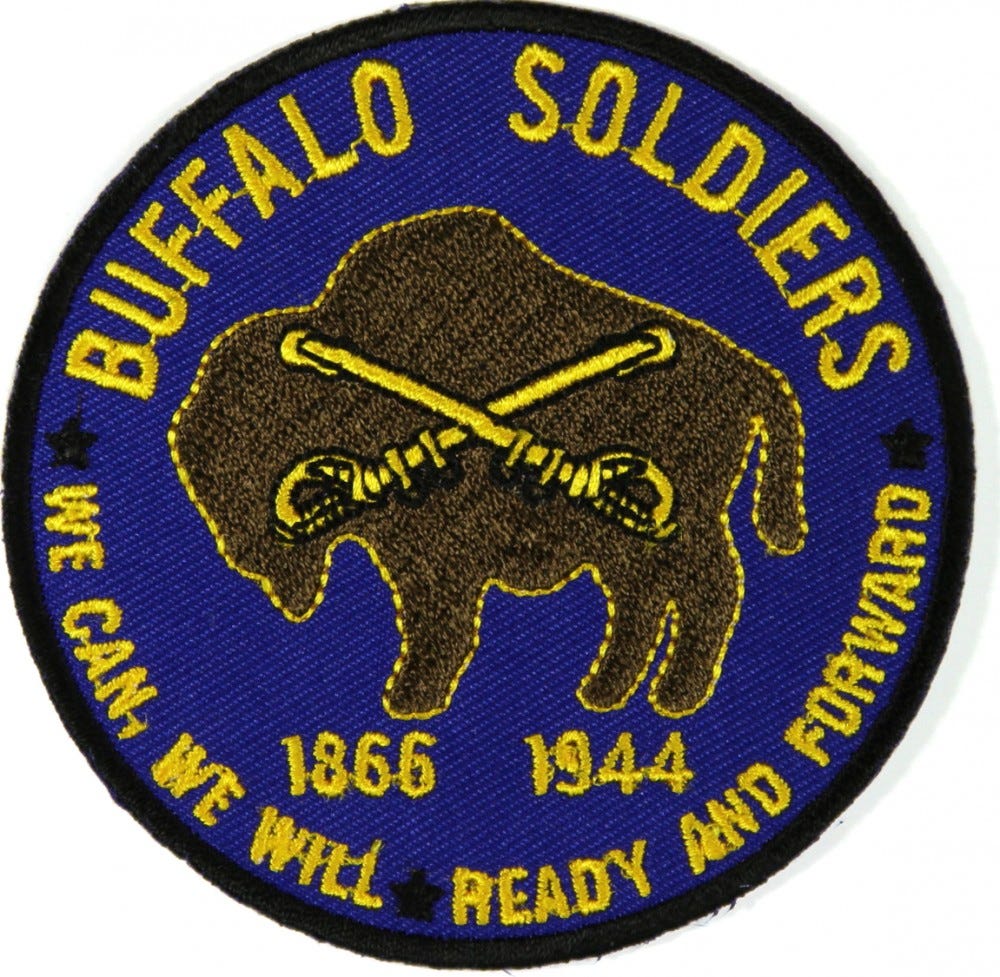
There are differing theories regarding the origin of this nickname. One is that Native Americans who fought against these soldiers referred to the Black cavalry troops as "buffalo soldiers" because of their dark, curly hair, which resembled a buffalo's coat. Another is that their fierce nature of fighting reminded the Indians of the way buffalo fought. The nickname was given as a testament to their valor in battle. The buffalo was a sacred animal to the Native Americans and they would not bestow its name on the soldiers unless they were worthy adversaries fighting ferociously to the end and living up to their motto "we can, we will and ready and forward".
The nickname soon became synonymous with all Blacks regiments formed in 1866. The soldiers seldom used the name amongst themselves, but they did accept the name as complimentary. The symbol of the buffalo was eventually incorporated into the crest of the 10th Cavalry Regiment. And eventually, the image of a buffalo became part of the 10th Cavalry's regimental crest. The Buffalo Soldiers were noted for their courage and discipline. The Black soldiers had the U.S. Army’s lowest desertion and court-martial rates.
Much attention is given to the irony of African-American soldiers fighting native people on behalf of a government that accepted neither group as equals. But at the time, the availability of information was limited about the extent of the U.S. government's often-genocidal polices toward Native Americans. Buffalo soldiers and scouts fought courageously against Native American warriors such as Geronimo and Victorio. But the irony of Black men fighting Red men for White men, as part of U.S. policy to fight and defeat Native Americans, was not lost on these soldiers.
Buffalo Soldiers played significant roles in many other military actions. Many of the Black soldiers that served during the Civil War went on to fight in the Spanish-American War and the Philippine-American War. They took part in defusing the little-known 1892 Johnson County War in Wyoming, which pitted small farmers against wealthy ranchers and a band of hired gunmen. The Buffalo Soldiers became heroes for the role they played in American history, famously charging up San Juan Hill during the Spanish American war. Although the pay was low, only $13 a month, many Blacks enlisted because they could earn more and be treated with more dignity than they often received in civilian life.
Once in Cuba, the “Smoked Yankees,” as the Cubans called the Black American soldiers, fought side-by-side with Lieutenant Colonel Theodore Roosevelt’s Rough Riders, providing crucial tactical support to some of the most important battles of the war. Buffalo Soldier regiments participated in the battle of San Juan Hill in Cuba on July 1, 1898. The troops of the 24th Infantry and the 9th and 10th Cavalry fought up the slope of San Juan Hill along with White regular army regiments and the 1st Volunteer Cavalry (the Rough Riders). Twenty-six Buffalo Soldiers died that day, and several men were officially recognized for their bravery. After the Battle of San Juan, five Black soldiers received the Medal of Honor and twenty-five others were awarded a certificate of merit.
After Cuba, the Buffalo Soldiers were sent to the Philippines to quell an insurgency, serving with distinction and seizing the first major stronghold on the island of Luzon. After their return from the Philippines, the 9th and 10th Cavalry remained on the U.S.-Mexico border and participated in General John J. Pershing’s hunt for Pancho Villa, a Mexican revolutionary who attacked a village named Columbus, New Mexico. In 1918, the 10th Cavalry fought at the Battle of Ambos Nogales, where they assisted in forcing the surrender of the Mexican federal and militia forces.
In nearly 30 years of frontier service buffalo soldiers took part in almost 200 major and minor engagements. From 1870 to 1890, the Buffalo Soldiers were awarded medals of honor, the army’s highest award for bravery. One of the 10th Cavalry’s officers was John J. Pershing, whose nickname "Black Jack" reflected his advocacy of Black troops, (although he did not defend their full participation during World War I, but bowed to the racist policies of President Woodrow Wilson's "separate but equal" philosophy).
When the United States entered World War I in 1917 its armed forces had to expand dramatically. Many thought that the Buffalo Soldier regiments would be the nucleus of a new all-Black division. This would not come to fruition and none of the original Buffalo Soldier regiments were sent to fight in Europe. This was due to racism within the administration of President Woodrow Wilson. Instead, the 9th Cavalry was in the Philippines. The 25th Infantry was garrisoned in Hawaii. The 10th Cavalry and 24th Infantry were patrolling the Mexican border. In 1918, the 10th Cavalry fought at the Battle of Ambos Nogales, where they assisted in forcing the surrender of the Mexican federal and militia forces.
In addition to their military duties, the Buffalo Soldiers also served as some of the first care takers of the national parks. The Buffalo Soldiers were some of our first park rangers in the Sierra Nevada. Between 1891 and 1913, the U.S. Army served as the official administrator of Yosemite and Sequoia National Parks. The soldiers were stationed at the Presidio of San Francisco during the winter months and then served in the Sierra during the summer months. Troops of all four regiments assigned to Pacific commands during the Spanish American and Philippine American wars departed and returned through San Francisco.
While in the parks, soldier's duties included fighting wildfire, curbing poaching of the park's wildlife, ending illegal grazing of livestock on federal lands, and constructing roads, trail and other infrastructure. If that was all they did, surely their time here would have been forgotten like the 24th Infantry’s time at Yosemite. But the 9th Cavalry soldiers also left their mark on the parks they patrolled. They served as the first park rangers and built the first nature trail at Yosemite. Not only was it the first at Yosemite, but it was the first at any national park. Their improvements certainly touched many for generations after.
The Buffalo Soldiers served as some of the first national park rangers when the U.S. Army served as the official administrator of Yosemite and Sequoia National Parks between 1891 and 1913. While only there for a short time, they left a huge legacy. In 1903, Captain Charles Young led a company of Buffalo Soldiers in Sequoia and General Grant National Parks. They built the first road into Sequoia that finally allowed the public to glimpse into that forest of giant sequoia trees. They built the first trail to the summit of Mount Whitney, the highest peak in the lower 48 states. Captain Charles Young became the first African American to serve as superintendent of a national park.
The 24th Infantry and the 9th Cavalry didn’t just patrol the parks. Under the leadership of Cpt. Young, they went above and beyond what was expected of them and made significant improvements to the parks they served. Truly the first national park rangers, these men left a lasting mark and legacy. President Theodore Roosevelt visited San Francisco in 1904. The 9th Cavalry, commanded by Charles Young, served as the honor guard and escort for the president. When President Roosevelt went to meet John Muir to camp at Yosemite and Sequoia, the 9th Cavalry again protected the two men.
During his tenure, he named a Giant Sequoia for Booker T. Washington. Young and his troops managed to complete more infrastructure improvements than those from the previous three years. They completed a road to the Giant Forest and a road to the base of Moro Rock. Their work on these new roads now allowed the public to access the mountain-top forest for the first time. Another Giant Sequoia was named in Young's honor in 2004. The Buffalo Soldiers carried their unit’s name with pride despite the racism and adversity they faced.