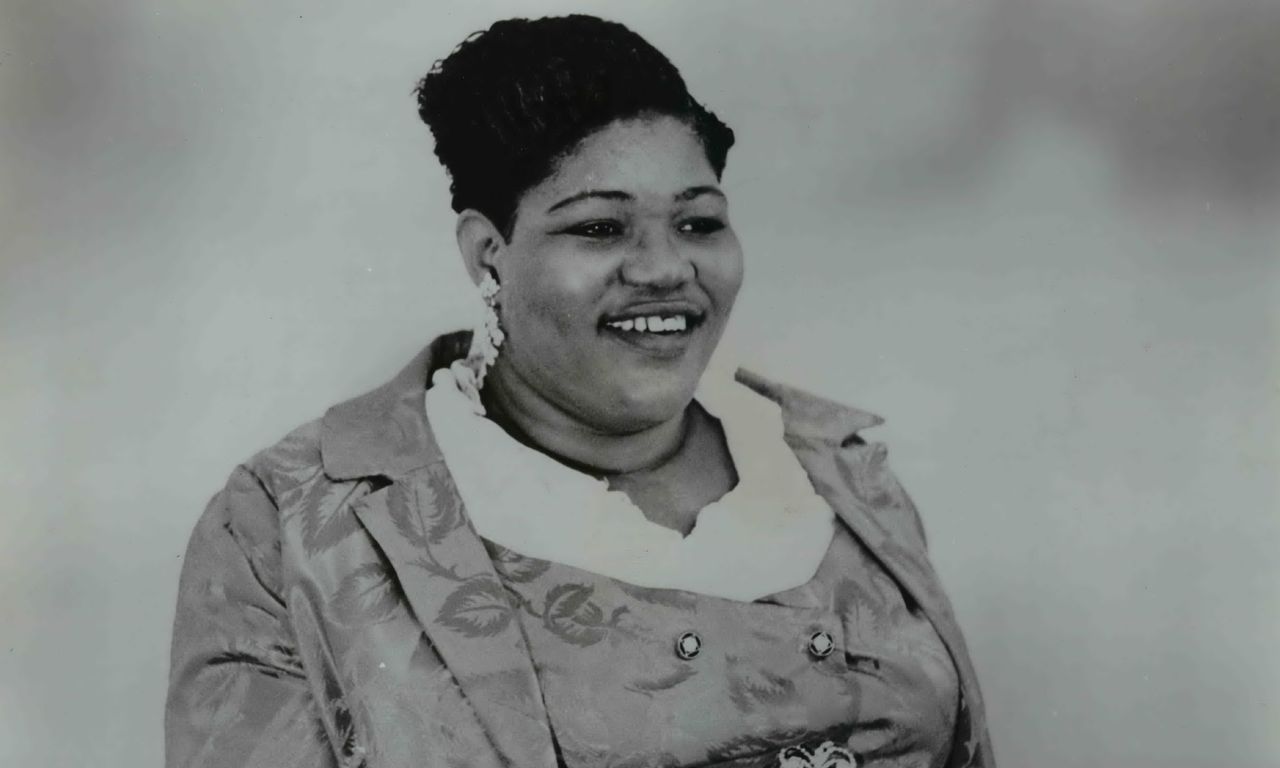
Willie Mae Thornton
Blues legend Willie Mae Thornton, better known as “Big Mama” was born on December 11, 1926, in Ariton, Alabama. She grew up singing in the choir in her father’s church near Montgomery, Alabama. She learned the ropes of secular music by listening to the work of Memphis Minnie and Bessie Smith. Willie Mae also learned to play the harmonica, picking up the instrument when she was eight. In 1941 at age 15, she won a singing contest and attracted the attention of Atlanta music promoter Sammy Green, who signed her for his Hot Harlem Review.
After touring with the show for seven years, in 1948, she relocated to Houston, Texas. Thornton left the Revue in favor of the state’s growing club scene, which she immersed herself in. Houston was a city with a thriving blues and jazz scene, and her vocal style was a good match for the upbeat R&B and jump blues sounds that were becoming a staple at Black nightspots, both on-stage and on the jukeboxes. She was discovered by Don Robey, a Black entrepreneur who owned several clubs and record stores in the Houston, TX area.
Don Robey signed her to his Peacock Records label in 1951, and the following year, she released her debut single. Thornton launched her recording career with a song called “Hound Dog,” written by a pair of budding songwriters, Jerry Leiber and Mike Stoller. Leiber and Stoller told her they wanted her to growl as she sang, and her rough and ready performance made the song a hit, selling over 500,000 copies and held the #1 spot in the Billboard rhythm and blues charts for nine weeks. While Thornton was a star on the R&B and blues circuit, her sound and her demeanor were too brash for the pop charts.
Elvis Presley smoother and bowdlerized version of “Hound Dog” that featured a different arrangement and different lyrics was a major pop hit in 1956 and successfully eclipsed her biggest claim to fame. Thornton continued to tour the “chitlin’ circuit” as fans began to favour newer R&B sounds over blues. She was called “Big Mama” for both her size and her robust, powerful voice. For some years, Big Mama suffered in obscurity like most of her fellow bluesmen. Sales of Thornton’s record dwindled with time, and ended her association with Peacock in 1957.
Thornton cut occasional one-off singles for a handful of R&B labels, but she didn’t release an album until 1966. The “Big Mama Thornton & the Chicago Blues Band” album was cut in a single day with Muddy Waters and his road band backing her. Her label issued the album Ball and Chain, which featured two cuts by Thornton (“Ball and Chain” and “Wade in the Water“). While Thornton enjoyed her greatest success in the ’50s, she continued to record well into the ’70s and performed into the ’80s, with her impassioned version of the blues.
While she never crossed over to the pop charts, her name gained wider prominence and her career enjoyed a significant resurgence. Rock n’ Roll performer, Janis Joplin, a Big Mama Thornton fan, was singing “Ball and Chain“, with the band Big Brother & the Holding Company. It was included on their 1968 album Cheap Thrills. “Ball ‘n’ Chain” was also performed at the Monterey Pop Festival. As a result of the Cheap Thrills’ success and that classic recording at the Monterey Pop Festival in 1967, Big Mama attracted a new audience among rock fans who were exploring the work of blues artists.