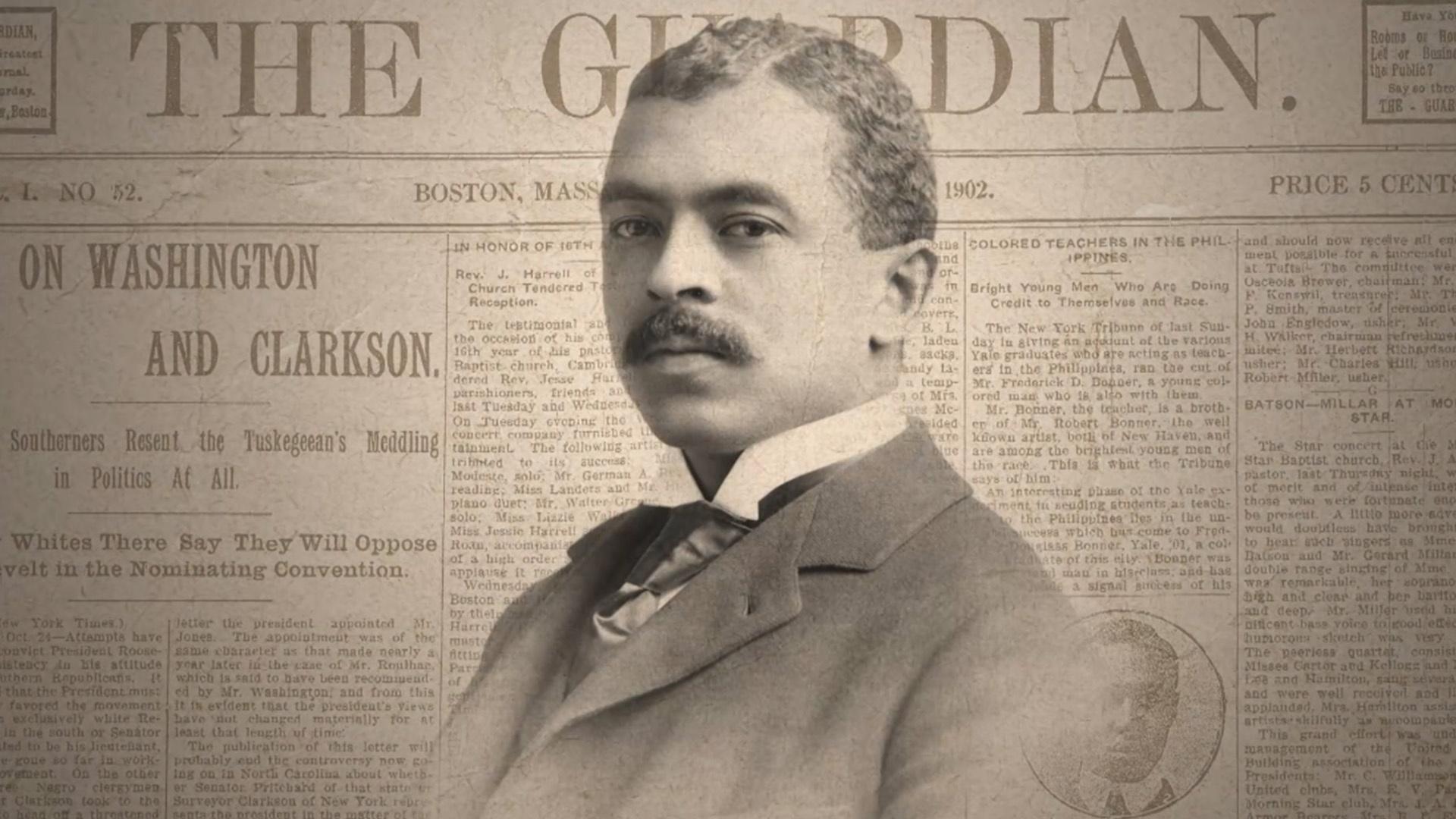
Monroe Trotter
William Monroe Trotter was a fiery, uncompromising journalist and vocal advocate of racial equality in the early 20th century. Trotter was born on April 7, 1872, in Chillicothe, Ohio during Reconstruction, and came of age during the Jim Crow era. He grew up in Hyde Park, a wealthy suburb of Boston, MA. in a family that had money and extensive political connections. At his Hyde Park High School, he's the only Black person in class. Trotter graduated as valedictorian and president of his high school class. He then attended Harvard University, where he received merit scholarships and was the first man of color to be awarded a Phi Beta Kappa key. In 1895, he graduated magna cum laude, and in 1896 he received a Master's degree. It was William Monroe Trotter’s status as a Harvard College student that allowed him to meet another future leader of the civil rights movement, W.E.B. Du Bois, who was a Harvard graduate student at the time.
Trotter’s success, however, could not shield him from the harsh realities of what it meant to be an African American during the twentieth century. Trotter’s race, combined with his radical politics, blocked him from finding long-term employment after graduation. After going from job to job, he finally landed a permanent position in real estate in 1896. Trotter married Geraldine “Deenie” Louise Pindell a friend from childhood, on June 27, 1899. He then decided to opened his own business. In the fall of 1901, the 29 year old William Monroe Trotter founded the independent African American newspaper, the Boston Guardian, and began speaking out against the racial inequality that he saw in his city. Deenie handled most of the business and bookkeeping for Trotter’s newspaper.
"The Guardian makes itself responsible for our collective deliverance. None are free unless all are free." states Trotter. Trotter noticed that Boston was becoming more segregated, rather than less. He began working to counteract this segregation. The Guardian provided an important outlet for Black radical activism and a crucial platform for Boston’s Black working class. “We have come to protest forever against being proscribed,” Trotter explained in the first issue, or shut off in any caste from equal rights with other citizens, and shall remain forever on the firing line at any and all times in defense of such rights." Although the paper circulated widely among Boston’s Black residents of all social classes, Trotter envisioned the Guardian as an outlet to speak directly to working-class African American people and address the issues within the community that concerned them most.
By 1901 most of the Black newspapers in America voiced the opinion of one man and one man only and that man was Booker T. Washington. Trotter advocated for more activism in the African American community, and frequently butted heads with Booker T. Washington. Though both men sought to advance civil rights for African Americans, Trotter strongly disagreed with Washington’s methods and publicly advocated for more confrontational tactics in the fight for racial justice. Trotter’s public challenges of Washington’s policies began in 1901 with his founding of the Boston Guardian and the Boston Literary and Historical Association. That October, he gave his first protest speech, attacking Washington's accommodationist stance. Trotter openly confronted the racial injustices that he saw in both the local and national contexts. His paper called Booker T. Washington the "Benedict Arnold" of the Negro race, or the "Great Traitor".
Trotter also labeled Washington as a hypocrite who turns everything into cash for himself. His attack was not just personal, he was protesting the central idea of White supremacy and it brought a bitter tinge to the disagreement. Washington did not allow anyone to criticize his leadership and anybody who dared to do that was going to get squashed, and Washington tried in various ways to squash Trotter. Washington tried to sue the Guardian multiple times for libel. Trotter's strident opposition to the racially conciliatory policies advocated by Washington, were quite well known. "The questions we're asking should not be what is wrong with Black people," Trotter would say. "What it should be is what's wrong with the systems that have created the conditions in which Black people live."
Washington's policies were enshrined in the Atlanta Compromise, outlined in an 1895 speech he gave in Atlanta, Georgia. He offered a solution to one of the most vexing problems of the day, the so-called race question or the Negro problem. What really Washington wanted was financial well-being for Black people. He was promoting his movement in a way that was not offensive to White people. In that speech, Washington said that Southern Blacks should not agitate for political rights (such as the right to vote and equal treatment under the law) as long as they were provided economic opportunities and basic rights of due process. Washington actively promoted the idea that Blacks, once they had proven themselves as productive members of society, would be granted full political rights. The "Atlanta Compromise," is one of the most significant speeches in Black history because it makes Washington the leader of his race.
Outspoken in his views, Trotter became determined to embarrass Washington. His awaited chance finally arrived on July 30th, 1903 at a Boston’s African Methodist Episcopal (AME) Zion church, while Washington was attending a National Negro Business League meeting. Trotter led two followers to yell out fierce questions to Washington, ignoring the objections of the chairman, William H. Lewis. Red peppers were thrown at Washington and people started sneezing and coughing. The crowd soon called the police. William Monroe Trotter stood on the pews shouting at Booker T. Washington. The church is exploding into arguments. A fight broke out and Trotter was subsequently arrested and sentenced to thirty days in jail for disturbing the peace and disorderly conduct.
"The Boston Riot", as it became known, was historically significant because it was the first direct opposition of Black people to their leader. This essence surprised both races across the nation and brought this debate into the eyes of so many others. Thus, the topic of civil rights was once again brought to the frontline of discussion, as the event served as a frontier to future discussions and debates. That said, the debate between Washington and Trotter proved that the form of controversy and public discourse served as a more appealing and attractive hook and exigence to national attention. Neither Washington’s accommodationist approach nor Du Bois and Trotter’s radicalism reached success because their beliefs never got implemented wholly. However, whether whose belief was more appropriate mattered little compared to the consideration process they triggered among millions of others.
W.E.B Du Bois condemn the disturbance in Boston, even though he didn't always agreed with Trotter. When Trotter was thrown in jail, it was clear to Du Bois that there was going to be no working with Washington. During 1903, Du Bois had announced his public break from Washington in his landmark book, "The Souls of Black Folk". Trotter and Du Bois could not accept Washington's accommodation. They became allies to confront injustice rather than find a way to live with it. They decide the moment has come that we are going to have to organize a different kind of approach: the protest approach, the militant approach. On July 11th, 1905, Du Bois, Trotter, and other anti-Bookerites organized a meeting of radicals from across the nation in western New York. Twenty-nine men representing fourteen states came. Meeting in July just across the Canada–U.S border in Fort Erie, Ontario they founded the Niagara Movement.
W.E.B Du Bois, William Monroe Trotter, and ultimately the activists of the Niagara Movement were calling for full civil rights political participation. The Niagara Movement was an all-Black organization, and that was strategic and intentional. Having an integrated organization might dilute in some ways their messaging, their overall vision and goals. They were launching an ideological struggle, and the target of its attack was the idea of accommodation promoted by Washington. In 1907, the Niagara Movement began to struggle financially as Washington and his supporters cut off most sources of White capital and discredited the organization. He also sent spies to infiltrate the organization. Another major struggle became the friction that developed between Du Bois and Trotter over the admission of women to the organization. Du Bois supported the idea, and Trotter opposed it believing that Black men had to take the leadership. Dr. Du Bois felt if you're going to do anything in the Black community, you must involve women because women are organizers and hard workers.
Du Bois growing prominence and other difficulties, lead to the organization collapse in 1908. Trotter was a person that ruffled other people's feathers. He was someone who insisted on his own way. Trotter could not compromise and he saw compromise as weakness and just would not do it. They just could not get along because each of them thought he was the king of the hill, and you can only have one king of the hill. Du Bois, who had collaborated and corresponded with Trotter for years, decided to avoid a conference for the National Negro-American Political League. He confided to a mutual friend, that it was “impossible to work permanently with Mr. Trotter.” He and Trotter never tried working together again. Just three years after the initial meeting Trotter was through with the Niagara Movement. Trotter wrote, "You will remember that I with reason consider the Niagara Movement leadership mean, tricky, petty, worse."
The next year in 1909, the National Association for the Advancement of Colored People (NAACP) came into existence as a result of the 1908 Springfield riot in Springfield, Ill. The one significant difference between the Niagara Movement and the NAACP was its White liberal leadership. Trotter and Du Bois were both present at meetings in 1909 in which its foundation was laid. The civil rights organization adopted Trotter's proposal to address segregated transportation as a grievance, but the group rejected his proposal to make lynching a federal crime. Trotter was not invited to be on the organization's executive committee. He believed that this new organization was fatally compromised by its largely White leadership and its dependence on White financial support.
Trotter never played a significant role in the NAACP, and in its early years actively competed with it. Trotter refused to join the Association because he did not approve of the amount of White involvement in the interracial group. He was also concerned about NAACP’s lack of strong opposition against Booker T. Washington. The NAACP attempted to moderate racial tensions and bring people together from both factions. Trotter’s participation was also limited in the new interracial group because of lasting effects of his personal feuds with Du Bois. As the NAACP was building momentum, Trotter joined a strategic revival of the National Equal Rights League (NERL), which grew directly out of the National Independent Political League. The NERL, in contrast to the NAACP, was made up of all Black members and as Trotter stated “an organization of the colored people, for the colored people and led by the colored people."
Trotter's opposition to Booker T. Washington placed him at odds with Theodore Roosevelt and William Howard Taft, Republican presidents who relied on Washington as an adviser and otherwise enjoyed widespread Black support. In 1912, Trotter supported candidate Woodrow Wilson for President. When Wilson won the presidency and decided to segregate federal offices, Trotter was interested in speaking with the Wilson — in what would be their second meeting — in hopes of convincing the president to end his segregationist and racist policies. Wilson said that his policies were not segregationist, but Trotter characterized Wilson's denial as "preposterous". Trotter continued his protests, eventually gaining an invitation to the White House in November 1914.
He strongly protested the President's support for segregation of Black federal employees in the workplace. Trotter directly challenged the president for permitting the segregation of Black and White government clerks. Trotter called out Wilson for his racism in a heated exchange. “Only two years ago you were heralded as perhaps the second Lincoln,” Trotter declared, “and now the Afro-American leaders who supported you are hounded as false leaders and traitors to their race.” “Have you a new freedom for White Americans and a new slavery for Afro-American fellow citizens?” Wilson took issue with Trotter’s tone — perhaps more than the accusation of racism. The President was offended and angered by Trotter's remarks and had Trotter removed from the White House. Trotters' confrontation with the president increased his many admirers in the Black community, who applauded his strong stance against White supremacy.
But he faced harsh critique among fellow Black elites, which included Dr. Du Bois and others of the NAACP. The Boston Evening Transcript, while observing that Wilson's policy was segregationist and divisive, pointed out that although Trotter was basically correct, he "offends many of his own color by his ... untactful belligerency." Trotter parlayed the publicity into a series of speaking engagements, in which he denied "that in language, manner, tone, in any respect or to the slightest degree I was impudent, insolent, or insulting to the President." Though Trotter was unsuccessful in convincing Wilson to change his segregation policies, he continued to advocate against a segregated government. He specifically focused on desegregating the military.
In 1915, Trotter helped to make D. W. Griffith’s “The Birth of a Nation” a public scandal. Five years earlier, he had succeeded in stopping a Boston production of Thomas Dixon’s “The Clansman,” the play, adapted from Dixon’s own novel, which was the basis for Griffith’s film. Dixon had been a classmate of President Wilson at Johns Hopkins, which is partly why “The Birth of a Nation” was screened, notoriously, at the White House. Trotter, along with other organizations, such as the National Association of Colored Women, organized mass protests at local theatres, city hall, and the statehouse. Trotter did not stop “The Birth of a Nation,” but his tactics were used by the civil-rights movement to integrate lunch counters, buses, schools, and other essential spaces.
When the Great Depression hit following the 1929 stock market crash, Trotter quickly found himself with few people in his circle as he fought impending bankruptcy and the newspaper’s steady decline. But, still Trotter routinely wrote in the Guardian about incidents of racial injustice, including the 1931 trials of the Scottsboro Boys. The personal and professional losses took a toll on his psyche. For Trotter, the arrival of his sixty-second birthday on Saturday, April 7, 1934 was no reason to celebrate; it only intensified the pain and anguish he felt. During the wee hours of the morning, Trotter decided to end his life. What Trotter could not have foreseen is that for all of his perceived failures, he had left a mark that would shape the future of Black radical politics.
Trotter devoted his career to the fight against racial discrimination and to the development of independent political action in the Black community. He fought not only White enemies but also would-be Black allies, including Booker T. Washington and W.E.B Du Bois. He attacked films and plays that glorified the Ku Klux Klan. At that time Trotter’s confrontational tactics were highly controversial and it alienated other civil rights groups, but his activism and approach became a model for the Civil Rights Movement. He had left a mark that would shape the future of Black radical politics. He had agitated for the rights and dignity of Black people, denounced White supremacy without hesitation — and in the process, inspired generations of Black activists. William Monroe Trotter was a revolutionary before his time. He was a dedicated man to the cause of civil rights for Black people worldwide. Even when he did not feel supported by members of his own race, he was persistent. Harvard-educated and a member of the Black elite, Trotter personified Du Bois’s “talented tenth.”