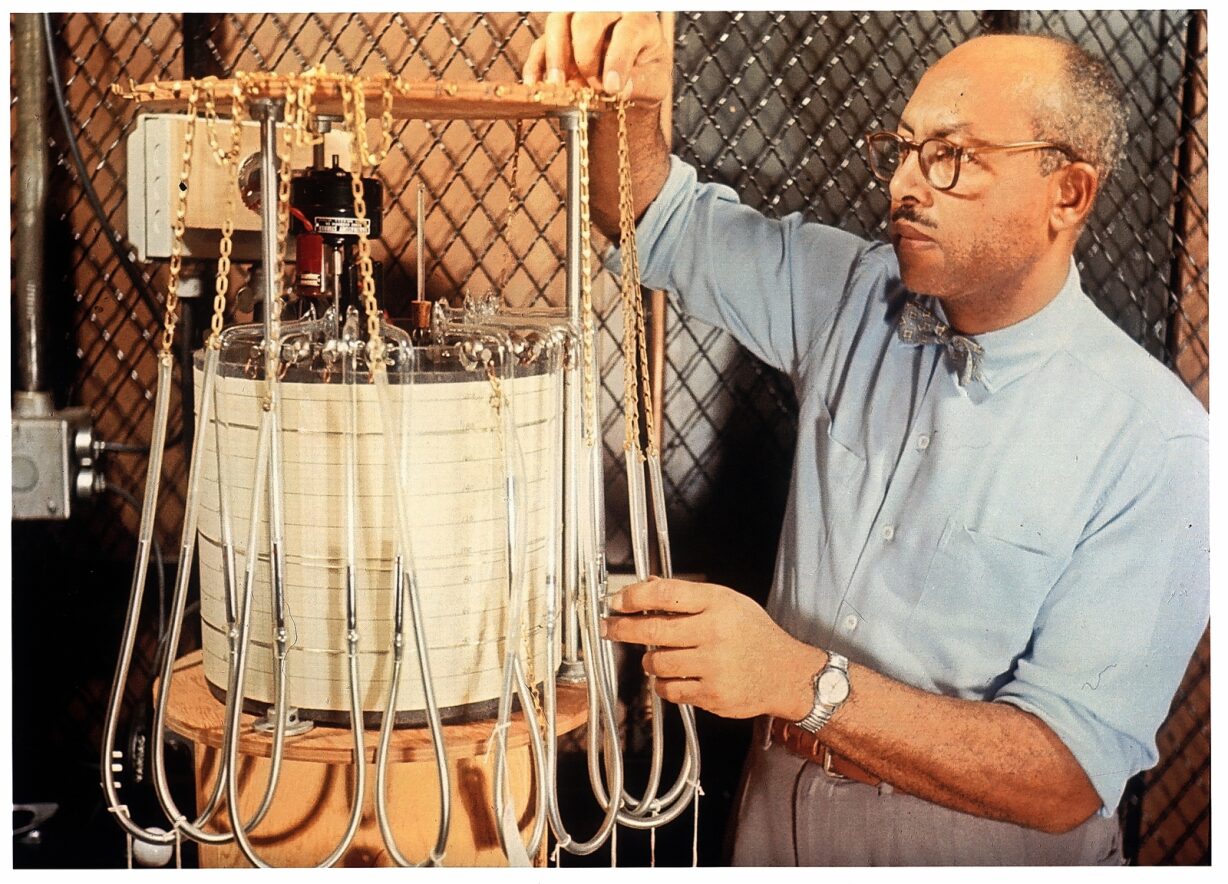
Walter Lincoln Hawkins was a scientist and inventor and environmental justice advocate. He was born on March 21, 1911, in Washington, D.C. He was the grandson of a slave and obtained his secondary school education in the segregated school system of the Jim Crow Era. When he was young, Hawkins was fascinated with how things worked. He would take apart one toy and reassemble it to make another one and make spring-driven toy boats to sail in the reflecting pool in front of the Lincoln Memorial. Hawkins and a fellow eleven-year-old once tried to build a perpetual motion machine, not realizing that it was an impossible task.
Once, Walter built a working radio so he could listen to Washington Senators baseball games. After graduating from high school, he went to Rensselaer Polytechnic Institute in Troy, New York, where he was one of only two Black students at the school. In 1932 he graduated with B.S., in chemical engineering. After graduation he enrolled in graduate school at Howard University where, he earned a master’s degree in chemistry. Professor Howard Blatt, Hawkins’ friend and mentor at Howard, informed him of a special scholarship at McGill University in Montreal, Canada. Hawkins enrolled at McGill, earned his Doctorate in Chemistry in 1938. Hawkins specialized in cellulose chemistry. He would stay at McGill to teach for several more years.
In 1940, Hawkins left McGill to continue his research at Columbia University when he received a fellowship from the National Research Council. Hawkins became the first Black person to join the technical staff of Bell Laboratories, in 1942. His earliest projects at Bell Labs were focused on producing cheap alternatives to rubber that could be made domestically during World War II. By controlling much of the Pacific theater in World War II, the Japanese had cut off much of America’s rubber supply from Southeast Asia. Hawkins contributed to the development of a rubber substitute made from petroleum stock.
After the war, Hawkins began work on new and improved insulation for telephone cables. Hawkins developed a plastic to cover telephone wires. At Bell Labs, Hawkins conducted research on polymers, specifically thermal and oxidative stabilization of polymers for telecommunications. Up until about 1950, telephone cables were coated with a costly, as well as toxic, lead-based material. This was replaced with polyethylene, which was introduced after World War II by the British. Scientists had known that lightweight plastics would be a good alternative, but common plastics did not last long outdoors.
Still, common plastics could undergo chemical reactions that make them brittle and unsuitable for long-term outdoor use. Thus protective additives were required to stabilize these plastic materials. In 1956, Hawkins, in collaboration with Vincent Lanza, invented a plastic coating that could withstand extreme fluctuations in temperature, last up to seventy years, and was less expensive than lead. Upon validation of this technology, telephone lines were installed in rural areas, bringing affordable phone service to thousands of people and reducing the costs of building and maintaining modern telephone systems, and the use of lead, an environmental toxin, was eliminated.
The new material, now known as “plastic cable sheath,” went into production in the 1960s and became widely used as an inexpensive, durable, and safe coating for telecommunications wire. The new coating saved billions of dollars and enabled the expansion of telephone service around the world, and continues to be used today. In addition to his technical efforts in developing the new polymer-based cable sheath, Hawkins considered developing appropriate testing methods to prove the materials would have long lifetimes and minimal plastic waste and towards communicating the underlying chemistry to non-technical audiences interested in expanding telecommunications technology.
In 1963, he became Bell Labs’ Supervisor of Applied Research, and in 1972, became head of his department. Hawkins also helped establish and run the Bell Laboratories Cooperative Research Fellowship Program, which recruits and supports minorities and engineers interested in earning PhDs. From 1976 to 1983, he served as the research director of the Plastics Institute of America. He also taught at New York’s Polytechnic Institute and acted as a technical consultant for chemical and pharmaceutical companies. Among his numerous technical achievements at Bell Labs was his design of a lab test using spectroscopy to predict the durability of a plastic surface.
He also contributed to the development of techniques for recycling and reusing plastics. After retiring from Bell Labs, Hawkins continued to consult with the organization on diversity programming. Whilst working at Bell Labs, he helped establish the Bell Laboratories Summer Research Program for Minorities and Women in 1974, which benefited over 1,200 participants at the time of his death in August of 1992 .Among his many awards, Hawkins was the first Black to be elected to the National Academy of Engineering (1975), and Hawkins also won the International Medal of the Society of Plastics. He was inducted into the New Jersey Inventors Hall of Fame (1992). He is a recipient of the National Medal of Technology and an inductee of the National Inventors Hall of Fame.