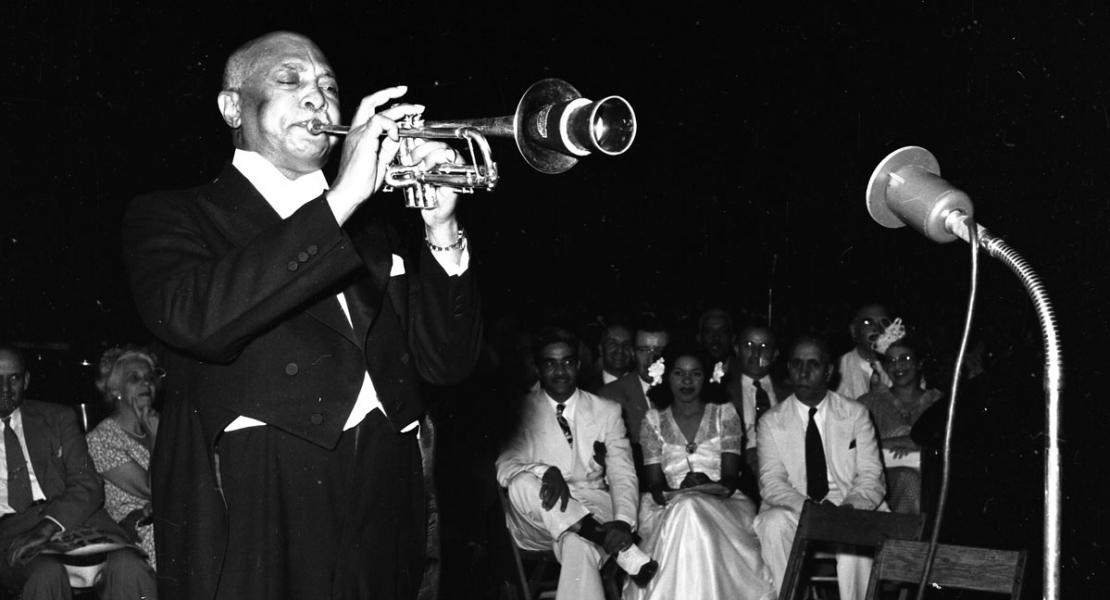
William Christopher Handy
William Christopher Handy, nicknamed W.C., was born in Florence Alabama. The son and grandson of Methodist ministers, the young W.C. Handy showed his love of music at an early age. His maternal grandmother, played organ in his father’s church. Although spiritual music was encouraged in the Handy household, music of a secular nature was frowned upon by Handy’s father. Mr. Handy wanted his son to follow family tradition and become a minister.
Going against family tradition, he began to cultivate his interest in music at a young age and learned to play several instruments, including the organ, piano, and guitar. He was a particularly skilled cornetist and trumpet player. He attended public schools in Alabama and after graduating, became a school teacher and then worked in iron mills throughout the south. Longing to experience the world beyond Florence, Alabama, Handy left his hometown in 1892. He traveled throughout the Midwest, taking a variety of jobs with several musical groups.
In the late 1880’s, Handy organized a quartet in which he performed as the cornetist. The quartet toured and performed at Chicago’s World Fair in 1893. Stopping in St. Louis on their return they found the city overrun with unemployed musicians who gathered in the district near the levee. Handy remained in the city, discouraged and impoverished, but alert to the music and people around him. In spite of his trials in St. Louis, he clung to his dream of becoming a musician, and in the next several years he rose to national prominence.
Handy worked as a teacher in 1900–02, at Alabama A&M. Drawing on the vocal blues melodies of Black folklore, he added harmonization to his orchestral arrangements. He spent some time in Huntsville, Texas as a bandmaster then moved to Clarksdale, Mississippi where he taught band and orchestra at local schools. Handy, who had been playing marches, waltzes, rags, classics and popular music, moved to Clarksdale, Mississippi, to lead a band, the Colored Knights of Pythias, which played for (segregated) audiences of all races in 1903.
In 1909 Handy and the band relocated to the thriving music center of Memphis, Tennessee. He and a partner, Harry Pace, founded the first successful Black-owned music publishing company. The Pace & Handy Music Company, began publishing Handy’s copious output. Handy’s “Memphis Blues” was among the first blues ever published, in 1912. In 1914, he wrote and had published his most famous composition, “St. Louis Blues,” which would become one of the most-recorded tunes of all time.
The Pace & Handy firm relocated to New York in 1918 and was reorganized as Handy Brothers Music Company in 1921. His work helped develop the conception of the blues as a harmonic framework within which to improvise. With his “The Memphis Blues” and especially his “St. Louis Blues”, he introduced a melancholic element, achieved chiefly by use of the “blue” or slightly flattened seventh tone of the scale, which was characteristic of Black folk music. Throughout the 1920s and 1930s W.C. Handy continued to produce hugely popular songs.
The blues genre with which he was synonymous rose to ever greater prominence and influence, ignited by Mamie Smith’s 1920 recording of “Crazy Blues.” Bessie Smith recorded a version of ‘St. Louis Blues’ with Louis Armstrong in 1925, providing Handy with his biggest selling record. He continued to perform, touring with Jelly Roll Morton and organizing a Blues Concert at Carnegie Hall in 1928.
The following year he co-produced a film of Bessie Smith performing ‘St. Louis Blues’. This was one of the first ‘talkies’ and it is a fantastic document of the ‘Harlem Renaissance’ as Black culture became available to America and the world. Revered as the “Father of the Blues“, Handy’s legacy permeates modern music. He copyrighted over 150 spiritual and folk songs and 60 blues compositions. His street in Memphis has been renamed W.C. Handy Park, and the annual W.C. Handy Blues Awards are the highest honor bestowed in the genre.
.