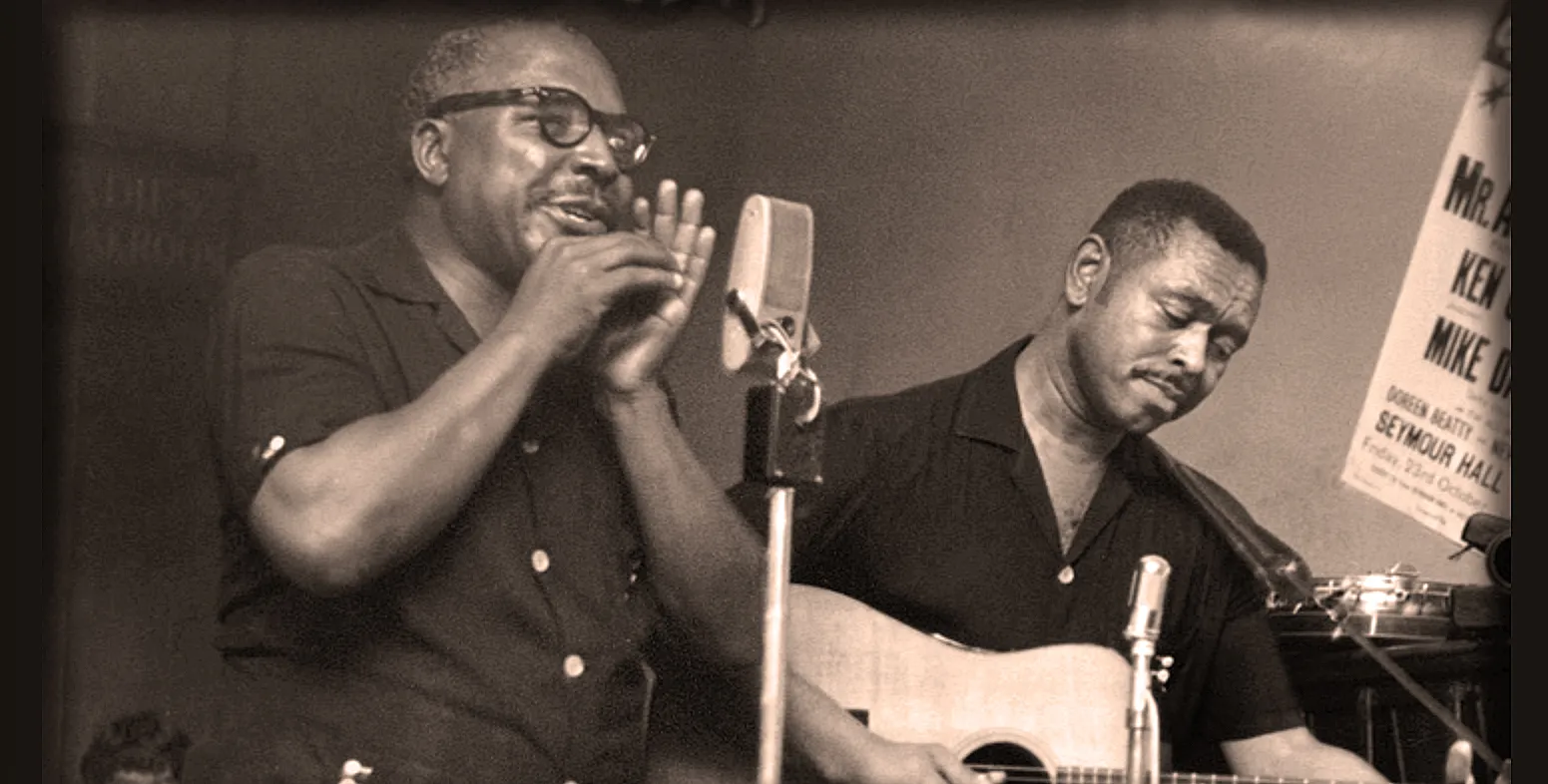
Sonny Terry & Brownie McGhee, had a 35-year-long partnership that helped to define Folk/Blues. Their Piedmont style blues has a very different feel to delta blues and its effect on modern music has a very different genesis to the route through Chicago that gave us Blues-rock. New York was the focal point for this genre to spread to the world and when this process was getting started, nobody was busier in the studio, on stage and on tour than Sonny Terry and Brownie McGhee. Sonny Terry and Brownie McGhee, have been performing together since 1939 -probably longer than any working blues or folk duo or group.
Sonny Terry, was born Saunders Terrell in 1911 in Greensboro NC. but he wasn’t born blind. He lost his sight in two separate accidents, one when he was 5 and the other when he was 16. That left him with extremely limited options for making any sort of feasible living, so he took to the streets armed with his trusty harmonicas. In 1934, the young Sonny was busking on street-corners in nearby Durham when he met and befriended guitarist Blind Boy Fuller. They played together nearly every day and Sonny was soon persuaded to move to Durham.
He had developed an energetic style of playing, with lots of breathy whoops, snorts and cries. He later called his style “whoopin’”. In 1937, Fuller had a recording date in New York and he took Sonny along to Vocalion studios to play on the session. Returning to Durham, NC., Sonny met the man who was to become his long term playing partner, Brownie McGhee. A friendship developed between the two men and following Fuller's death in 1941, Terry and McGhee moved to New York. The change proved fruitful as they immediately found steady work, playing concerts both as a duo and solo.
Brownie McGhee, born Walter McGhee was born in 1915 and raised in Knoxville TN. When he contracted polio, his brother Granville (or ‘Stick‘) would push him round in a cart. When he was able to walk again, Brownie dropped out of school to play guitar with his father’s group, The Golden Voices Gospel Quartet. He took up the life of a wandering Bluesman, developing a fine finger-picking style in the manner of his hero Blind Boy Fuller.
Brownie decided to go to Durham to meet Fuller and, of course, met Sonny too. Fuller’s manager JD Long was impressed with Brownie’s playing and arranged for him to record for the Okeh label in Chicago in 1940. JD also encouraged him to play with Sonny when Fuller was not available, so when Blind Boy Fuller died from blood-poisoning in 1941, the pair’s response was to record Sonny’s song, ‘The Death of Blind Boy Fuller’. Brownie was even persuaded to appear as Blind Boy Fuller II for a while, but he didn’t want a career impersonating his mentor.
Sonny and Brownie had formed a solid working partnership so they decided to get out of Carolina, and moved to New York together in 1941. There was an influx of Blues players into New York just after WWII ended, and they found a flourishing club scene for jazz, boogie-woogie, blues and folk music. Sonny and Brownie, found a welcome in the left-leaning, anti-racist bohemian life of the metropolis. There they joined Woodie Guthrie, Cisco Houston, Lead Belly, Lee Hays and Pete Seeger in an artistic mix of poets, writers and actors.
In those early days Sonny and Brownie often played and recorded together, but they also had separate careers. Both went on stage as actors. Sonny spent two years in a production of ‘Finnegan’s Rainbow’ and Brownie spent even longer in Tennessee Williams’ ‘Cat on a Hot Tin Roof’. It was the folk boom of the late '50s and early '60s that made Brownie and Sonny household names (at least among folk aficionados). They toured long and hard as a duo, cutting a horde of endearing acoustic duet LPs along the way.