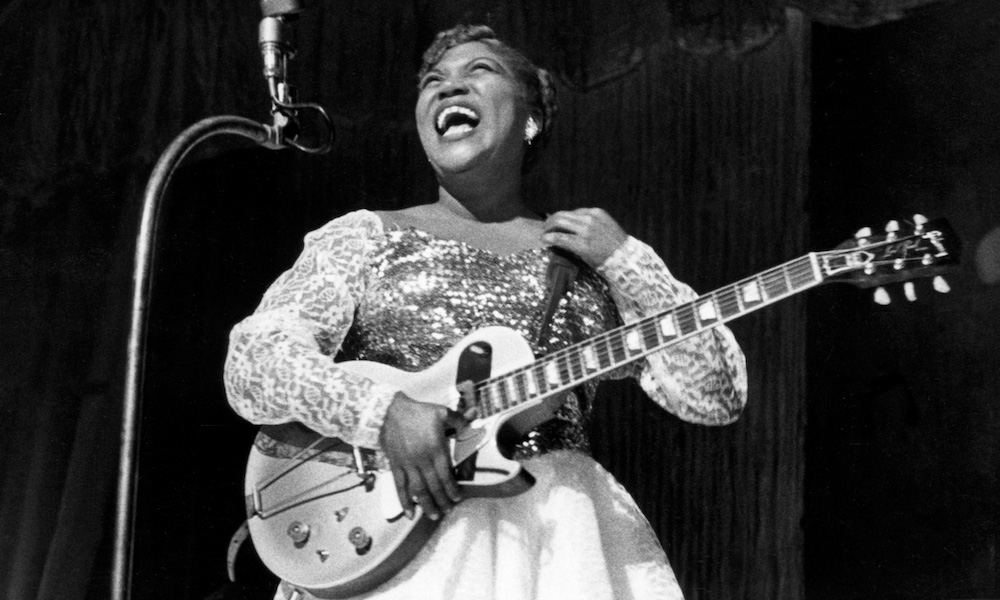
Sister Rosetta Tharpe
One of the most influential gospel artists of all time, Sister Rosetta Tharpe turned the electric guitar into an instrument of praise. In the process, she became an international gospel artist, broke down barriers for women in instrumental music and was among the first to alert major record companies to the power and popularity of gospel singing. Rosetta was raised in the Church of God in Christ (COGIC). She and her mother, an evangelist named Katie Bell Nubin, moved to Chicago in the 1920s.
The marriage did not last long. By 1938, Rosetta had taken her talent into venues such as the Cotton Club, where she became part of the Harlem club’s famous revue. Rosetta made her first records for Decca in October 1938. The first one, “Rock Me,” was a version of Thomas A. Dorsey’s “Hide Me in Thy Bosom.” Her version drew ire from the Father of Gospel Music, who felt gospel songs were not designed for anything but holy dancing.
Her Cotton Club performances were disparaged by churchgoers who believed a sacred singer should not appear in nightclubs. Nevertheless, music impresario John Hammond selected Rosetta to help represent sacred music at his 1938 From Spirituals to Swing concert at Carnegie Hall. Rosetta moved effortlessly between sacred and secular. She was a vocalist with orchestras led by Lucky Millinder and Benny Goodman, but continued to sing and play guitar in COGIC churches. One of her biggest gospel hits came in late 1944, with Strange Things Happening Every Day. With that recording she holds the honor of singing the first Gospel song to crossover on the Billboard race charts in 1945.
This Decca recording, accompanied by Sammy Price and his jazz combo, reached No. 2 on the Hit Parade. From that point forward, Rosetta stuck strictly to Christian musical fare, though her electrifying guitar picking would influence future rock ’n’ roll guitarists. In many ways she can be considered the Godmother of Rock n Roll. She is attributed for being responsible for the careers of the many of the biggest rock giants to come after her.
Rosetta teamed up with vocalist Marie Knight of Newark, New Jersey, in 1946. Among the duo’s gospel hits were Didn’t It Rain and Up Above My Head. Rosetta’s 1949 rendition of White Christmas hit No. 8 on Billboard’s R&B Hit Singles chart and earned her and the Rosettes a coveted spot on CBS Television’s Supper Club with Perry Como on January 1, 1950. In 1957, Rosetta embarked on a tour of Europe, where she performed alongside Chris Barber’s Jazz Band. Because several future rock performers attended Rosetta’s concerts, some consider her English appearances to have helped ignite the flame of the 1960s British Invasion.