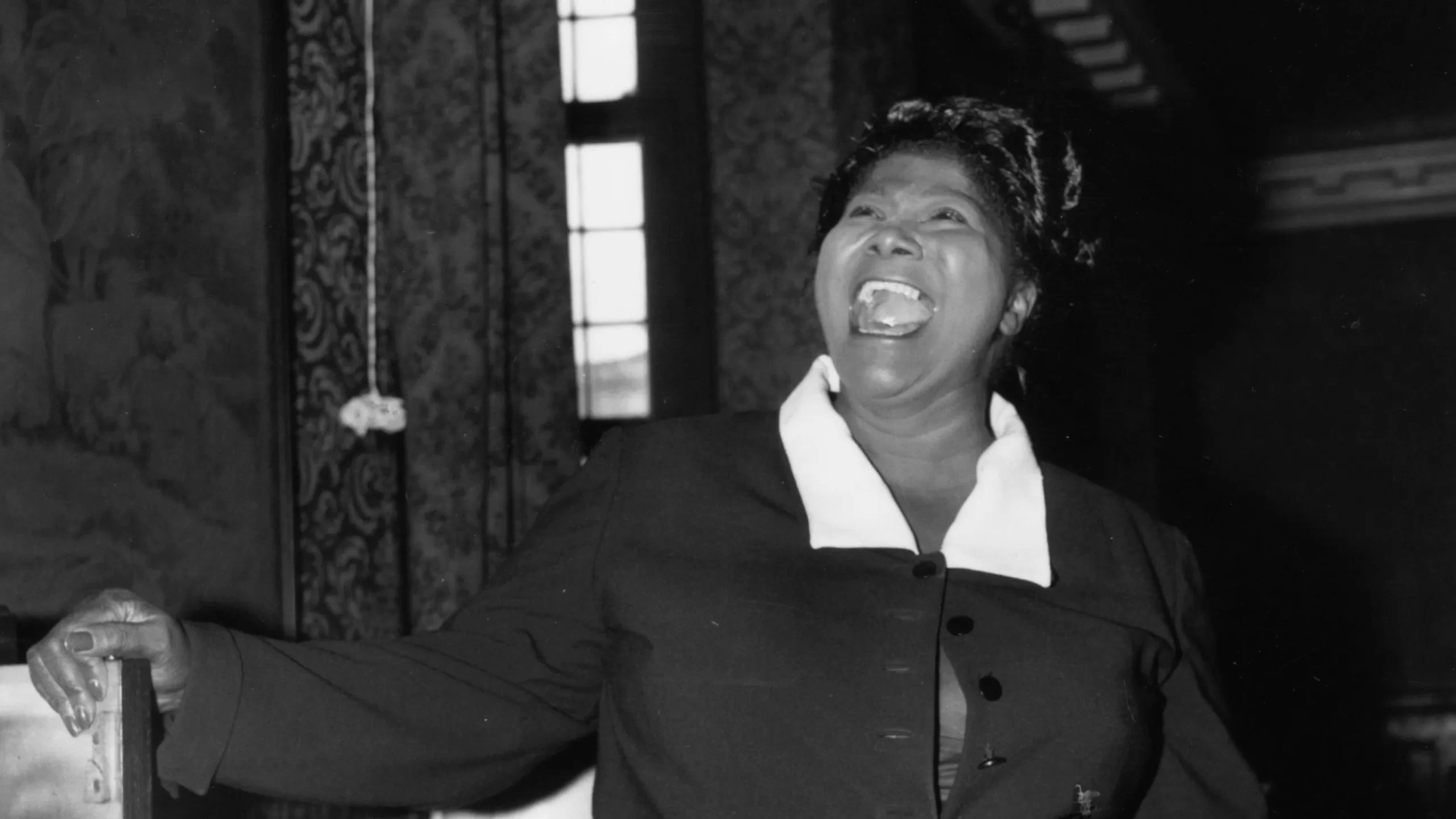
Mahalia Jackson
Mahalia Jackson is viewed by many as the pinnacle of gospel music. She is widely considered one of the most influential vocalists of the 20th century. Mahalia Jackson was born in New Orleans, Louisiana, on October 26, 1911. Her mother died when Jackson was five. She was raised by an extended family of one brother, six aunts, and several half-brothers and sisters, children of her father. Her singing began at the age of four in her church, the Plymouth Rock Baptist Church in New Orleans. Some of her relatives were entertainers and played blues and rags in Ma Rainey’s Circus.
The strong musical life of New Orleans in the early 1900s made a profound impression upon the young Mahalia Jackson. In addition to the sacred music, she was surrounded by music of the Mardi Gras, street vendors, and the bars and dance halls of New Orleans’s Black community. Her early style blended the freedom and power of gospel with the stricter style of the Baptist Church. Though influenced by jazz and blues, she was drawn to gospel music and firmly established herself as a gospel singer. She was influenced by such famous singers as Bessie Smith, Ida Cox, Enrico Caruso and Ma Rainey, and her own style began to emerge into a more soulful expression.
When Mahalia was 16, she moved to Chicago. It was here that she started on the road to becoming a professional musician. Mahala was invited to join the Choir at Salem Baptist Church in Chicago. As a result of this affiliation, she was befriended and begun touring with the Johnson Brothers, an early professional Gospel group. She paid her dues by recording with local labels, but it would take 20 years for her to rocket to fame. In 1929, Mahalia met the composer Thomas A. Dorsey, known as the Father of Gospel Music.
They toured the Gospel Music circuit for 14 years together. One of Dorsey’s compositions, “Take My Hand, Precious Lord,” became Jackson’s signature song. Jackson made her first gospel recording in 1931. In 1931, Jackson recorded “You Better Run, Run, Run”. Not much is known about this recording, and it is impossible to find. She took part in a cross- country gospel crusade and began to attract attention in the Black community with such songs as “He’s Got the Whole World in His Hands,” “I Can Put My Trust in Jesus” and “God Gonna Separate the Wheat From the Tares.” This was her first recording, in 1934.
At age 26, Mahalia’s second set of records were recorded in 1937. Jackson was accompanied by Estelle Allen on the piano and sang songs like “God’s Gonna Separate The Wheat From The Tares,” “My Lord,” “Keep Me Everyday,” and “God Shall Wipe All Tears Away.” Unfortunately the records did not sell enough and Decca dropped her. However, a few years later she achieved much greater success. In 1946, Mahalia Jackson signed with Apollo Records.
While she was with Apollo records, she recorded several records that initially had slow sales, but in time would become legendary hits. In 1947, Mahalia Jackson was given the title “Queen of Gospel Music,” for her recording of “Move on up a Little Higher”. The song became the first top-selling gospel song and catapulted Jackson’s career. The record was so popular stores could not keep it in stock. That recording sold an astonishing eight million copies. The song’s success skyrocketed her to fame in the U.S. and later in Europe.
At the outset, however, Miss Jackson experienced difficulty in getting her music accepted in the larger, more middle-class Black churches because of the bounce and vigor with which she performed. But as her fame spread, these churches opened their doors to her, especially when she sang some of the more traditional songs, such as “Just as I Am” and “I Have a Friend.” Though her recordings were rarely played on any but gospel and Christian radio, nevertheless she had a great influence on not just her genre but also on other younger artists. She promoted and mentored both Aretha Franklin and Della Reese – the latter joined Jackson’s gospel group at age 13.
In 1950, Mahalia became the first gospel singer to sing at Carnegie Hall in New York. As she became more famous, she continued to attend and perform in Black churches, often for free, to connect with congregations and other gospel singers. Later in 1952, she toured Europe, and sang to capacity crowds. In 1954, Mahalia signed a contract with Columbia Records; Her debut album at Columbia was called “The Worlds greatest Gospel Singer.” Jackson sang in two Hollywood movies, St. Louis Blues in 1958 and Imitation of Life in 1959.
She also performed at President John F. Kennedy’s inauguration in 1961. Closely associated with the Black civil rights movement, Miss Jackson was chosen to sing at the Rev. Dr. Martin Luther King Jr.’s March on Washington rally at the Lincoln Memorial in 1963. The song, which Dr. King had requested, came as much from Miss Jackson’s heart as from her vocal cords. Her powerful voice was used to support the Civil Rights Movement in the 1950s and 1960s when she sang for dozens of fundraising benefits. Jackson’s voice is noted for being energetic and powerful, ranging from contralto to soprano, which she switched between rapidly.
She resisted labeling her voice range instead calling it “real strong and clear“. One of her last public performances was at the funeral of her friend, Martin Luther King, Jr., in Atlanta, Georgia, in 1968. After King’s death in 1968, Jackson largely withdrew from public political activities. Mahalia Jackson received multiple Grammy Awards, including the Lifetime Achievement Award (1972). She was posthumously inducted into the Gospel Music Hall of Fame in 1978. She has a star on the Hollywood Walk of Fame.
Jackson is remembered for her strong, soul-like delivery, her deep commitment to her faith, and her lasting influence on musicians from all of different types of musical genres. Singing these and other songs to Black audiences, Miss Jackson was a woman on fire, whose combs flew out of her hair as she performed. She moved her listeners to dancing, to shouting, to ecstasy. Many of Miss Jackson’s songs were evocations of religious faith and were intended, in keeping with her own profound belief in God. Her rhythms might be syncopated, but her soaring voice aimed to obey the psalmist’s injunction to “make a joyful noise unto the Lord.“