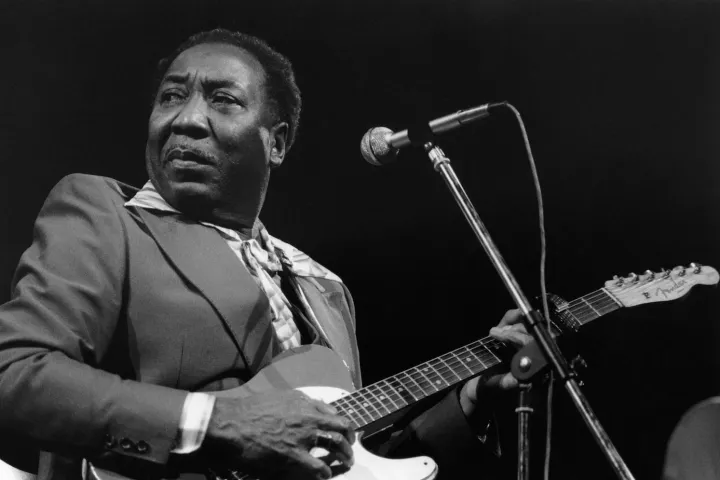
Muddy Waters was born McKinley Morganfield was a blues guitarist and singer who played a major role in creating the post-World War II electric blues. Waters acquired his nickname because as a young child he liked to play in the mud. When he began his musical career he adopted Muddy Waters as his legal name. As a young man, he drove a tractor on the sharecropped plantation, and on weekends he operated the cabin in which he lived as a “juke house,” where visitors could party.
Waters was influenced by Mississippi Delta musicians Robert Johnson and Son House. He started his career as a blues singer and musician on the harmonica and then switched to the guitar. By the early 1940s Waters had earned enough as a performer to open a small club, where he expressed his musical talent in daily performances. After he moved from Mississippi to Chicago in 1943, he was mentored by Big Bill Broonzy. Waters soon realized that the only way to be heard in the South Side bars and house parties he booked was to be electrified.
Working in a Chicago factory by day and playing in blues clubs at night, Waters soon became a fixture on the city’s south side during and immediately after World War II. He probably started playing electric because, "couldn’t nobody hear you with an acoustic" in the south side clubs. In 1944 he bought his first electric guitar, which cut more easily through the noise of crowded bars. This amplification and big beat sound, mixed with the traditional style and then layered with Muddy’s earthy vocals proved to be a wickedly successful mix.
In 1948, Waters made his first recordings with the new Chess/Aristocrat label, “I Can’t Be Satisfied” and “Feel Like Going Home”. Waters predominantly using the electric instruments that would be characteristic of his work. This began a prodigious partnership that would produce perhaps the most widely-recognized body of work in the Chicago Blues genre. By the early 1950s Waters was king of the Chicago blues scene and was recording with one of the best and hottest blues band.
His band found success on the R&B charts. His single, “Hoochie Coochie Man” reached number eight and “I Just Want to Make Love to You” reached number four. The success of Waters's ensemble paved the way for others in his group to break away and enjoy their own solo careers. In 1952 Little Walter left when his single "Juke" became a hit, and in 1955 Jimmie Rogers quit to work exclusively with his own band. By the late 1950s, rock and roll and rhythm and blues supplanted blues as the major musical genres for his mostly Black audiences.
Waters left for England in 1958 where he was a major success. Many White folks in America, after hearing about his triumph in England, rushed to the stores to buy his albums. Then in 1960, Waters and his electric style blues transformed the Newport Folk Festival into a smashing blues bash. Waters kept performing in Europe and America, more and more for the young White public.
He expressed dismay when he realized that members of his own race were turning their backs to the genre while a White audience had shown increasing respect for the blues. In 1977 Johnny Winter convinced his label, Blue Sky, to sign Waters, the beginning of a fruitful partnership. Waters' "comeback" LP, "Hard Again", was recorded in just two days and was a return to original Chicago sound he had created 25 years earlier. In 1981, he recorded his final album King Bee.