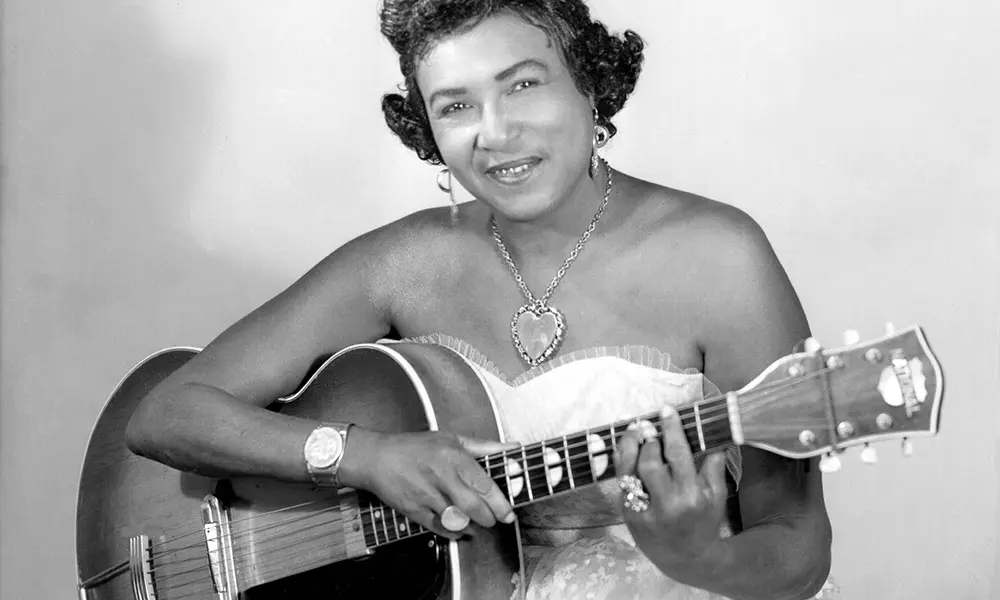
Memphis Minnie
Born Lizzie Douglas in rural Algiers, Louisiana in 1897, Memphis Minnie rocked the blues with guitar in hand and a voice both honeyed and forceful. When she was ten years old, her family moved to Walls, Mississippi, about twenty miles south of Memphis, Tennessee. Minnie started playing banjo at age seven and got her first guitar a couple years later. In 1910, at the age of 13, she ran away from home to live on Beale Street, in Memphis. She played on street corners for most of her teenage years, occasionally returning to her family’s farm when she ran out of money.
Her sidewalk performances led to a tour of the South with the Ringling Brothers Circus from 1916 to 1920. As skilled, charismatic and raunchy as her many male peers, Minnie challenged their monopoly on the genre with her songs and performances. She moved to Chicago in the 1930, where she famously beat Big Bill Broonzy in a guitar picking contest on his own turf. She began performing with Joe McCoy, whom she married in 1929. After a talent scout heard the duo performing for tips in a barbershop, they made their first recordings that year, billed as “Kansas Joe and Memphis Minnie.”
By 1935, Minnie was established in Chicago and had become one of a group of musicians who worked regularly for the record producer and talent scout Lester Melrose. Other blues performers Minnie collaborated with included Georgia Tom, Tampa Red, Black Bog, and Blind John Davis. Minnie’s records covered a wide range of subject matter. Many of her songs were openly sexual and delivered in her signature confident, sassy voice. Other topics included crime, voodoo, trains, and health. Throughout all her tracks, she was instrumentally and lyrically in tune with the lives of Black Americans.
By 1941 Minnie had started playing electric guitar, and in May of that year she recorded her biggest hit, “Me and My Chauffeur Blues“. As a guitar player and blues singer, she ranks along with the blues’ best female artists, as well as with the best male blues artists as well. She recorded around 200 songs, some of the best known being “When the Levee Breaks“, “Bumble Bee” and “Nothing in Rambling“. She was among the first 20 performers elected to the Hall of Fame in the inaugural W. C. Handy awards in 1980. Memphis Minnie ranks with Ma Rainey, Bessie Smith, and Big Mama Thornton as one of the blues’ most influential and historically significant female artists.
One of the rare women of her era to gain prominence as a guitarist, Minnie overcame considerable odds to achieve success, battling both racism and sexism. She has been heralded as a champion of feminist independence and empowerment. Minnie’s influence was particularly strong among female musicians, as she uniquely shaped her life in a time of limited possibilities offered to African American women. Her style was rooted in country, but she helped form the electric Chicago blues, as well as incorporate what would later be R&B and rock ’n’ roll into her music.