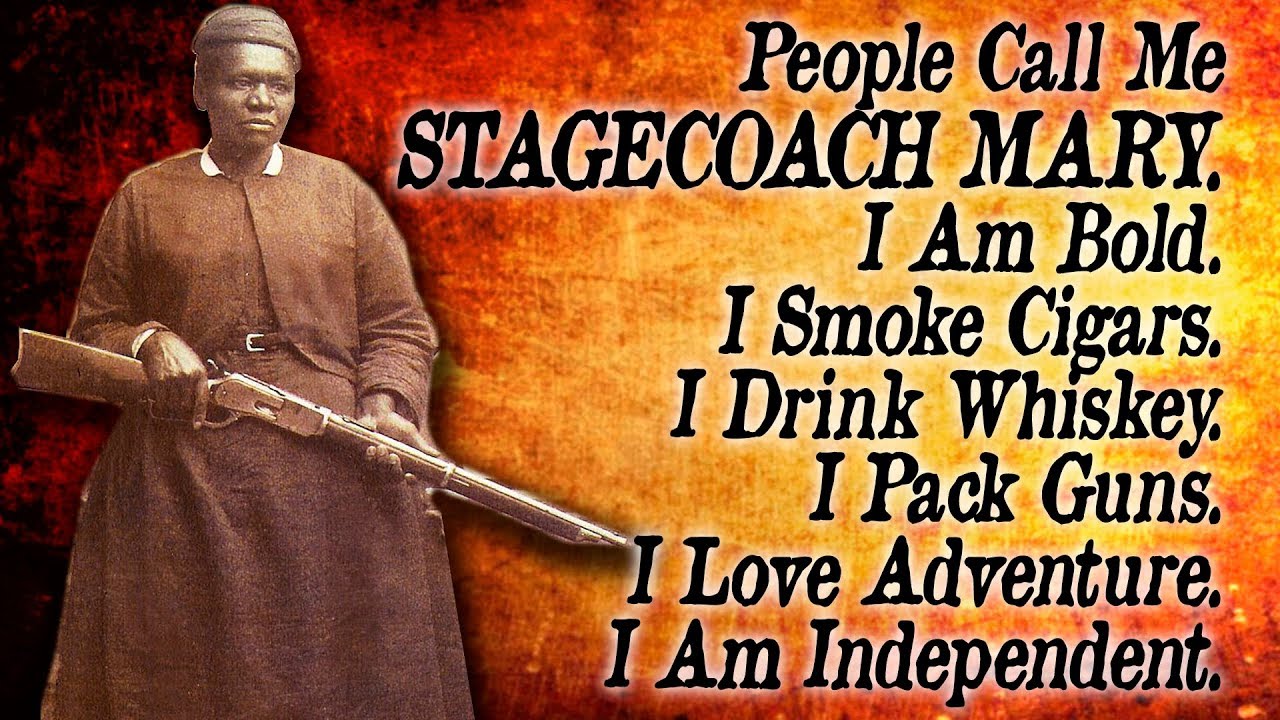
In all the west, Mary Fields had no equal. She was a 6ft 200lb, cigar smoking, gun-totin' pioneer who settled her arguments with her fists. Once in a while she would settled her arguments with her six-shooter. Fields was born into slavery, in around 1832, in Hickman County, Tennessee. Like many other enslaved people, her exact date of birth is not known. As a young girl Mary outgrew most of the boys her age and by 18-years-old she struck an imposing figure at 6ft and over 200 pounds.
She formed a lifelong friendship with Sarah Teresa Dunne, a relative of her master Edmund Dunne. In 1865, with the passing go the 13th Amendment and the abolishment of slavery, 33-year-old Mary became a free woman. For a number of years, she found employment aboard the steamboat Robert E Lee, until she fortuitously bumped into her former master. He informed her that her old friend Sara had joined a convent in Toledo, OH. Without hesitation, Mary packed up her belongings and traveled north to join her friend.
Sarah Teresa Dunne was now Mother Amadeus Dunne, the convent’s Mother Superior. For around the next 15 years, she dedicated herself to her work at the convent for which she received room, meals, and fifty dollars a year. When the nuns headed to Montana to to establish a school for Native American tribes, Mary remained in Toledo. In 1885, Mother Amadeus became quite ill and asked that Mary be summoned from Ohio. Mother Amadeus had pneumonia and she wanted the comfort of her friend and companion.
Arriving in Cascade, Montana in 1885, she was the first Black woman to ever set foot in the small town. After Mother Amadeus got better, Mary stayed and began taking care of repairs to the school, doing chores, and hauling supplies from the rail station to St. Peter’s Mission. Refusing the assistance of men, Mary would carry immensely heavy loads of lumber and stone on her back. When construction the mission was complete, Mary settled there with the sisters and began hauling freight on a stagecoach for a living.
She was a valued staff member, but unfortunately, Mary was known to speak her mind. News of her subversive behavior reached the bishop, who raised serious concerns about Fields’ habits of drinking, smoking, and shooting guns. Because of the severe Montana weather, Mary dressed like a man, except for a long dress and apron that she wore over men's pants. This covering allowed her to take on multiple roles regarded as “men’s work” at the time. Work such as maintenance, repairs, fetching supplies, laundry, gardening, hauling freight, growing vegetables, tending chickens, and repairing buildings.
Mary eventually became the forewoman. Native Americans called Fields "White Crow", because "she acts like a White person but has Black skin". Life in a convent was placid, but Fields' hearty temperament and habitual profanity made the religious community uncomfortable. In 1894, after several complaints and an incident with a disgruntled male subordinate that involved gunplay, the bishop barred her from the convent. Fields was on her own, and she set about living a life that was shocking by 19th-century standards.
She took in laundry and did odd jobs, started restaurant businesses and became known for liking hard liquor and gunfights. Her generous nature of serving food whether people could pay or not led to it being forced to close. Her friend Mother Amadeus talked to several people about a position for Mary. In 1895, she got a contract from the postal service to become a star route carrier—an independent contractor who carried mail using a stagecoach donated by Mother Amadeus. It suited Mary Fields to a tee.
Mary built a reputation of being fearless while working as a mail carrier. As a star carrier, her job was to protect the mail on her route from thieves and bandits and to deliver mail. Delivering mail in the Wild West carried immense dangers and involved long arduous horseback journeys through hostile territories. A successful delivery was valued more than the life of the carrier. A popular saying among postal service workers of the time was that the horse and rider should perish before the mail.
She carried a rifle and a revolver. She met trains with mail, then drove her stagecoach over rocky, rough roads and through snow and inclement weather. When the snow was too deep for horses she would strap the mail bags to her back and deliver them on foot. Stagecoach Mary never missed a day of work. In her 10 years of service, she went from an outcast to one of Cascade’s most respected citizens. Mary Fields was only the second woman in the United States (and the first Black woman) to serve in that role.
After ten years of delivering the mail, Mary decided it was time to retire, and she settled down in Cascade, Montanta, and opened a laundry business. During her time in Cascade, Mary became beloved by the locals for her fearlessness and generosity, as well as for her kindness to children. Mary was the only African-American living in Cascade at the time, and the town apparently loved her. On her birthday, (she didn't know the exact date, so she picked a day out of the year) the schools closed so that the children could celebrate that day with her.
She often ended her day with a drink and a cigar at the local saloon with the men of the community. There, she earned respect for her business savvy. One day a fellow who had not paid is laundry bill came into the saloon. Mary saw him, stepped up behind him and knocked the man down with one blow. She then put her foot on his chest and wouldn’t let him up until his bill was paid. After that, customers made sure their laundry bill was paid up. Mary Fields was a person who lived a life of freedom and courage. She refused to abide by the gender and race roles of the time and lived life on her terms.