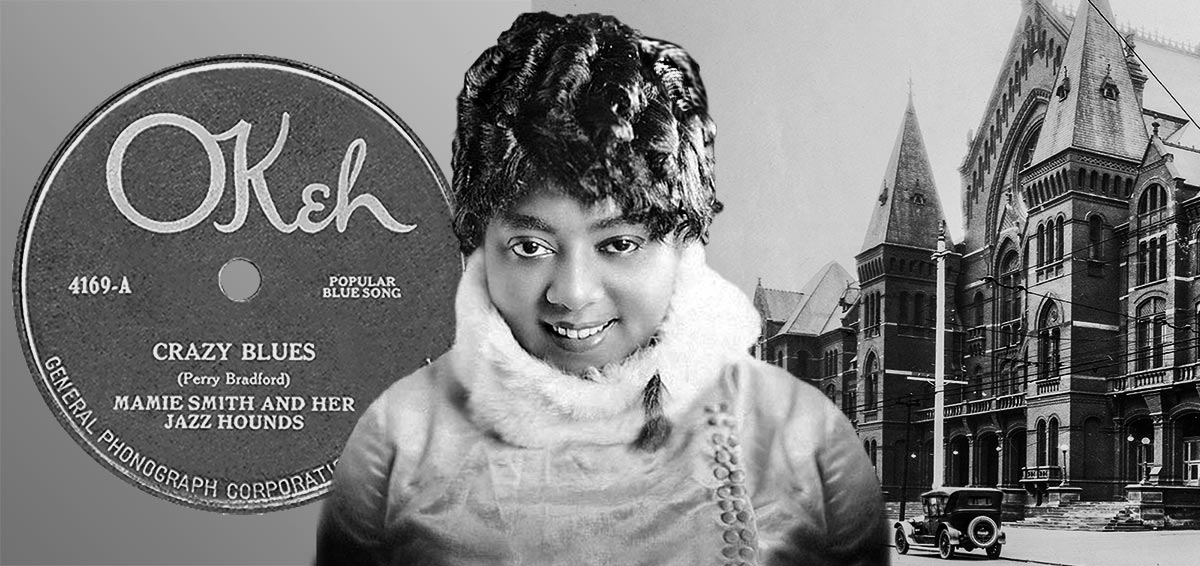
Mamie Smith
Mamie Smith was the first true queen of the blues. She created a sensation with the phenomenal success of her 1920 recording of “Crazy Blues”, and “It’s Right Here for You” and her extravagant stage shows. The success of “Crazy Blues” prompted other record companies to try to find female blues singers that could match the sales of “Crazy Blues”. It was a very important record, because it opened the doors of the recording industry to African-Americans, whether they were Blues, Jazz or popular singers and musicians.
Mamie Smith was born Mamie Robinson in Cincinnati on September 19, 1890, but her family moved to New York City when she was a child. She began performing in vaudeville shows as a teenager, and by the early 1910s. Smith sang in nightclubs and theaters throughout the city, often accompanied by pianist Willie “The Lion” Smith. She started performing as a singer in Harlem at venues such as Baron Wilkin’s Little Savoy Club, Leroy’s, Edmunds, Percy Brown’s and Banks’ Place.
Smith herself really wasn’t that much of a Blues singer, she was more of a vaudeville performer, although she included Blues and Jazz numbers as part of her act. In 1920, Okeh Records invited Mamie Smith to record two songs: “That Thing Called Love” and “You Can’t Keep a Good Man Down”. The records sold well, and Okeh invited Smith to record again. In August 1920, she recorded “Crazy Blues,” a song written by Perry Bradford. The song became an unexpected hit, selling more than 75,000 copies in its first month. It became the first blues recording by a Black woman to be commercially successful. Total sales of the record were said to top a million.
Perry Bradford put together a band he called the “Jazz Hounds“, which featured such jazz notables as Coleman Hawkins, Bubber Miley, Johnny Dunn, and more. Smith put on quite a show that included trapeze acts, dancing, comedy, lavish costumes and jewelry as well as music. Smith continued to record for Okeh until 1923. She continued to record for several years, blues, jazz, and popular songs, often accompanied by top musicians of the day, including Louis Armstrong and Sidney Bechet.
Mamie set the standard for female blues singers that followed in her foot steps. Nearly every other Classic Blues singer of the 1920s borrowed something from her act or styled themselves to achieve her success. Mamie Smith’s contributions to the music industry and African American culture are significant. Her recordings helped to popularize the blues and paved the way for other African American women to enter the recording industry. She also challenged racial stereotypes and paved the way for greater representation and opportunities for African American artists.