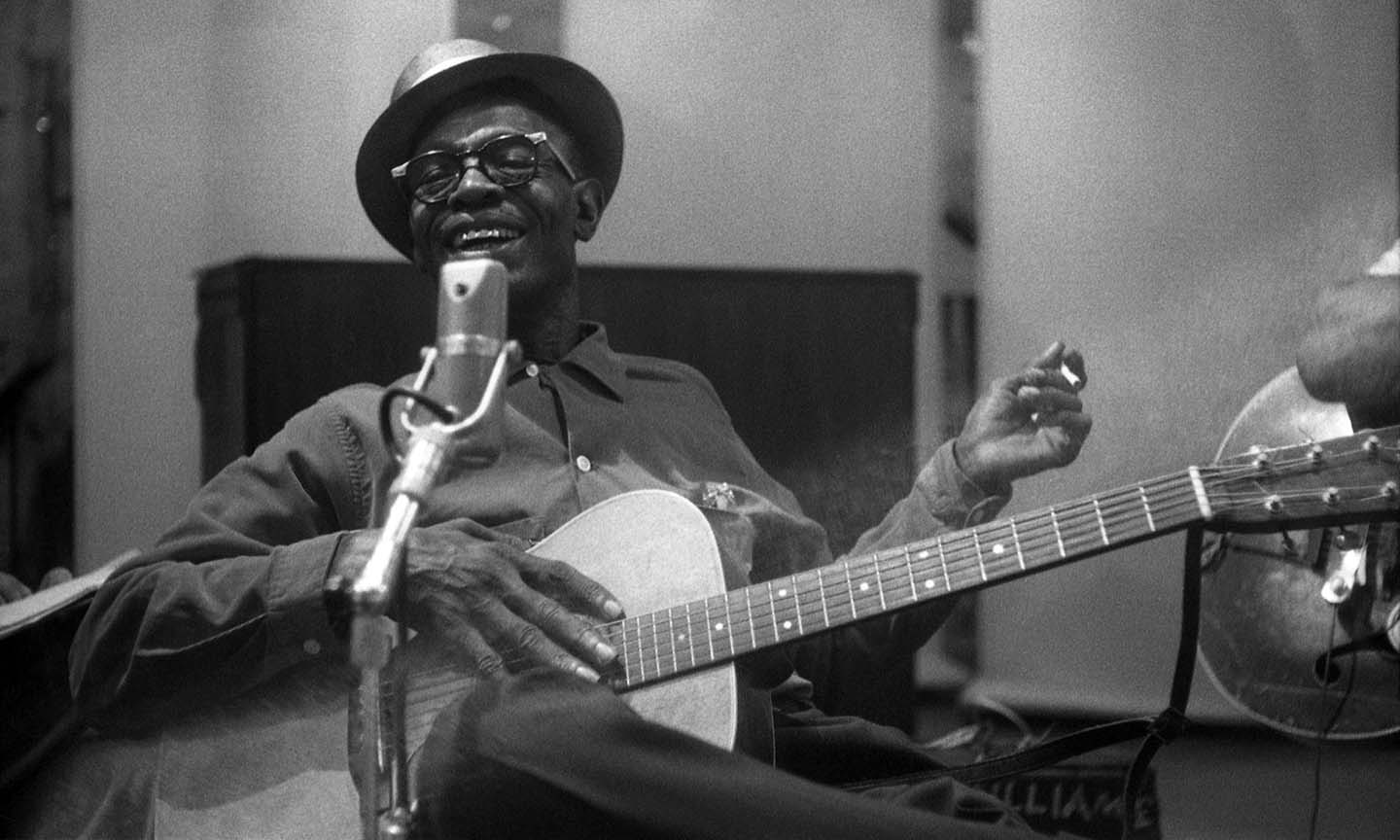
Lightnin Sam Hopkins
Lightnin Sam Hopkins was born Samuel John “Lightnin” Hopkins on March 15, 1912 in Centerville, Texas. The family moved to Leona in Texas where he grew up. As a child, he was immersed in the sounds of the blues. He developed a deep appreciation for the music at the age of 8. He soon dropped out of school and started work on a plantation. In 1920 he watched Blind Lemon Jefferson at a picnic in Buffalo, Texas, which inspired him to make a “cigar box” guitar. Hopkins accompanied Blind Lemon Jefferson on guitar at informal church gatherings.
During that time, Jefferson reputedly never let anyone play with him except Hopkins. It was during these sessions, Hopkins learned a lot about music and performing for audiences. He went on to learn from his distant older cousin, the country blues singer Alger “Texas” Alexander. Their partnership continued until the mid 1930’s when Hopkins was sent to Houston County Prison Farm, for some unknown offense. After serving his time, Hopkins moved to Houston in an unsuccessful attempt to break into the music scene.
He, like many other bluesmen, began playing at picnics and dances at local farms on a Friday and Saturday night. Later he took to hoboing throughout Texas. By the early 1940s, he was back in Centerville, working as a farm hand. However, something in him would not allow him to give up on the blues. So, he took a second shot at Houston in 1946. In 1946, Hopkins and Alexander were given the chance to record by an Aladdin Record’s talent scout. Inexplicably only Hopkins followed up the offer when Lightnin’ made the trip out west to Los Angeles on November 4, 1946.
He cut “Katie Mae Blues,” with pianist Wilson “Thunder” Smith. It was a hit in the Southwest, so Aladdin got him back into the studio a year later and he recorded “Short Haired Women,” which sold around 40,000 copies. At the same time as recording for Aladdin, he cut records for Goldstar in Houston. Sometimes it was the same songs. In fact, he would go on to make records for over twenty different labels during his long recording career. He made the R&B charts in 1949 with “Tim Moore’s Farm”.
Over the course of the next three years he had four more hits, the biggest was “Shotgun Express,” which made No.5 on the R&B charts. Hopkins took a hiatus from recording between 1954 and 1959, although he did make a couple of records in 1956. Hopkins later traveled to Los Angeles, where he accompanied the pianist Wilson Smith. The duo recorded twelve tracks in their first sessions in 1946. An Aladdin executive decided the pair needed more dynamism in their names and dubbed Hopkins “Lightnin” and Wilson “Thunder.”
It has been estimated that he recorded as many as a thousand songs throughout his career. He made his debut at Carnegie Hall on October 14, 1960, alongside Joan Baez and Pete Seeger, performing the spiritual “Mary Don’t You Weep”. In 1968, Hopkins recorded the album Free Form Patterns, backed by the rhythm section of the psychedelic rock band 13th Floor Elevators. Hopkins’s style was born from spending many hours playing informally without a backing band. His distinctive fingerstyle technique often included playing, in effect, bass, rhythm, lead, and percussion at the same time.