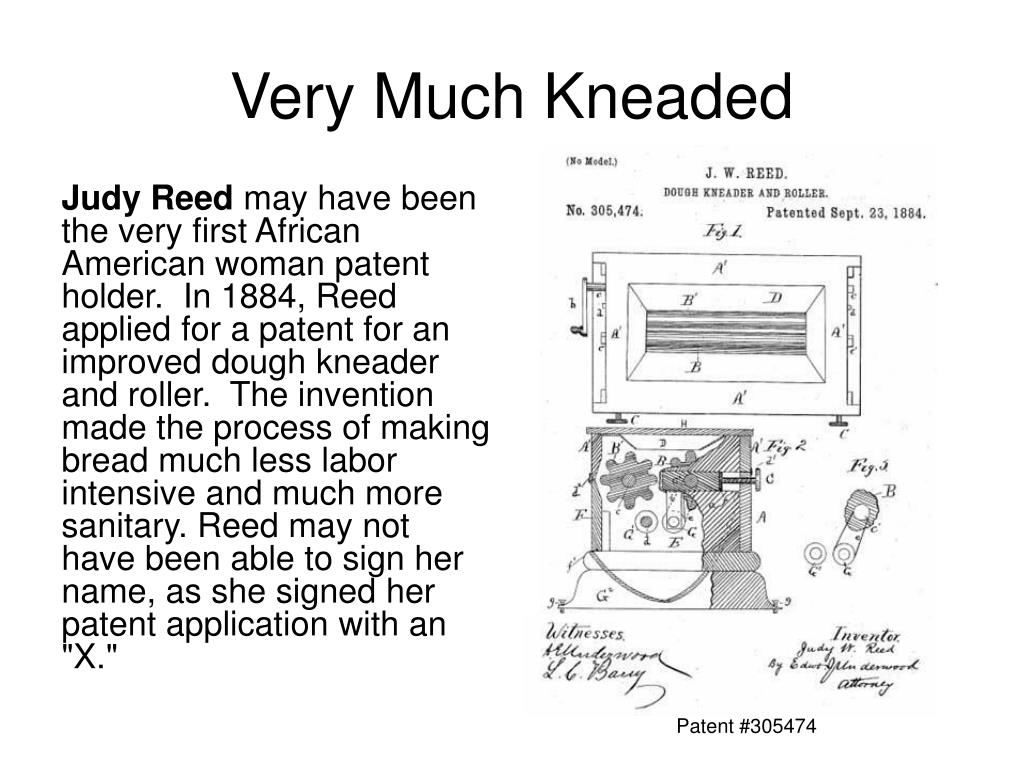
Little is known about Judy Woodford Reed, her birth was commemorated around the year 1826. There are lots of attributes that are not notorious regarding Reed. She primarily showed up at the 1870 Federal Census as a 44 year old seamstress in Fredericksviile Parish near Charlottesville, Virginia in Albemarle County, along with her husband Allen, a gardener, and their five children. She resided in Washington, D.C. and it is unknown if she was able to read, write, or even sign her name, as her patent is signed with an “X”, leaving doubt. Besides the patent registration, there are no other records of the life of Judy Reed. Judy Woodford Reed applied for a patent on her “Dough Kneader and Roller”, and received her patent on September 23, 1884.
The application was for an improved design on existing dough kneaders. Reed’s device allowed the dough to mix more evenly as it progressed through two intermeshed rollers carved with corrugated slats that would act as kneaders. The dough then passed into a covered receptacle to protect the dough from dust and other particles in the air. It made the process of preparing bread and other baked goods more efficient and less demanding. Her innovation addressed the needs of that time when women were primarily responsible for household tasks like baking. Obtaining a patent during that century was an impressive accomplishment for anyone, but it held even greater significance for an African American woman.
Women sometimes used their first and/or middle initials when signing documents, often to disguise their gender, and patent applications didn’t require the applicant to indicate his or her race. Judy Reed is considered the FIRST Black woman to receive a U.S patent. It is unknown whether any earlier African-American women received patent rights; there was no requirement to indicate race in the documents, and women often used only their initials to hide their gender. Until 1863 it was illegal for slaves to be literate, and anyone who was caught reading, writing, or providing education was likely to face severe punishment or the death penalty. Because Reed had used her mark (an X) and not her signature, technically, the first Black woman to fully sign a patent was Sarah E. Goode of Chicago for a folding cabinet bed on July 14, 1885.