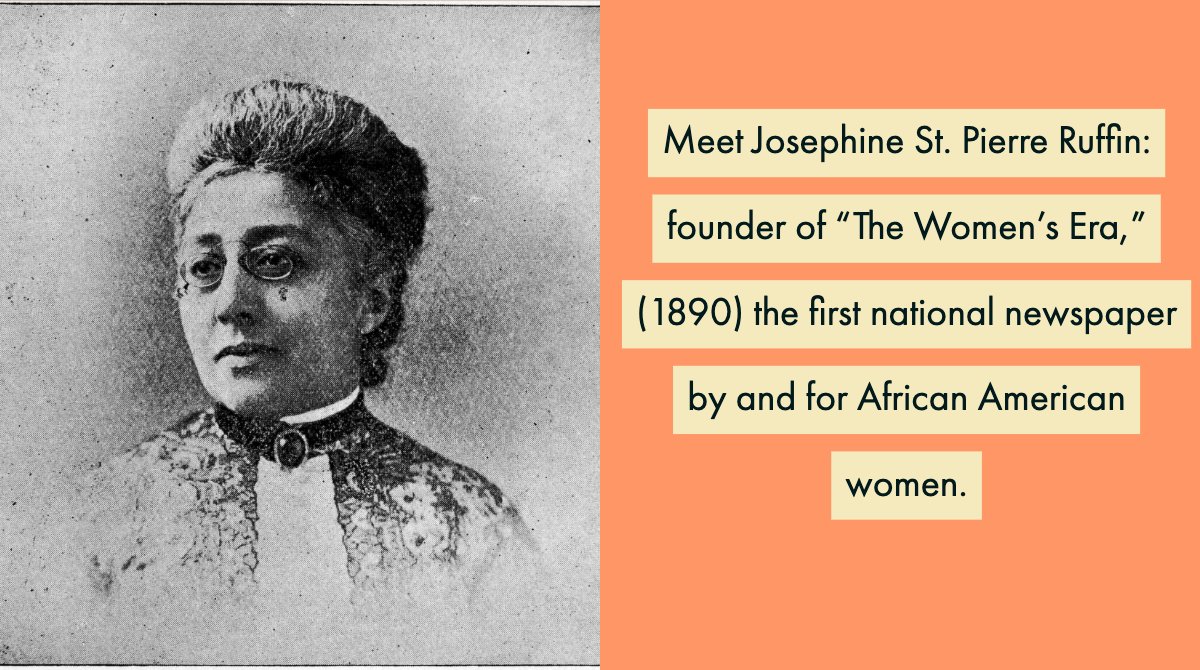
Josephine St. Pierre Ruffin was publisher, journalist, civil rights leader, suffragist, and editor of the Woman's Era, the first national newspaper published by and for Black women. Josephine St. Pierre Ruffin was born in Boston on August 31, 1842 to a White mother from Cornwall, England and a Black father from Martinique, an island of the West Indies in the Caribbean Sea. Josephine attended a private elementary school in Boston. Initially, her classmates’ parents did not know about her racial background and assumed she was white because of her light skin. When they discovered she was Black, they successfully pressured the school’s leaders to remove Josephine.
Public schools in Boston were segregated at the time. Josephine was not allowed to attend school with White students. The Boston schools integrated in 1855. In 1858, Ruffin married George Lewis Ruffin, a barber from another affluent Black family in Boston. George Ruffin went on to become the first African American to graduate from Harvard Law School and the first Black judge in Massachusetts. They soon moved to England in response to the U.S. Supreme Court’s 1857 Dred Scott decision, but they returned to Boston after the outbreak of the Civil War to support the fight against slavery.
Ruffin began her efforts in public service during the Civil War by recruiting Black men for the 54th and 55th Massachusetts infantry regiments. After the war, she joined the Massachusetts Woman Suffrage Association (MWSA) and forged connections with prominent suffragists such as Lucy Stone and Julia Ward Howe. In 1870, she joined the Massachusetts Suffrage Association. This organization fought to give women the right to vote. Her particular interest was the development of Black women in New England and nationwide.
Josephine befriended many influential activists like Susan B. Anthony, Elizabeth Cady Stanton, and Booker T. Washington. Ruffin’s husband passed away in 1886, after which she decided to further dedicate herself to working on behalf of Black women. After years of active service in women’s clubs, she co-founded The Woman’s Era Club in 1893 with her daughter, Florida Ruffin Ridley, as well as Maria Louise Baldwin, Ida B. Wells, and several other Black women from Boston. In 1894, she launched "The Woman’s Era", a newspaper for Black women.
The newspaper included stories written by Black women from all over the country. It was the first national newspaper published by and for Black women. The fight against racial inequality was a common subject in The Woman’s Era. As the newspaper’s editor, Josephine often added personal commentary in her articles. She was particularly outspoken about her views on racial segregation. After the Supreme Court’s decision to uphold racial segregation in the Plessy v. Ferguson case, she encouraged readers to break the law because it was unjust.
In 1894 she organized the first National Conference of Colored Women in America. Publicized in The Woman’s Era, the conference took place in Boston in 1895 and drew 100 women from twenty clubs across the country. The club, eventually became the official organ of the National Association of Colored Women in 1896. The club discussed topics like politics and literature, provided scholarships to Black women, and helped Boston’s Black residents live better. Josephine was the president of the Woman’s Era Club until 1903.
During 1895, Josephine St. Pierre Ruffin organized the first national meeting of Black women. She wanted to show support for Ida B. Wells, who had received criticism for her anti-lynching writing. During the convention, the attendees established the National Federation of Afro-American Women. Ruffin and the other conference attendees established an umbrella organization to unify their clubs, later called the National Association of Colored Women’s Clubs (NACWC), which still exists today.
The NACW hosted the National Federation of Afro-American Women at the Charles Street AME Church in 1896. The Woman’s Era club, however, remained Ruffin’s main vehicle for civil rights. Continued resistance of all-White national women’s clubs reinforced her commitment to the importance of the Black clubwomen’s movement, and she remained an active participant throughout her life. In 1900, she tried to desegregate the General Federation of Women’s Clubs. She asked the federation to accept the Women’s Era Club and did not mention that most of its members were Black.
The federation approved her application, and Josephine traveled to their national convention. When they discovered she was Black, her club’s application was denied. For the next two decades, Josephine traveled across the country to give speeches about women’s rights and racial equality. She also continued to volunteer for organizations that helped Black communities. She remained an active clubwoman and helped found the Boston chapter of the National Association for the Advancement of Colored People (NAACP) in 1910.