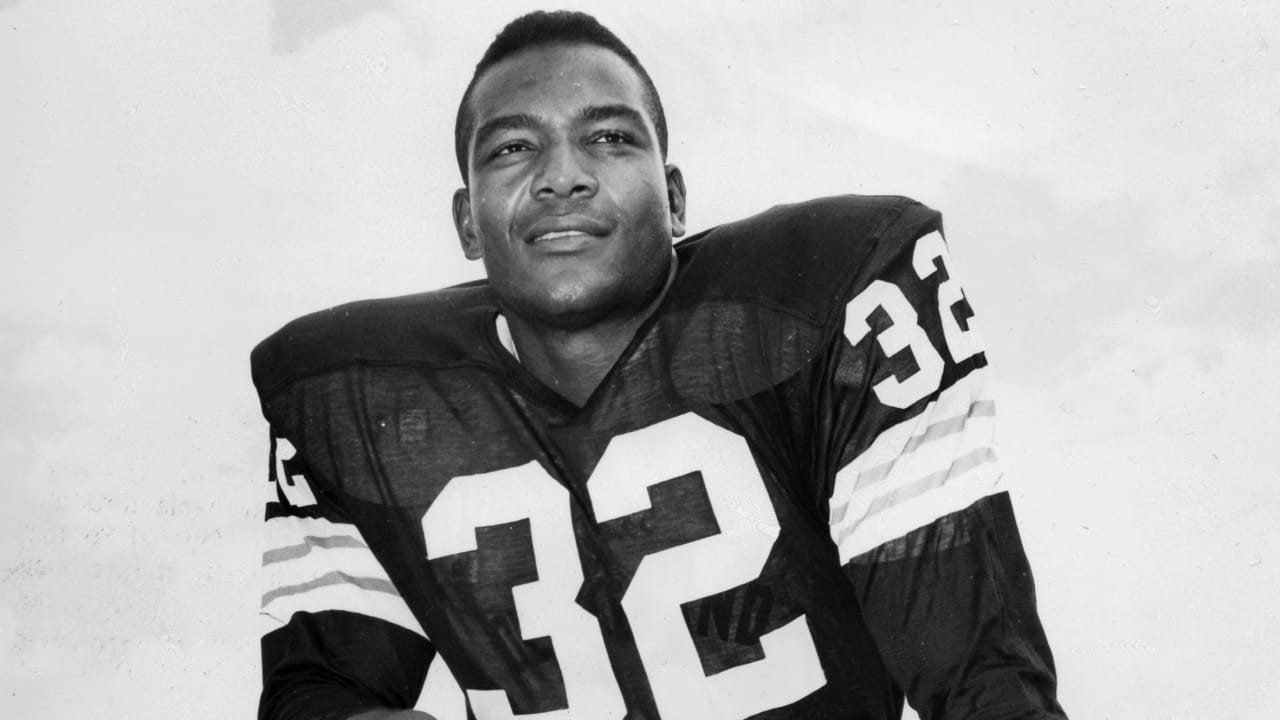
Jim Brown
Jim Brown was a superb, outstanding craftsman whose primary job was to run the football for the Cleveland Browns. For nine seasons, he did it better than any player before him. He led the National Football League (NFL) in rushing for eight of his nine seasons. Brown was the dominant player of his era and is arguably considered one of the greatest running backs and football player period of all time. He later found success as an actor. From 1957 through 1965, Brown played for the Cleveland Browns, and he led the league in rushing yardage every year except 1962.
Brown was a bruising runner who possessed the speed to outrun opponents as well as the strength to run over them. He rushed for more than 1,000 yards in seven seasons and established NFL single-season records by rushing for 1,527 yards in 1958 (12-game schedule) and 1,863 yards in 1963 (14-game schedule), a record broken by O.J. Simpson in 1973. Brown got “only” 996 yards in an injury-riddled 1962 season, his lowest total since he had 942 as a rookie in 1957. He did not win the NFL rushing title for the first – and only – time in his career.
There was some speculation that he might not have much left, after only five years. But, Brown knew better, and after an offseason to heal, he came back fully healthy and quashed those rumors by getting 1,863 yards, breaking his own record set five years before. At the close of his career, he had scored 126 touchdowns, 106 by rushing, had gained a record 12,312 yards in 2,359 rushing attempts for an average of 5.22 yards, and had a record combined yardage (rushing along with pass receptions) of 14,811 yards.
Brown was more than just a one-of-a-kind running back. He caught passes, returned kickoffs, and even threw three touchdown passes. Jim was a unanimous first-team All-NFL pick eight times, 1957 through 1961, 1963-1965. He played in nine Pro Bowls in nine years andwas a three-time MVP. Known for his powerful and elusive running style, Brown led the Cleveland Browns to the NFL title in 1964. He closed out his career with a three-touchdown outburst in the 1966 Pro Bowl.
At 30 years of age and seemingly at the height of his athletic abilities, Brown retired from football to pursue an acting career. Fans still ponder what heights he might have reached had he stayed on the firing line a few more seasons. As exceptional as Brown’s statistics were, his durability may have been even more amazing. Despite a constant pounding from defenses always stacked against him personally, HE NEVER MISSED A GAME IN NINE YEARS.
Brown’s post-NFL life was devoted to two causes: African American economic development and community engagement. Inspired by the Black Freedom movement’s emphasis on self-reliance and community-based approaches, Brown helped found the Black Economic Union, which pursued a capitalist economic approach to racial equality. Brown maintained that this group helped support four hundred African American businesses during its most active period, 1967-1974.
At the height of mass incarceration in African American communities, he launched the Amer-I-Can Foundation, which sought to help formerly incarcerated youth reach their academic potential, develop job skills, and improve the quality of their lives by equipping them with the necessary tools for self-improvement. Brown’s consistent involvement within African American communities helped him negotiate a highly-successful gang truce in Los Angeles, which helped reduce violence in inner-city Los Angeles in 1992.