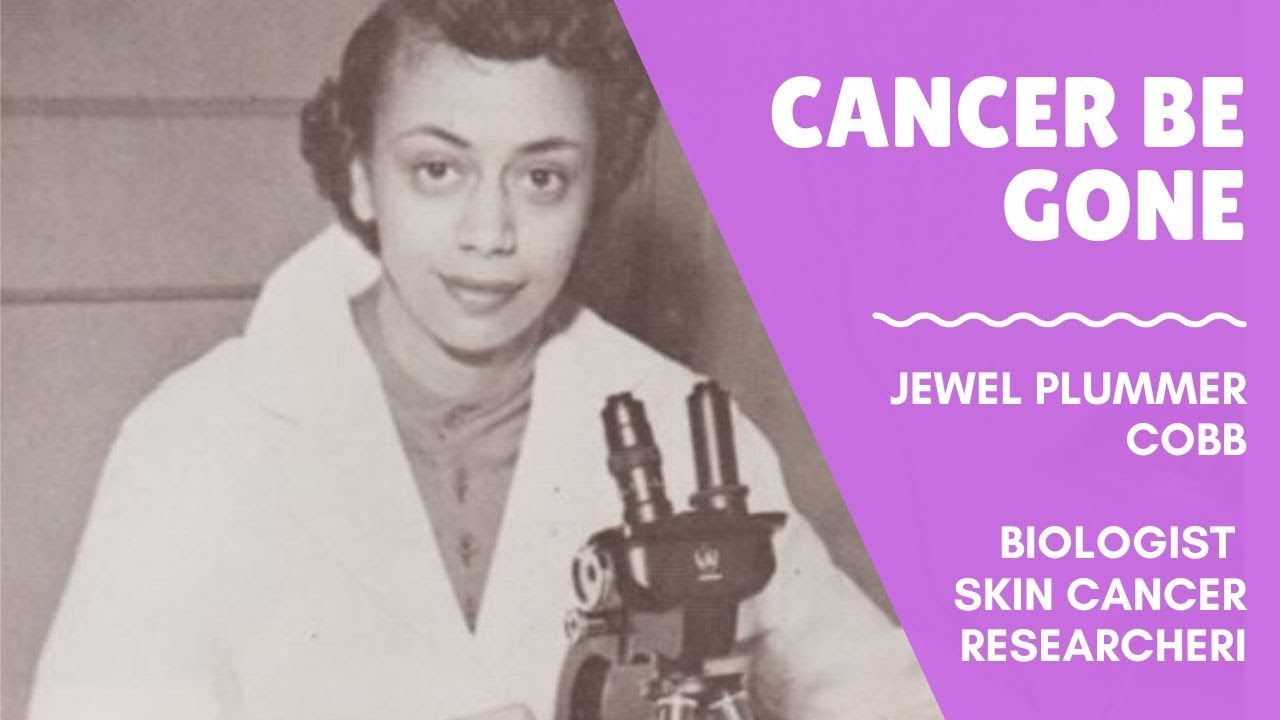
A cellular biologist, a research scientist that studied how ultraviolet light from the sun can damage skin cells. She also helped developed chemotherapy treatments for cancer. Later she became an academic administrator for six schools.
Jewel Plummer Cobb was a biologist, cancer researcher, and academic administrator. She was born Jewel Isadora Plummer into a family of medical professionals, on January 17, 1924 to Frank and Carriebel Plummer. Her grandfather, Robert, was born into slavery in 1860 and graduated from the pharmacy program at Howard University. Robert’s son, Frank, was a graduate of Cornell University and after serving as an army medic during World War I, earned his medical degree from Rush Medical School in Chicago. Jewel's mother, Carriebel, also held a degree and taught physical education.
So, Jewel had the unusual experience, for a Black woman born during that time, of being surrounded by family members who were able to pursue professional careers. However, they also didn’t try to shield her from the realities of being Black in America. They were members of the National Association for the Advancement of Colored People (NAACP) and the Urban League. The family struggled and moved often because of the ever-changing demographics in Chicago (Whites moving out of certain neighborhoods and Blacks moving in). Plummer's economically privileged upbringing offered her a childhood of intellectual exploration.
Jewel developed an interest in learning from a young age. Jewel excelled academically despite the overcrowded, poorly funded schools she was forced to attend because of her race. Although she anticipated becoming a physical education teacher, her interest in science solidified during her sophomore year of high school. While looking through a microscope in biology class she became fascinated by the things she saw under the lens. She said it was “wonderful to be able to see things through it that I could not see ordinarily". Her ambition quickly changed from following in her mother’s footsteps and becoming a P.E. teacher to teaching high school biology.
After graduating from Englewood High School, Plummer enrolled at the University of Michigan in 1941 to pursue a degree in biology. Plummer started her undergraduate studies at the University of Michigan 1942, but she left in her sophomore year because of the institution’s practice of requiring all Black students to reside in one house on campus. It wasn’t a true transfer, though, because she was forced to start over as a freshman. Putting in extra study time, she was able to test out of the entry-level courses and catch up to where she would’ve been if she’d remained at Michigan. In 1944, at just 20 years old, Jewel earned her bachelor’s degree from Talladega and became a member of the Alpha Kappa Alpha sorority.
On the recommendation of her teacher, she applied to the New York University graduate program in biology. Cobb initially was denied a fellowship for graduate study, allegedly due to her race, but was granted the fellowship after an interview. She earned her master’s in 1947, and her doctorate (Ph.D) in 1950 under the direction of biochemistry professor M.J. Kopak, studying an enzyme involved in melanin synthesis. While a graduate student at New York University, Jewel spent the summer of 1949 as an independent investigator at the Marine Biological Laboratory (MBL), where she studied the inhibition of cell division in sea urchin eggs. This would set her on a path of discovery and accomplishment in the field of cell physiology over the next seven decades.
In July of 1950, Plummer was awarded with a postdoctoral fellowship sponsored by the National Cancer Institute. She accepted a position at the Harlem Hospital Cancer Research Foundation, led by Dr. Louis T. Wright. Plummer studied the affects of different chemotherapy drugs on cancer cells culled from patient biopsies. She also examined how hormones, ultraviolet light, and chemotherapeutic drugs could cause changes in cell division. Plummer started out investigating the effects of a new chemotherapy agent, triethylenemelamine, on human tumor cells. She co-authored two papers with Dr. Wright, and a third with him and his daughter Jane Cooke Wright, who was a trailblazer and pioneer in cancer research as well.
After the death of her father, Dr. Jane C. Wright established a fruitful collaboration with Cobb focused on fundamental cell research, which led to a paper published in the journal Cancer in 1957. In 1952, Jewel established her own lab at the University of Illinois Medical School where she directed the Tissue Culture Laboratory. In 1954, Plummer married Roy Cobb, an insurance salesman. During this time she moved her lab back to Harlem Hospital, where she resumed her innovative collaboration with Jane Wright. Wright was studying the effects of chemotherapy in cancer patients, and in parallel, Cobb cultured cells from the tumors of these patients and studied their response to chemotherapy treatment.
Jewel Plummer Cobb and Jane C. Wright made a critical contribution in the early 1960s by demonstrating the effectiveness of methotrexate in treating skin and lung cancer, as well as childhood leukemia. Methotrexate is now used for a broad range of cancers, including breast cancer. Much of Cobb's research was focused on the skin pigment melanin, and her most significant research has been with testing new chemotherapeutic drugs in cancer cells, the impact of which continues. Although her interest in biology could have led her to become a medical doctor, Cobb was not interested in working directly with the sick. She was, nonetheless, interested in the theory of disease, an interest that later led her to become one of the leading cancer researchers in the United States.
In 1967, she came to Connecticut where she was appointed Dean and Professor of Zoology at Connecticut College in New London. Cobb served as a professor of Zoology and as Dean of Arts and Sciences at Connecticut College from July 1969 until July 1976. Upon accepting the position at Connecticut College, she expressed: "This is a college in transition, moving forward at an exciting pace. We need more black students and teachers to help us formulate and carry out our bold new plans." Cobb was the first Black Dean in the College's history. During her time at Connecticut College, she implemented a Black Scholarship program that provided financial assistance to at least 37 Black undergraduates at the college.
She was elected to the National Institute of Medicine in 1974. In July 1976, Cobb decided to leave Connecticut College and become a dean and professor of Biological Sciences at Douglass Residential College at Rutgers University. Cobb's decision to leave was not premeditated, rather it centered on an interest in becoming a full-time administrator for the Women's division of Rutgers. While at Douglass, Cobb was selected by the Rockefeller Foundation to participate in a global conference in Italy concerning the future of higher education for women. Additionally, in April 1978, Cobb was nominated by President Jimmy Carter as a member of the Board of Foreign Scholarships, best known as the organization responsible for determining Fulbright eligibility.
Dr. Cobb did extensive cancer research, specializing in cell biology, and was a member of the National Science Board from 1974 to 1980. She was appointed President of California State University at Fullerton in 1981. Immediately, she began to improve campus facilities from the start of her term. She acquired financial capital for the construction of the first ever student residence on campus. The completion of this apartment complex was later named in her honor. While at Cal State, Fullerton she led a successful effort to obtain funding for the campus’s new science and engineering building and the new computer science building. In 1990 Cobb relinquished the Presidency and became a California State University, Los Angeles Trustee Professor.
Cobb is the recipient of several honorary doctorates and many awards, including the Kilby Award for lifetime achievement in 1995. One of Cobb’s primary legacies is her 1979 paper Filters for Women in Science, which outlined the challenges that young women face in entering and succeeding in science and engineering careers. Cobb’s distinguished contributions to scientific research, education, and inclusiveness did not go unrecognized. She received a Lifetime Achievement Award for Contributions to the Advancement of Women and Underrepresented Minorities from the National Academy of Sciences.
Throughout her career, Cobb was a vocal advocate for diversity and inclusion in science, and worked tirelessly to promote opportunities for Black women in the field. She served on numerous committees and advisory boards, and was a mentor and role model to many young scientists. She was the recipient of 21 honorary doctorates and was a trustee of several universities and corporations. Cobb's insistence on providing resources and programs to increase minority representation at her colleges of employment define her legacy outside of the laboratory.