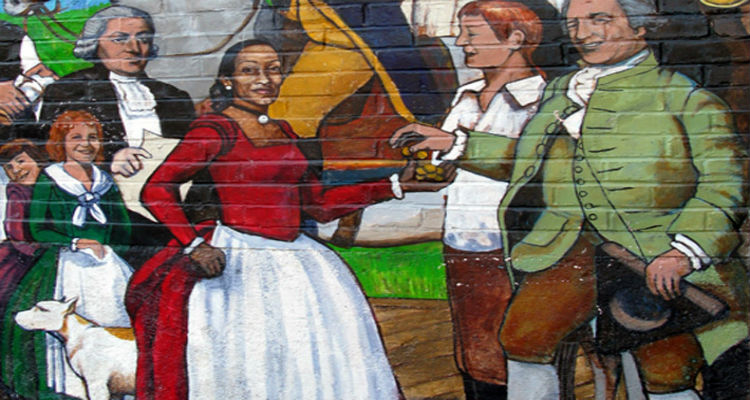
An enslaved woman suing for her freedom? This was the case of Jenny Slew. Jenny Slew was born to a free White woman and an enslaved Black man, around 1719. Jenny contended her parents were married and had established a family home. That fact would become the core of a historic legal case forty-six years later. She had been raised free and lived as a free woman. But, in 1762, at age 43 she was kidnapped and enslaved by John Whipple. Slew argued in a civil suit that since a child’s legal status follows that of the mother, she, also deserved her freedom like her mother. She turned to the courts for help. Slew found a sympathetic attorney, Benjamin Kent, to take her case.
In March, 1765 Jenny Slew sued Mr. Whipple in the Inferior Court of Common Pleas on a charge of trespass for holding her in bondage illegally. She charged that Whipple had held her in bondage illegally. Jenny simply stated that because her mother was a free white woman, she was free. She demanded her freedom and 25 pounds in damages, charging Whipple with violating her liberty. Most colonies denied slaves the right to sue in court, but Massachusetts allowed slaves to bring forward civil suits, even though they would still be regarded as property.
Furthermore, most civil suits were brought forward by men. Slew’s attorney Benjamin Kent argued that her mother was a White and free woman, so she was free. In the colonies at the time, a child’s legal status descended from a mother. Slew filed her complaint in the Inferior Court of Common Pleas in Newburyport which threw out her petition since she filed under the name “Jenny Slew, Spinster”. The court argued that since she had been married, such a name was incorrect. Adding insult to injury, the court assessed Jenny Slew £4 damage and court costs to be paid to John Whipple.
Still determined, however, in 1766, Jenny took her case to the Essex Superior Court of Judicature in Salem, Massachusetts, and they agreed to hear her case. In both cases, the slaveholder, Whipple, attacked Slew’s legal right to sue him, for any reason. He pointed out that Slew had been married. As a married woman, she had no identity separate from her husband and therefore could not sue on her own behalf. In other words, a slave could appeal to the law but a married woman could not. Slew almost didn’t get her case to court for this reason.
She had indeed been married, and more than once. Jenny Slew was saved by the fact that she had been married to slaves. So instead the validity of her marriages was called into question. The Superior Court agreed to hear her case and granted her a jury trial. In November of 1766, the jury ruled in favor of the plaintiff against John Whipple for capturing her “with force and arms,” and keeping her as his slave for three year. Jenny also maintained that Whipple was doing “other injuries against the peace” and to her. Per law, a child took on the status of the mother. Slew’s mother was White so by law, she was not a slave.
She was freed and awarded four pounds in damages. The judgment read that your status as a slave was based on the status of your mother, but Jenny’s mother was White. So by law she was not a slave. Hers was one of the first successful cases that was won by using that argument. Present in the Salem courthouse during the 1765 trial was a lawyer named John Adams, who took notes on the proceedings. The future president of the United States, has records of the trial in his legal papers. According to one of his diary entries on November 5, 1766, Adams wrote about a trial of a “mulatto woman… suing for liberty” against a White man accused of kidnapping.
Slew had the odds stacked against her. She was a Black woman, who was suing a White man and would be judged by White men. But she fought and won not only her own freedom but the freedom of others. Jenny Slew is believed to have been the first person held as a slave to be granted freedom through trial by jury, and the people of Massachusetts were becoming increasingly anti-slavery. Some years later another Black woman, Elizabeth ‘Mumbet’ Freeman, went to court in Massachusetts in order to obtain freedom, not only for herself, but for all those enslaved in that state.
Elizabeth attended a public reading of the new constitution, where she heard the words enshrined in the document’s very first article: “All men are born free and equal.” Elizabeth figured that this meant she was owed her freedom. This was the first time anyone had challenged slavery by insisting that it was against a state’s constitution. Amazingly, Elizabeth Freeman won her case and was freed. Other slaves followed Freeman’s action. Slew and Freeman were among the first in a long line of Black Americans who asked the law to defend their freedom and humanity. Some would be denied and some would have their petitions answered. But faith in law would continue to be a mainstay of the search for justice.