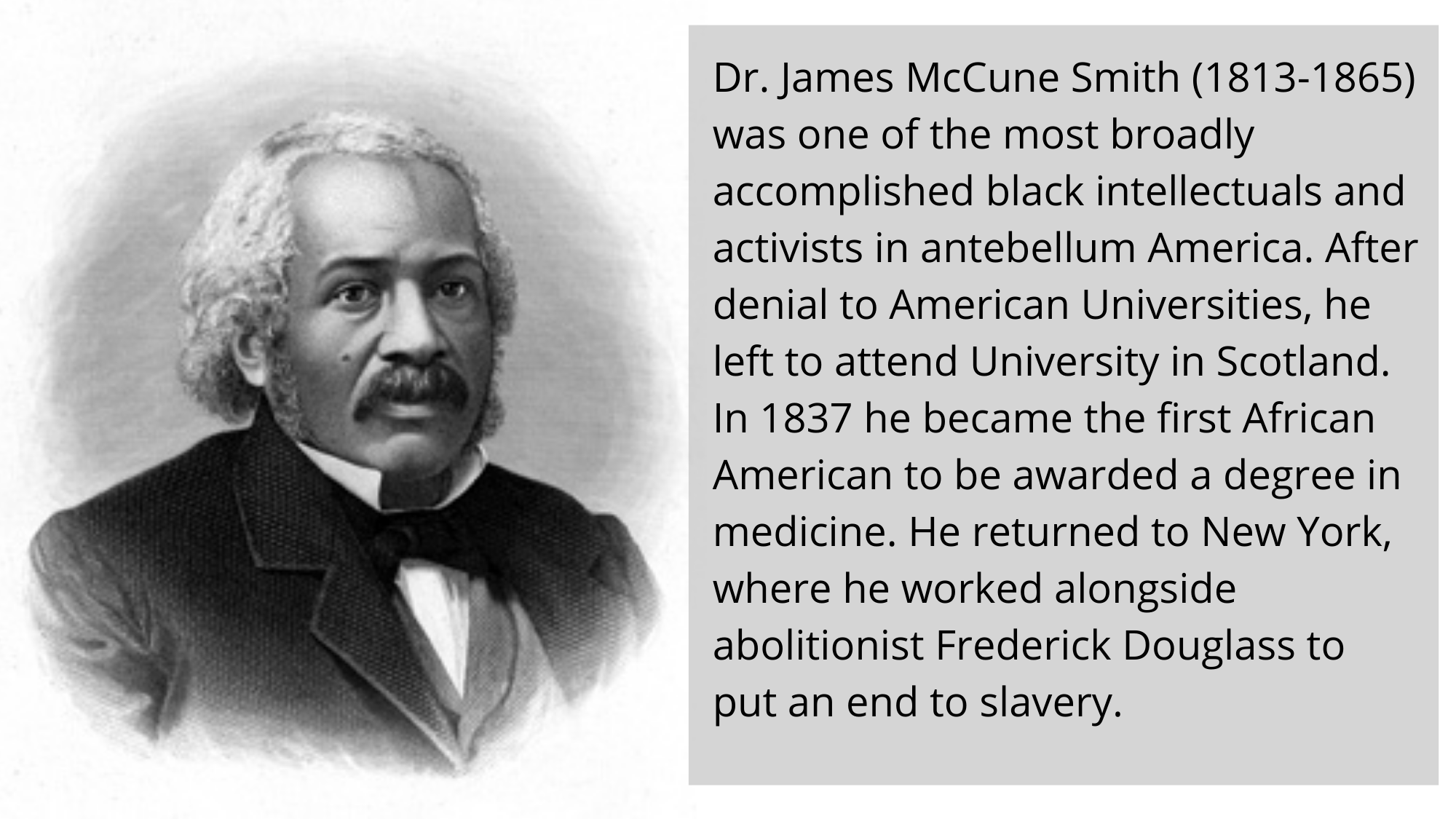
Many African Americans have faced hardships, especially in the medical field. They were not allowed to attend certain schools due to the color of their skin, but still managed to make a way. That was the case for the first African American to earn a medical degree. Dr. James McCune Smith was born into slavery in New York on April 18, 1813. His mother was a former slave who purchased her own freedom, while his father is believed to have been either a White merchant or freed slave. He labored as a bonded blacksmith 6 days a week, studying Greek and Latin on nights and weekends to prepare for college.
Though technically “free”, the lives of African Americans in New York during the 1820s and 1830s were marred by the legacy of slavery and discrimination. Runaway slaves were openly hunted in the city’s alleys, streets and wharves. Growing up, James attended the African Free School in New York City, that schooled Henry Highland Garnet, Samuel Ringgold Ward, Alexander Crummell, and Ira Aldridge. From the sparse records of his work, James was described as a brilliant student, and samples of his performance show his exceptional talent in both writing and drawing. Smith was chosen to deliver the welcoming address to General Marquis de Lafayette, the French war hero during the general’s visit to the school in 1824, he was eleven years old at the time.
At the age of 14 he was set free by the Emancipation Act of New York of 1827, making that the final date that New York freed their remaining slaves. Upon graduation from the African Free School, James McCune Smith sought but was denied admission to medical school at Geneva Medical College and Columbia University because he was Black. His teacher Rev. Peter Williams Jr., a graduate of the African Free School who had been ordained in 1826, encouraged Smith to attend the University of Glasgow in Scotland. His pastor raised funds to send him to Scotland. Smith earned three degrees over five years: his Bachelor’s in 1835, his Master’s in 1836, and finally his medical degree in 1837. Thus he became, the first Black American to be awarded a degree in medicine.
While in Scotland, Smith joined the Glasgow Emancipation Society, an organization that helped to fund his education. After graduating at the top of his class in 1837 and completing a medical internship in Paris, France, he returned to New York City better educated than most White doctors. By virtue of his education and literary abilities, he quickly became an exceptional figure in New York’s African American community. He made history as the first ever pharmacy run by an African American when he opened a pharmacy and medical office that served both Black and White patients, located on 93 West Broadway. Smith joined the four-year-old American Abolition Society before the end of the year and quickly emerged as a powerful anti-slavery and anti-racism organizer, orator, and writer.
In the following spring, at the annual meeting of the Society, Smith was one of five featured speakers and the only Black speaker. The ultimate goal was abolition, but Smith and other African American leaders were at least equally concerned with discrimination in the North, a matter of little concern to William Lloyd Garrison and other White abolition leaders. Nevertheless, Smith supported the abolition cause with, among other things, a regular column in Frederick Douglass' Paper. In 1839, he followed Samuel Cornish as editor of The Colored American, which was the first venue for free Black people to express opinions for a broad readership.
In 1840, Smith wrote the earliest known case report by a Black physician, entitled "Case of Ptyalism with fatal termination". Because of his race, he was not allowed to present the case before the New York Medical and Surgical Society, so Dr. John Watson, who consulted with him on the case, did so instead. In 1844 Smith authored the first case report ever written by a Black physician in the United States. It was entitled "On the Influence of Opium upon the Catamenial Functions" in the New York Journal of Medicine, the earliest known contribution to the medical literature by a Black physician. He drew from his medical training to discredit popular misconceptions about differences among the races.
Intellectually erudite and passionate, Smith wrote prolifically about medicine, science, education, racism, and literature. Smith used scientific reasoning to counter racist notions that Blacks were mentally inferior to Whites. James efforts were notable given that some other Black academics accepted the “utility” of phrenology. They argued that organs of the brain were adaptable regardless of “race” in their efforts to debunk the claims of racist ethnologists. His pioneering work debunked doubts about the ability of African-Americans to transition into free society. Smith's statistics refuted the argument of slave owners and prominent thought leaders that African-Americans were inferior. One of the earliest advocates of the use of "black" instead of "colored," McCune Smith treated racial identities as social constructions, arguing that American literature, music, and dance would be shaped and defined by Blacks.
In 1846, the New York City Colored Orphan Asylum hired Smith to care for nearly 200 children in residence because 1 in 20 children were dying from measles, smallpox, and tuberculosis. He served the as chief physician at the Asylum. Early in his time there he debunked claims that homeopathic treatments reduced children's death rates in New York City orphanages. In addition to caring for orphans, the home sometimes boarded children temporarily when their parents were unable to support them, as jobs were scarce for free Blacks in New York. A transportation company refused him passage on its streetcars because he was Black, so Smith walked nearly 7 miles daily until the Asylum provided him with conveyance. He remained on staff there until his death.
Smith went as far as to challenge proslavery John C. Calhoun, a former U.S vice president and South Carolina senator who favored secession. Calhoun used the 1840 Census to criticize abolition, that Black people were better off under slavery, and that African Americans were prone to insanity. Smith's response, showing the information to be false, was called, "The Influence of Climate upon Longevity" published in 1846. Smith analyzed the census both to refute Calhoun's conclusions and to show the correct way to analyze data. Smith also provided statistics to show that the death rate among slaves was higher than among free Blacks. "What mockery is it," Smith exclaimed, "for men to talk of the kindness of the masters in taking care of aged slaves, when death has relieved them of so large a share of the burden!" It was the first publication from a African American physician known to debunk medical racism.
James McCune Smith was one of the "Committee of Thirteen", who organized in 1850 in Manhattan to resist the newly passed Fugitive Slave Law by aiding refugee slaves through the Underground Railroad. A prominent abolitionist, Smith worked with Frederick Douglass to establish the National Council of the Colored People in 1853. This was one of the first permanent Black national organizations, beginning with a three-day convention in Rochester, New York. At the convention in Rochester, he and Douglass emphasized the importance of education for their race and urged the founding of more schools for Black youth. Smith wanted choices available for both industrial and classical education. Douglass valued his rational approach and said that Smith was "the single most important influence on his life" James McCune Smith was dedicated to doing all he could to support African American emancipation and equality, in any way he could.
He also maintained close ties to classmate Henry Highland Garnet, praising his incendiary speech urging slaves to rebel, even when other members of the abolitionist community, especially his friend Frederick Douglass, objected strongly to Garnet's sentiments. Smith tempered the more radical people in the abolitionist movement and insisted on arguing from facts and analysis. He was elected as a member in 1854 of the recently founded American Geographic Society. He was never admitted to the American Medical Association or local medical associations, very likely as a result of the systemic racism that Smith confronted throughout his medical career. Smith wrote against the 1857 Supreme Court’s decision in the Dred Scott case denying Black individuals citizenship.
Smith’s thinking reflected the diversity of his interests and the breadth of his training. He took strong stands against Black migration to another country, for Black education of all sorts. Smith believed that native-born Americans had the right to live in the United States and a claim by their labor and birth to their land. He was against racial theories that declared people of African descent were a separate, inferior part of creation. His approach to racial activism was often two-sided. On the one hand, he strongly advocated a program of self-help and racial uplift that promised to “elevate” Blacks in the eyes of Whites and roll back the tide of prejudice. On the other hand, he argued that only an independent Black movement could vindicate the “manhood” of the race and achieve meaningful equality.
In the mid-1850s, Smith joined James W.C. Pennington and other Black leaders in establishing the Legal Rights Association (LRA) in Manhattan. A pioneering minority-rights association, the LRA waged a nearly ten-year campaign against segregated public transportation in the city. This organization successfully defeated segregation in New York and served as a model for later rights organizations, When the Civil War broke out, Smith saw, as did his colleagues, unparalleled opportunities for African Americans to enact this philosophy. Along with notables such as Frederick Douglass and Martin Delany, he lobbied relentlessly for the chance for Blacks to demonstrate their loyalty to liberty and their capacity for civic participation through military service.
James McCune Smith believed that slavery would truly die not merely through the war alone, but through a thorough and equitable redistribution of Southern wealth into the hands of the four million freed people whose labor had been so long expropriated. In 1863, Smith was appointed as professor of anthropology at Wilberforce College, but declined the offer. Both Smith and his wife were of mixed African and European descent. As he became economically successful, Smith built a house in a mostly White neighborhood. In the 1860 census he and his family were classified as White, along with their neighbors.
Despite his trailblazing work in social justice for Black people, Smith’s descendants viewed themselves as White. To escape racial discrimination and have more opportunities, his children passed into White society, and found societal acceptance as educators and real estate agents. His sons married White spouses and his unmarried daughter lived with a brother. They worked as teachers, a lawyer, and as business people. In July 1863, during the New York City draft riots in Manhattan, Irish rioters attacked Blacks throughout the city and burned down the orphan asylum. After the riots, Smith moved his family and business out of Manhattan to Brooklyn, as did other prominent Blacks. Numerous buildings had been destroyed in their old neighborhoods, and estimates were that some 100 Blacks were killed in the rioting. No longer feeling safe in the lower 4th Ward, the Smiths moved to Williamsburg, Brooklyn.
Smith died on November 17, 1865, at the age of 52, only nineteen days before ratification of the 13th Amendment to the United States Constitution that abolished slavery. James McCune Smith was the first full-fledged African American polymath (a person of great learning in several fields of study) as well as the preeminent African American intellectual of the 19th century. He was fluent in French, German, Greek, Hebrew, Italian, Latin, and Spanish and the author of more than 100 articles in ethnology, geography, and medicine. McCune Smith’s activism showed aspiring African Americans that becoming a professional Black physician could be more than simply treating patients. His analytical writing and public lectures had a profound impact on the abolitionist movement and his contributions to medicine opened the door for Black Americans in the medical field.