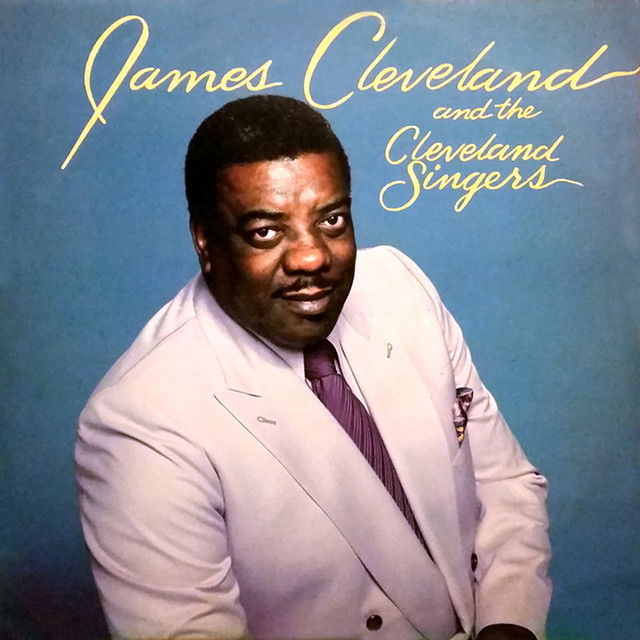
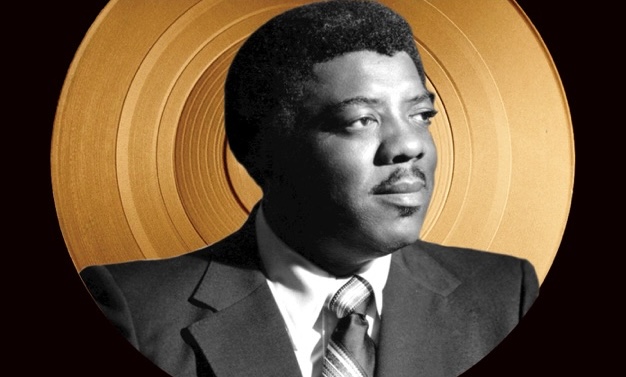
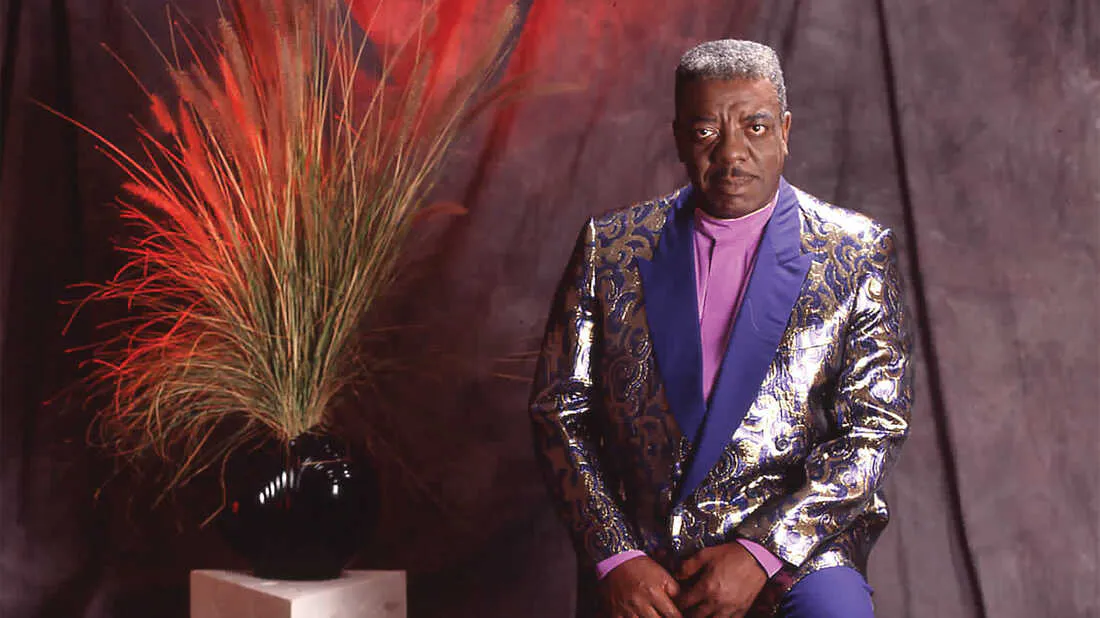
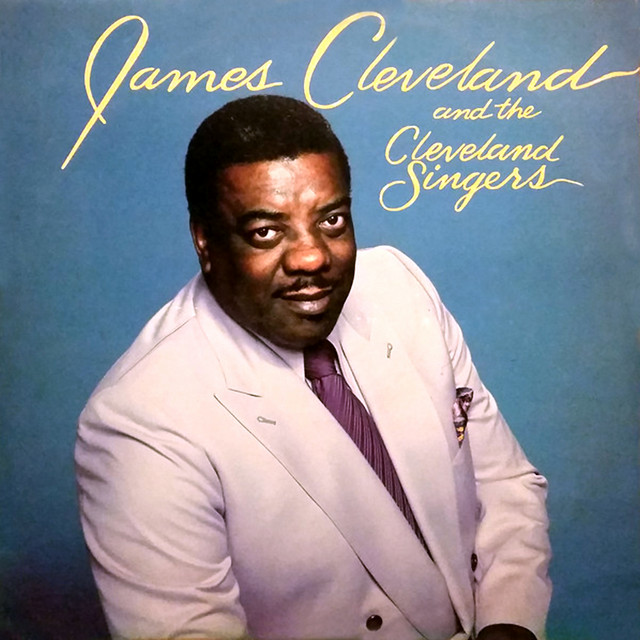
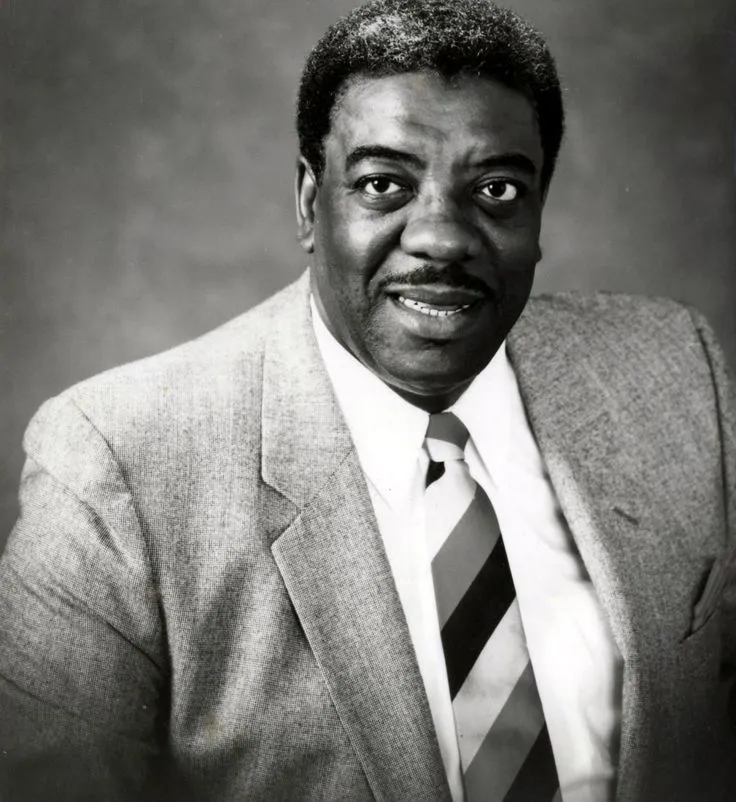
James Cleveland was a driving force behind the creation of the modern gospel sound by incorporating traditional Black gospel, soul, pop, and jazz in arrangements for mass choirs. Throughout the 1950s and 1960s, he established himself in various cities as a church music minister and formed notable gospel groups, including the Gospelaires and the James Cleveland Singers. James Cleveland was born in Chicago, perhaps on December 5, 1932 (his birthday has also been given as December 23, and his birth year as 1931. Cleveland grew up in an environment where gospel flourished. His grandmother introduced him to Chicago's Pilgrim Baptist Church, where the budding musician was influenced by choir director Thomas A. Dorsey—also known as the "Father of Gospel Music".
Under Dorsey's tutelage, the youth made his solo debut with the choir at the age of eight. The famous gospel music pianist and composer Roberta Martin played keyboards for the choir and helped develop James’s skills on the piano. It was her group, the Roberta Martin Singers, who first helped shape the youth's singing and piano style, with Roberta Martin herself inspiring the youngster to begin composing. The vocalist subsequently taught himself to play piano, often recounting how he practiced on imaginary keys until his parents could afford to purchase an upright for him. At age fifteen he joined a local group, the Thorne Crusaders, with whom he remained for the next eight years. At age sixteen wrote "Grace Is Sufficient," recorded by the Roberta Martin Singers He strained his vocal cords while with the Crusaders, which was said to contribute to the distinctive, gravelly voice which became a hallmark of his later in his career.
When Roberta Martin's group began featuring Cleveland's compositions, the artist found himself piquing the interest of prominent gospel talents. In 1948 Cleveland's "Grace Is Sufficient," performed at a Baptist convention, prompted Martin to begin publishing the new composer's work. As a young man, Cleveland moved to Philadelphia, where he helped form the gospel group the Gospelaires, a trio led by Norsalus McKissick and Bessie Folk. He made his recording debut on the Apollo label in 1950, singing "Oh What a Time" with the Gospelaires. His arrangements modernized such traditional standards as "(Give Me That) Old Time Religion" and "It's Me, O Lord". After leaving the Thorne Crusaders, in 1953 Cleveland served as pianist and arranger for Albertina Walker's Caravans, first establishing himself as a superlative gospel arranger, then emerging as a singer—the Caravans scored their earliest hits.
The Caravans became the launching pad for today's gospel legends. Besides Cleveland, the group counted among its membership several gospel luminaries including Shirley Caesar, known as the First Lady of Gospel; Cassietta George, who co-wrote some of the group's best hits; Delores Washington; Josephine Howard, mother to R&B artist Miki Howard; Inez Andrews, whose song "Mary, Don't You Weep" became a staple in the industry. In November 1954, Walker provided Cleveland the opportunity to do his very first recording. By staying out of the studio for a while, she convinced States Records to allow him to record with her group. He continued to record with The Caravans until States Records closed down in 1957.
Seeking to put into action his own creative vision, Cleveland left the Caravans in 1959 and formed his own group, the Gospel Chimes. Over the next several years, Cleveland achieved a series of creative breakthroughs. In 1959, he recorded a version of Ray Charles' hit "Hallelujah, I Love Her So" as a solo artist. He moved to Detroit in 1960 to take a position as music director at the famed New Bethel Baptist Church where the Reverend C. L. Franklin, father of soul vocalist Aretha Franklin, was pastor. By 1960, Cleveland, had become associated with a new tenor in gospel music. He became known by more than just the professionals within gospel music with his version of the Soul Stirrers' song, "The Love of God", backed by the Voices of the Tabernacle Choir. While recording with various Detroit choirs, Cleveland attracted the attention of New York-based Savoy Records and was signed to the label early in the 1960s.
He went on to record more than 100 albums for Savoy, sixteen of which were gold albums. Cleveland recorded three long-playing (LP) albums for the Savoy label with the Angelic Choir, featuring Billy Preston at the organ. Working with Savoy's executive producer Fred Mendelsohn, Cleveland and the Angelic Choir released two albums before recording the iconic masterpiece, Peace Be Still, in September 1963, which sold thousands of copies at that time and garnered Cleveland his first gold album. Volume I, titled This Sunday in Person, was apparently the first live gospel session to be recorded. Cleveland liked the idea of capturing worship in song live on a recording where the listeners can feel and become of a part of the service. The second volume, 1962’s James Cleveland and the Angelic Choir, featured Cleveland’s hit recording of the gospel standard “How Great Thou Art”. The third volume, Peace Be Still, recorded live and released in 1963, was the first gospel LP to sell move than fifty thousand albums. Peace Be Still also stayed on the Billboard charts for at least fifteen years after its release.
On the title track of the record, Cleveland crystallized his choral work and hit on a powerful formula that he would follow many times throughout the rest of his career. The recording features Cleveland’s trademark arrangement: a large choir, rhythms heavily influenced by blues and jazz, and swaying organ and percussion accompaniment. Cleveland’s rough-hewn vocals alternate theatrically with the smooth-sounding, swelling choir. Perhaps most notable about the recording is the rousing chorus that assumes prominence in the second half of the performance, as the choir rhythmically and intricately chants “Peace Be Still.”
Cleveland moved to Los Angeles in 1963, serving as pastor of the New Greater Harvest Baptist Church, where he attained even greater popularity working. He returned to touring with the newly organized James Cleveland Singers, which included Odessa McCastle, Georgia White, Eugene Bryant, and Billy Preston, among others. During 1964 Cleveland formed the James Cleveland Singers. He gradually built an international reputation, and became one of the best paid of the gospel music entertainers. During this time, he took as his mission the forging of gospel choirs into a modern musical force, capable of assimilating the more sophisticated influences and harmonies of jazz, blues, soul, and even classical music. During his adult career, he took as his mission the forging of gospel choirs into a modern musical force, capable of assimilating the more sophisticated influences and harmonies of jazz, blues, soul, and even classical music.
Cleveland capitalized on his success by founding his own choir the Southern California Community Choir, which he formed when he founded the Cornerstone Institutional Baptist Church, which grew from ten to thousands of members throughout the remainder of his life. His first album with the church choir, The Voices of Cornerstone, was released in 1980, which featured a rendition by Cleveland of "Jesus, Lover of My Soul", and the title track, "A Praying Spirit", written by Elbernita "Twinkie" Clark and recorded by The Clark Sisters. The Southern California Community Choir sang behind him on his two Grammy Award LP albums Live at Carnegie Hall and In the Ghetto. For him, gospel music and gospel teaching are inseparable—different mediums conveying the same message. For Cleveland, gospel music is so vital that in 1968 he organized the first Gospel Music Workshop of America (GMWA).
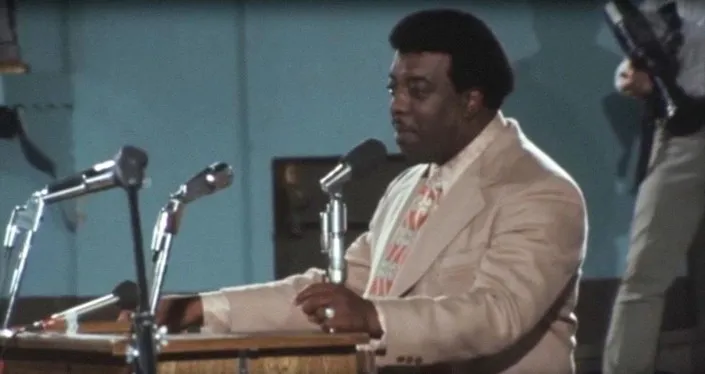
Designed both to help preserve the gospel tradition and to feature new talent, the workshop has grown to include more than five hundred thousand members representing almost every state. The purpose of the workshop was to bring together singers from all over the country in order to perpetuate the art of gospel music. The workshops eventually attracted thousands of adherents and laid the groundwork for the popularity of gospel music. In 1972, he collaborated with Aretha Franklin on the Grammy-winning multi-million-selling LP Amazing Grace. It was recorded live at the New Temple Missionary Baptist Church in Watts in Los Angeles, with his Southern California Community Choir. His feature on the album and Aretha's success as a pop artist made the album a historic landmark in gospel, with a special CD re-release of The Complete Recordings (the unedited album recording session of the Amazing Grace project).
By the 1970s and 1980s, Cleveland had become a gospel music legend. Disc jockeys, impressed by the sheer power of Cleveland’s voice, played his music and several of his records became minor pop hits. However, unlike talented gospel artists like Sam Cooke and Aretha Franklin who crossed over to pop careers, Cleveland maintained an unswerving allegiance to gospel. His imaginative arrangements are credited with introducing jazz and pop rhythms to gospel and paved the way for gospel-pop fusion artists such as Edwin Hawkins and Andrae Crouch. Cleveland would bring together a number of artists to back him on appearances and records. The historic documentary film Gospel, released in 1983, features James Cleveland for the first time on the motion picture screen, along with the Southern California Community Choir, Walter Hawkins & the Family, The Mighty Clouds of Joy, Shirley Caesar, and The Clark Sisters.
Cleveland continued to introduce, appear, and record with some of the most notable gospel choirs and independent artists of the time. For his contributions to gospel music, vocals, composition, and performance, Cleveland has been called the Crown Prince of Gospel. He was an exciting vocalist—with a hoarse, gritty quality to his voice, in striking contrast to the sweet-toned, imploring choir that accompanied him. The “foghorn” quality of his vocals has been likened to that of Louis Armstrong, and his preaching lyrics were heartfelt and gripping. Indeed, with a voice that has earned acclaim as one of gospel's greatest, and a religious fervor that has refused the lure of secular music, Cleveland, more than any artist of his generation, served as a champion of gospel in its purest form. Cleveland suffered severe respiratory problems in his later years and died of heart failure on February 9, 1991, in Los Angeles. Aretha Franklin memorialized Cleveland in the New York Times with these words: “Anyone who heard him, you were touched by him. He was a motivator, and innovator. He leaves the greatest legacy.”