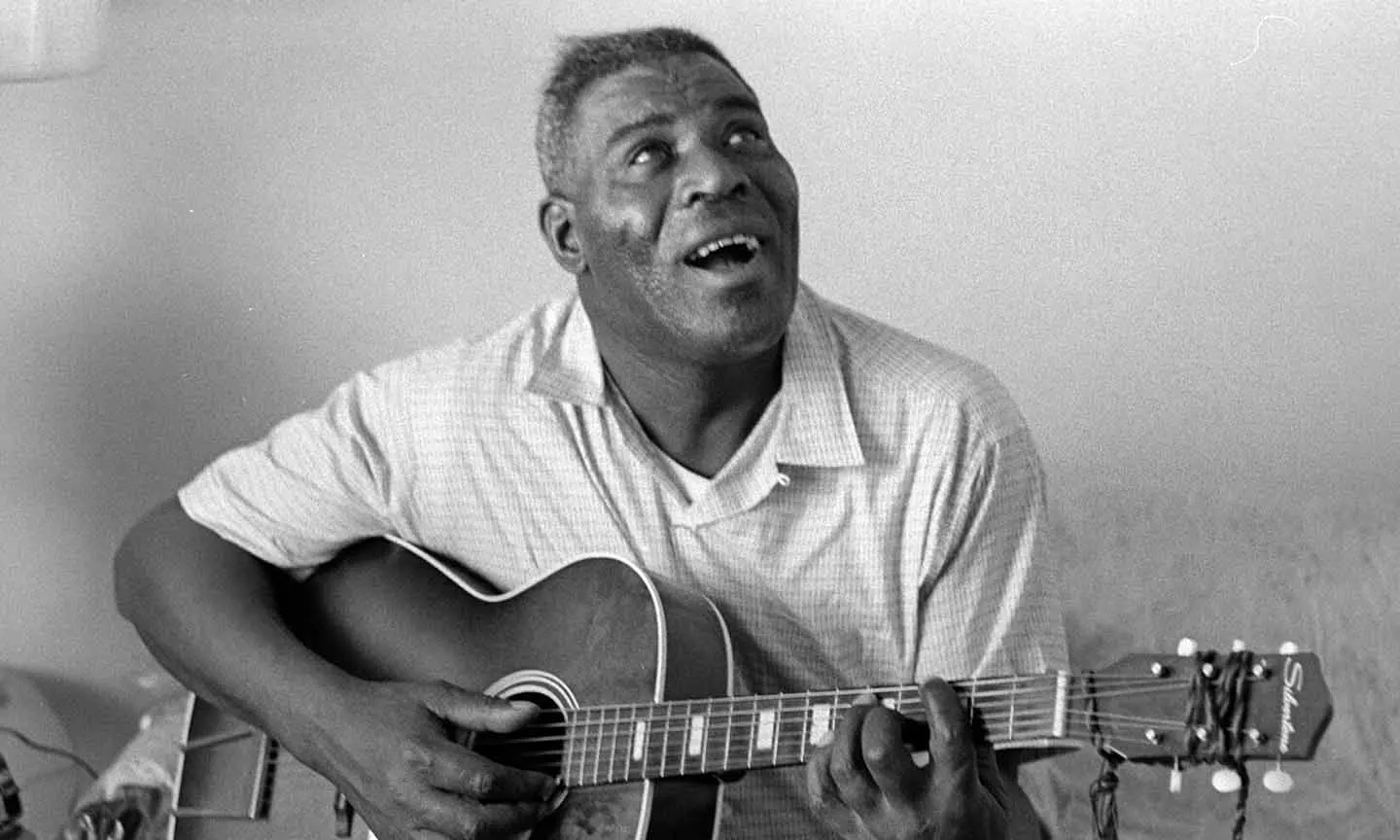
Howlin Wolf
Howlin Wolf, an iconic blues singer and composer was one of the principal exponents of the urban blues style of Chicago. He was born in West Point, MS, on June 20, 1910, and named for Chester A. Arthur, the 21st President of the United States. Burnett got the nickname “Wolf” because his grandfather would scare the youngster by telling him that the wolf in the woods would get him if he misbehaved. The rest of the family would then call him “Wolf” and howl at him. Burnett was brought up on a cotton plantation, and the music he heard was the traditional tunes of the region.
He started singing professionally when quite young and in the 1920s and ’30s performed throughout Mississippi, playing in small clubs. Burnett was influenced by other popular blues performers of the time, including the Mississippi Sheiks, Blind Lemon Jefferson, Ma Rainey, Lonnie Johnson, Tampa Red, and Charley Patton. He learned to play harmonica from blues legend Sonny Boy Williamson and added it to his performing arsenal. In 1930, Burnett met Charley Patton, the most popular bluesman in the Mississippi Delta at the time.
He would listen to Patton play nightly from outside a nearby juke joint. There he remembered Patton playing “Pony Blues“, “High Water Everywhere“, “A Spoonful Blues“, and “Banty Rooster Blues”. In the 1940s he went to Arkansas, where there was a flourishing blues tradition, and formed his own group. That group included James Cotton and Little Jr. Parker, both of whom became noted blues performers in their own right. Burnett developed a distinctive style, highlighted by his naturally raspy voice and howling, a technique he developed by trying to imitate Jimmie Rodgers’s signature yodels.
As “Howlin’ Wolf” he performed in the region with bluesmen including Johnny Shines, Floyd Jones, Sonny Boy Williamson II, and Robert Johnson. Burnett accompanied himself on guitar and harmonica. But his main instrument was his guttural and emotionally suggestive voice, which gave his songs power and authenticity. Howlin’ Wolf stood six-foot three and close to 300 pounds in his salad days. After his first record, “Moanin’ at Midnight” (1951), became a hit, Burnett relocated to Chicago and became one of the legends of Chess records. Upon arriving in Chicago, Burnett broke into the scene quickly and assembled a band in the West Memphis style.
In 1954, he recorded “Evil,” his biggest hit to that point. It was also the first of many tunes that Willie Dixon wrote for Burnett. In 1956, Burnett recorded his masterpiece work, “Smokestack Lightnin’.” He teamed up with guitarist Hubert Sumlin whose subtle soloing style behind Wolf’s voice was a hallmark of a long string of hit records. His band’s lineup rotated regularly and featured many influential Chicago-style blues performers. The great Willie Dixon, played bass and co-wrote classic Howlin’ Wolf songs such as “Spoonful” and “Little Red Rooster.”
Howlin’ Wolf was noted for his brooding lyrics and his earthy, aggressive stage presence. He was one of the principal exponents of the urban blues style of Chicago. Blues-rock fans all over the world recognized Wolf as the genuine article, a Delta Bluesman who conquered Memphis, then Chicago and then the world. Modern popular music owes much to Howlin’ Wolf, whose efforts bridged the divide between Delta country blues and Chicago electric blues, which he helped pioneer.