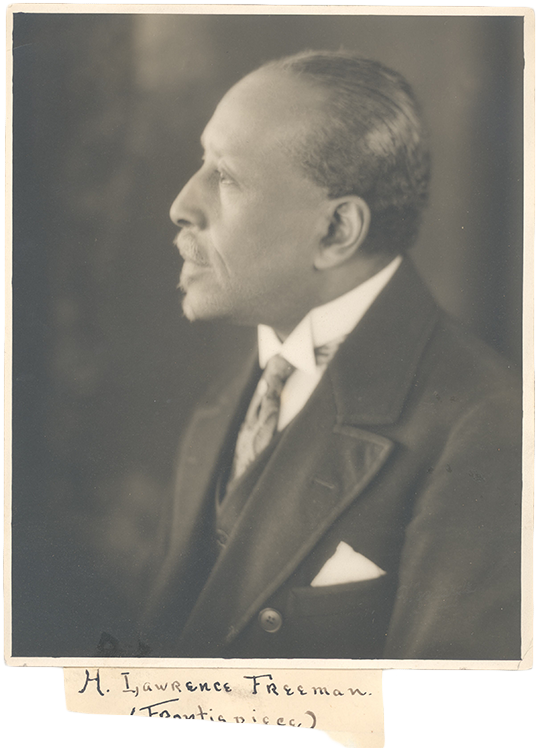
Harry Lawrence Freeman was a pioneering composer, librettist, conductor, and teacher. He became the first African American to compose an opera, adding nearly a score of works in the same genre during a long career as teacher and composer. Freeman was born in Cleveland, Ohio in 1869, four short years after the end of the Civil War and the freeing of the Southern slaves. He was slightly removed from the immediate reality of the aftermath of Southern slavery. His family had been free, and had been land owners, before the Civil War began. Freeman’s mother Agnes was an amateur singer, and the young Harry showed early talent as a musician.
Initially self-taught, Freeman’s musical abilities were apparent at a young age. Freeman showed early signs of impressive musicianship when at the age of ten he could play many melodies by ear on the reed organ, a skill he learned while attending public school. Because of familial affluence, Freeman opted to attend Cleveland’s Central High School, where he organized and directed a boy’s quartet and sang soprano. The quartet performed mostly at school events and churches in the area. He also worked as a church organist. After high school Freeman moved to Denver, Colorado, and began his early compositional phase. At the age of 18, he was working in the Denver Men’s Club, when saw his first opera, Richard Wagner’s "Tannhäuser". This memorable work of art changed Freeman’s life forever, and was inspired to compose his own works.
Smitten instantly with the idea of composition, he composed a wordless song for piano every day for the next 200 days. Eventually, Freeman discovered that he could also write the lyrics for his pre-made songs. In 1893 at age 24, Freeman moved back to Cleveland and began studying composition with Johann Beck, who at that time was the conductor of the Cleveland Symphony. Beck became Freeman’s first mentor and advocate, giving him the opportunity to test his new compositions with the premier ensemble of Cleveland. During his study with Beck, the Cleveland Symphony performed parts of his early operas. This is one of the first times an all White orchestra performed the music of a Black composer.
Beck compared Freeman’s musical style to that of the great German composer Wilhelm Richard Wagner. In 1891, he opened the Freeman Grand Opera Company in Denver. The company would perform his first operatic works, "Epthalia and The Martyr", at Denver’s Deutsches Theater in 1891 and 1893, respectively. Despite the comparison, Freeman could find work only in so-called “race” music. In the late 1890s, Freeman began work on an opera based on African mythology, and also published popular songs under the name H. Freeman. During this time, he even toured with the blackface minstrel group "Ernest Hogans Rufus Rastus Company", writing songs for them. In 1898, his second opera "Nada" was completed, and later was revised under the title Zuluki. At age 30, in 1899, he married a prominent singer and actress, Charlotte Louise Thomas.
In 1900, the Cleveland Symphony debuted excerpts from Freeman’s early operas. After receiving rave reviews of his music, Freeman moved to Chicago and became the music director and composer-in-residence for the Pekin Theater, where he composed his only ballet, "The Witches Dance" (1907), which was featured in a comedy sketch called Captain Rufus. While working at the Pekin, Freeman also had a two year tenure at Wilberforce University in Wilberforce, Ohio, teaching music classes. With the experience of teaching at Wilberforce, Freeman resettled in New York City in 1908, to open the Freeman School of Music in Harlem, which The [Indianapolis] Freeman described as “one of the most reliable in the city.
In Harlem the Freeman family saw many successes. Along with the Freeman School of Music, the Freeman School of Grand Opera and the Negro Grand Opera Company (NGO) were established, institutions that provided Freeman opportunity to have his works performed. His wife, possessed a beautiful dramatic or spinto soprano voice and was often the prima donna for her husband’s works. He composed several more operas in the years that followed, including "An African Kraal" (1903), "The Octoroon" (1904), and "Valdo" (1906). During his time in New York, Freeman was inspired by jazz, Tin Pan Alley, early Broadway musicals and vaudeville, and he began to incorporate these styles into his own. He was a friend and colleague of ragtime composer Scott Joplin. Both had followed the instructions of Antonín Dvořák when they acculturated African American practice with European opera structures. In his time, Joplin was known as the “King of Ragtime” and is one of the most influential composers in American history.
In addition to grand opera, Freeman wrote stage music and served as musical director for vaudeville and musical theater companies in the early 1900s. These included Ernest Hogan's Musical Comedy Company, the Cole-Johnson African-American musical theater company, and the John Larkins Musical Comedy Company. In 1912, Joplin, who was then living in New York, asked Freeman's help in revising his three-act opera, "Treemonisha," production of which had stalled the previous year. With the Negro Grand Opera Company, Freeman broadcast his opera "Voodoo", during 1913 and revised in 1924. Although Freeman finished composing the opera in 1914, it was not premiered until fourteen years later.
The first performance of "Voodoo" was on the radio station, WGBS on May 20, 1928. After the concertized version for radio, Freeman’s dreams were fulfilled when in August 1928 a fully staged production of Voodoo was mounted by the Negro Grand Opera Company of New York City at the famed Palm Garden. This production was the first African American grand opera to be performed on Broadway. Freeman received the prestigious William E. Harmon Foundation Award ($400 and a gold medal) in 1930 for Voodoo, an award given to the finest African American artists and composers.
"Voodoo" is perhaps Freeman's best known work. Freeman pushed more traditional grand opera limitations when composing Voodoo than with his previous operas. Instead of confining himself to only traditional Western European harmonies, he implements African American styles of spirituals, blues, jazz, and even voodoo chants. This shows just how ahead of his time he truly was. Voodoo is one of the most well known examples of jazz-opera fusion. It deals with the cult of that name in Louisiana. Voodoo does not follow Freeman’s typical cause-and-effect plot line as found in "The Martyr", but rather presents a treacherous love triangle that ultimately results in death. It takes place on a New Orleans plantation after the Civil War.
His ambitious Negro Grand Opera Company, only managed to mount a few performances in the decade. Since he was mostly barred from big-budget opera halls, Freeman staged some of his own productions. Vendetta, a three-act set in Mexico, was performed at the Lafayette Theater as well as Park Palace. The Tryst, a one-act about Native Americans, had an engagement in New York as well. Freeman faced the challenge of requiring musicians who understood the classical traditions of opera as well as the American styles he blended into it. He was guest conductor and composer/music director of the pageant "O Sing a New Song" at the Chicago World's Fair in 1934. The program for the pageant also featured other notable Black composers, such as Harry T. Burleigh, Will Marion Cook, W. C. Handy, and William Grant Still.
Freeman had big dreams for his operas. He even sent of of his scores to The Metropolitan Opera asking if they could stage the work in 1935. He was rejected, not because of the quality of the work, but because the Metropolitan Opera was not interested in staging a work by a Black composer. Freeman performed at Carnegie Hall twice during his lifetime, once in 1930 and again in 1947. In 1947 "The Martyr" — his first “grand opera” performed at the World’s Columbian Exhibition in Chicago in 1893 — took the stage at Carnegie Hall, with Freeman conducting an interracial cast. The production received reviews from both mainstream and African-American newspapers.
In addition to composing the music, Freeman wrote his own librettos for almost all of his operas. In the 1940s, Freeman was working regularly as a concert organizer and conductor and founded the Aframerican Opera Foundation to support African American composers and singers of opera. Among other luminaries, he asked Eleanor Roosevelt to sit on the board of directors. During the second World War, his music was largely forgotten. Although he failed to become as well known as his mainstream contemporaries, Freeman must, at least, be recognized as a bona fide pioneer for the next generation of African American composers. Harry Lawrence Freeman completed twenty-two operas over the course of his professional career. He passed away in 1954 in the midst of efforts to revitalize his work as both a composer and advocate.