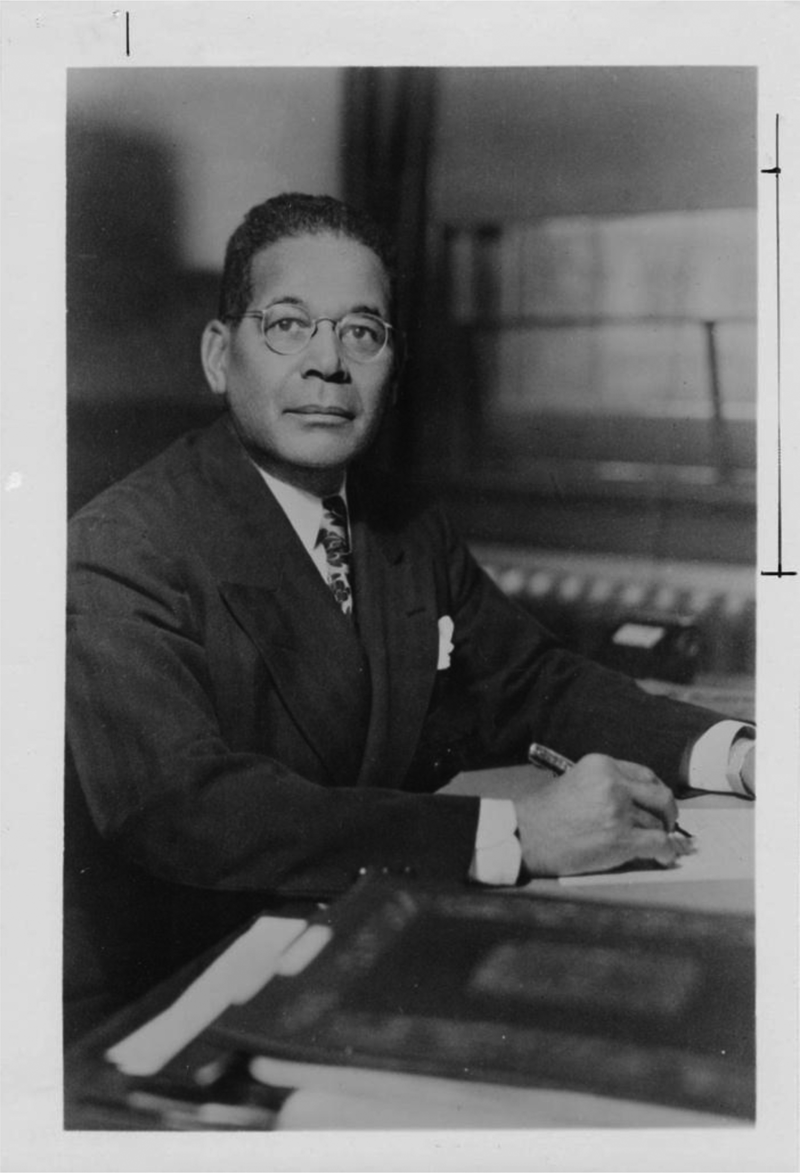
George Edmund Haynes, PhD, a noted sociologist and founder of the National Urban League, devoted his life to the betterment of African Americans through the establishment of socioeconomic programs. Haynes was born in Pine Bluff, Arkansas on May 11, 1880, the oldest of two children of a domestic worker mother and day laborer father. His family moved to Hot Springs, which offered Blacks better educational, social, and vocational opportunities. Haynes attended segregated schools as a child. His mother instilled in him a desire for self-improvement and a belief in formal education to escape poverty and discrimination. Her support, and ambition prompted him to pursue a college degree. Haynes completed a year of high school-level courses at the Agricultural and Mechanical College in Normal, Alabama.
Haynes enrolled at Fisk University in Nashville, TN in 1899. Four years late he received his Bachelor of Arts degree in 1903. With his mother and sister, he moved to New York City as part of the Great Migration out of the Deep South. He won a scholarship to Yale Graduate School, where he earned his master's degree in sociology in 1904. Haynes, in 1905 began his career at the Young Men’s Christian Association (YMCA) working with African American youth in the Association’s Colored Men’s Department, waiting tables and stoking furnaces to pay his living expenses and earning money to support his mother and sister.
During the summers of 1906 and 1907, Haynes studied at the University of Chicago. While studying at the University, Haynes became interested in social problems affecting Black migrants from the South. This interest led him to enrolled in the New York School of Philanthropy in 1908. The school's curriculum enthusiastically supported the need for social research as an integral part of the educational program. Haynes had developed a strong interest in social science while studying for his masters degree at Yale. George graduated from the School of Philanthropy in 1910, an achievement which marked a first for any African American student.
Following his graduation, Haynes continued his studies at Columbia which included further development of the research on the Black person in industry in New York. Haynes became the first African American scholar to earn a sociology PhD from Columbia University in 1912, completing his dissertation, “The Negro at Work in New York: A Study in Economic Progress”. After its completion, Haynes' thesis was honored by being selected for inclusion by the faculty of political science of Columbia University in a published series entitled, "Studies in History, Economics and Public Law". He began to teach at Fisk while completing his doctoral degree at Columbia University. It was customary for doctoral candidates to work on their degrees while teaching.
In addition to a strong commitment to research and sociology, Haynes was also dedicated to establishing a national organization to provide social work to newly urban Blacks in such an organization. To that end he cofounded, with White philanthropist Ruth Standish Baldwin, the Committee for Improving Industrial Conditions of Negroes in New York in 1910. The organizations included the Association for the Protection of Colored Women, and the Committee on Urban Conditions among Negroes. Shortly thereafter, Haynes and Baldwin led efforts to merge the committee and local welfare agencies to form the National League on Urban Conditions among Negroes (NCLUCAN), an organization which by 1916 had become synonymous with social work in the Black community.
The organization changed its name to the National Urban League in 1920. Haynes served as the first executive director from 1911 to 1918 of the new organization. He also was a co-founder and patron of "Opportunity: A Journal of Negro Life", an academic journal supported by the NUL. Under its founding editor, Charles S. Johnson, the journal also published African-American literature and arts, and encouraged it through playwriting competitions and related activities. During this time with the support of the YMCA, he toured the South and visited almost all of the Black colleges to assess African American higher education and encouraged students to achieve educational excellence and to help their schools set high academic standards.
From his interest in education, Haynes established the Association of Negro Colleges and Secondary Schools located at Fisk University. He directed and served as secretary of this program from 1910 to 1918. He further assisted in coordinating a collaboration between the New York School of Philanthropy and the NCLUCAN, which led to the creation of the nation’s first social work training program for African American graduate students at Fisk. Shorty after, Haynes was offered a position as director of the Department of Social Science. Haynes trained a skilled cadre of students in social science and social work. These students went on to excel in those fields and assist him in his academic research. As his research on the changing dynamics of race at the turn of the 20th century expanded, his reputation grew.
Despite the seriousness of Haynes' commitment and the high quality of his professional involvement in history, social work education, and sociological research, he was, in the main, ignored by the elite in both sociology and social work. It is difficult to account for his contributions being disregarded except for reasons of racial prejudice. His contributions to social work as founder of the first national social work organization for social services to Blacks and the first school of social work for Blacks have also been relegated to a footnote in social work history. The program of study that Haynes developed at Fisk reflected his faith that a thorough knowledge of sociology, economics and social problems was needed to alleviate social problems.
During his years as a traveling secretary for the Young Men's Christian Association, Haynes had worked out a schedule and kept records of the operation of the Jim Crow cars on Southern Railways and was planning to make that the basis for his thesis for doctoral research. As Haynes gathered data for this study between January, 1909 and January 1910, it became clearer to him that "Negroes were being influenced by the same economic and social forces as the Whites and the response of the two were similar" Sometime around 1914, Haynes developed the first course in a U.S. college related to Black history.
During World War I, the Woodrow Wilson administration worked to build African-American support for the war effort. in the early years of his term, Wilson had lost support among Blacks by enabling segregation of federal offices, which had been desegregated for decades. He acceded to the demands of Southerners in his Cabinet. This action was strongly protested by both individual Blacks and Whites, as well as by leading national organizations such as the NAACP and church groups. The new War Labor Administration, where he tried to mobilize Black workers in the national war effort. In the buildup of the defense industries, both Black and White workers were attracted to new, high-paying jobs, and there were often tensions between them due to competition for work.
In 1918 Haynes, was the educational secretary of the National Urban League. By 1918, President Woodrow Wilson had taken notice of Haynes’s work and tapped him to serve as the first Black American selected to a sub-cabinet-level position, in the capacity of Director of Negro Economics of the U.S. Department of Labor. Haynes was to advise Wilson in “all matters affecting Negroes.” Haynes developed ways to improve the labor conditions of Black workers. He began a series of discussions with Black leaders and others to gauge the most effective ways the federal government could help achieve this. Haynes set the stage for grass roots action in the states. By Armistice day in 1918, only half a year after Haynes' appointment, most large states East of the Mississippi had Black labor programs.
A total of 11 states had program committees by November 1918. They investigated "conditions of Negro workers, educated Negroes and whites on the need for good race relations, helped in job placements, alleviating discrimination and race friction, and developing recommendations for federal action. However, within a year of his arrival, race riots had broken out across the country, due in part to demographic shifts and changing social attitudes. Because of these race riots during the summer of 1919 and a backlash against modest racial reform, Southern Democrats undertook several initiatives that diminished Black Americans progress at the federal government level. This included de-funding Haynes’s new agency. It disappeared altogether when Warren G. Harding Administration took office in March 1921.
In 1921 Haynes became the first Executive Secretary of the Department of Race Relations for the Federal Council of the Churches of Christ in America. Here he applied his study and analysis to the question of race and religion in American society for the Council until his retirement in 1947. During the 1930s, Haynes turned his attention to research in conjunction with the YMCA, conducting surveys related to interracial cooperation on that organization’s effectiveness in South Africa during 1930 (before apartheid was legally established), and in other African nations. He was selected as a consultant on Africa by the World Committee of YMCAs.
After retiring from Fisk, Haynes taught at City College of New York from 1950 to 1959. He served on the board of trustees of State University of New York. From 1951 to 1960, he taught history and sociology classes at New York’s City College. Haynes was also a regional consultant for the YMCA in South Africa from 1942 to 1955. He wrote two books: Africa, Continent of the Future (1951) and Trend of the Races(1922), which demonstrate his belief in the union of all races. Haynes had always realized, that opening lines of communication between individuals, classes and institutions, mobilizing community resources and conducting scientific research were vital and legitimate professional responsibilities worthy of continued pursuit. He worked indefatigably, until his death January 8, 1960, to that realization.