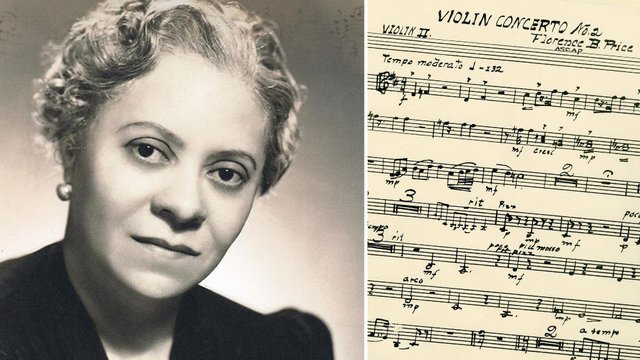
Florence Beatrice Price (née Smith) was a trailblazer in American classical music. She was the FIRST Black woman who became famous as a symphonic composer. Florence was born on April 9, 1887, in Little Rock, Arkansas, one of three children in a mixed-race family. Despite racial issues of the era, her family was well respected and did well within their community. Her father, Dr James Smith, was the sole African American dentist in Arkansas. Florence Price’s musical journey began at an early age, with the encouragement of her talented and supportive family. She began playing the piano and composing at age four and went on to have her first composition published at the age of 11. She attended Capitol Hill School in Little Rock, graduating as valedictorian in 1902. In 1903, when Price was only 16 years old, she attended the prestigious New England Conservatory of Music, in Boston, MA. This was a notable achievement for a Black woman at that time. Yet for a while, she told people she was of Mexican descent, on the advice of her mother who worried about the reception her daughter would receive.
Boston was a world away from her life in Arkansas, and it was no paradise. Despite segregation in public schools and transportation being prohibited in Massachusetts, discrimination remained. She took private composition lessons with George Whitfield Chadwick. Under Chadwick’s mentorship, Price experimented with African American folk inspirations in her compositions—something that would guide the rest of her musical career. She excelled in composition and performance, graduating with honors in 1906, at the age of 19. After earning her Artist’s Diploma in organ performance and a piano teacher’s diploma, Price returned to the South. After graduation, Florence returned to Arkansas to teach music at the Cotton Plant–Arkadelphia Academy. She left Cotton Plant after only one year, however, to teach at Shorter College in North Little Rock (Pulaski County), where she remained until 1910.
Smith moved to Atlanta, Georgia, in 1910 and headed the music department at Clark University in Atlanta in 1912. She married attorney Thomas Jewell Price on September 25, 1912. The couple had three children, a son, who died in infancy, and two daughters. Shortly they moved back to her home town of Little Rock, Arkansas. Her husband worked with Scipio Jones, a noted attorney who successfully defended the appeals of twelve Black men sentenced to death in the aftermath of the Elaine Massacre in Phillips County during the Red Summer of 1919. While in Little Rock, Price established a music studio, taught piano lessons, and wrote short pieces for piano. Despite her credentials, she was denied membership into the Arkansas State Music Teachers Association because of her race.
In 1927, a series of horrifying racial incidents prompted more than 5,000 White people to riot in the area. The Chicago Defender, an African American newspaper, reported that in the following days, more than 400 Black people left the city fearing for their lives, many heading north. The Defender was later banned from circulation in Little Rock, out of “concern” it would “stir up” racial tensions. The Price family was part of the exodus to move to Chicago, Illinois. Here, Price seemed to have more professional opportunity for growth despite the breakdown and eventual dissolution of her marriage. Price found a rich and vibrant community of Black musicians in Chicago. She was part of the Chicago Black Renaissance, which was really a subset of the Harlem Renaissance. She studied composition, orchestration, and organ with the leading teachers in the city. Price found a rich and vibrant community of Black musicians in Chicago. She began studying at the American Conservatory of Music and Chicago Musical College and established herself in the Chicago area as a teacher, pianist, and organist.
Financial struggles and the failed relationship with her husband, Florence Beatrice Price divorced her husband in 1931. She became a single mother, but she and her daughters remained in Chicago. To make ends meet, she also taught music privately to young students, including high schooler Margaret Bonds, in the community. Florence and her daughters moved in with the family of Bonds, whose mother, was a leading light in Chicago’s vivacious musical community. To make ends meet she worked as an organist for silent film screenings and composed songs for radio ads under a pen name. Florence became the director of the Chicago Treble Clef Club, a group that organized recitals and events around the city. She was an active member of the National Association of Negro Musicians (NANM), an organization that is dedicated to uplifting and preserving the music of African Americans. Through the NANM, Florence met luminaries such writer Langston Hughes and contralto Marian Anderson, both prominent figures in the art world who aided in Price's future success as a composer.
Florence and Margaret started collaborating and began to achieve national recognition for their compositions and performances. In 1932, both Price and Bonds submitted compositions for the Wanamaker Foundation Awards. Price won first prize with her "Symphony in E minor", and third for her Piano Sonata, earning her a $500 prize. (Bonds came in first place in the song category, with a song entitled "Sea Ghost".) Founded in 1927 by philanthropist Rodman Wanamaker, the contest reflected his desire to create a platform for Black composers. Opportunities like the Wanamaker Music Contest were few and far between for Black musicians. Price's "Symphony in E minor" is a thrilling four-movement work packed with soaring melodies, inventive writing and gorgeous harmonies. The first prize piece was performed by the Chicago Symphony Orchestra under the German-born conductor Frederick Stock. It premiered on June 15th, 1933 at the Chicago's Worlds Fair. This historic concert made Florence Beatrice Price the FIRST African American woman to have a symphony performed by a major national orchestra.
That concert was followed quickly by orchestras of Detroit, Michigan; Pittsburgh, Pennsylvania; and Brooklyn, New York. That concert also included the first Black soloist with the Chicago Symphony, her friend Margaret Bonds. In this regard, Price shared similar accomplishments with fellow Black composers William Grant Still and William Dawson, whose works were performed by leading orchestras in the 1930s and 1940s. Price was the first Black female classical composer to achieve this level of recognition in the United States and Europe. In 1934, Price represented her class at the Chicago Musical College, performing her "Concerto in D minor" for Piano and Orchestra as part of the 1934 commencement program. This performance was met with critical acclaim. Florence Beatrice Price would go on to perform this Concerto at the National Association of Negro Musicians in Pittsburgh, gaining further critical praise from The Pittsburgh Press and the Pittsburgh Sun Telegraph. The Telegraph specifically praised Price's blending of her African American culture into her work, calling it "real American music."
On October 12, 1934, the Women's Symphony Orchestra of Chicago, a well known orchestra, performed the "Concerto in D Minor". This began a long term association between the orchestra and Price. This partnership helped Florence to gain recognition, and her Concerto in D minor would go on to be performed by other major symphonies within her lifetime. This national and international recognition made her more popular back home. Price made considerable use of characteristic African American melodies and rhythms in many of her works. Her "Concert Overture on Negro Spirituals", "Symphony in E minor", and "Negro Folksongs in Counterpoint" for string quartet, all serve as excellent examples of her idiomatic work. Florence’s music brings together the European classical tradition in which she was trained and the haunting melodies of Black spirituals and folk tunes. Throughout the rest of the 1930s Price taught music lessons, continued to compose for piano and organ, and worked as an orchestrator for WGN radio and as an organist for silent films.
Price’s songs were performed by many prominent singers of her day, including Leontyne Price, Blanche Thebom, and Etta Moten. Her compositional style combined contemporary influences, such as those of the Harlem Renaissance. Under the name Vee Jay she also wrote a number of popular tunes such as "Songs to the Dark Virgin" and "Hold Fast to Dreams". Marian Anderson performed "Songs to Dark Virgin" and "My Soul’s Been Anchored in de Lord" on the world stage on the steps of the Lincoln Memorial in Washington DC on Easter Sunday, April 9, 1939– before an integrated audience of 75,000 people. This boosted Price's fame and popularity even further. A number of Price's other orchestral works were played by the Works Progress Administration Symphony Orchestra of Detroit and the Women's Symphony Orchestra of Chicago. In 1935, the Alumni Association of Philander Smith College in Little Rock sponsored Price’s return to Arkansas, billing her as “noted musician of Chicago” and presenting her in a concert of her own compositions at Dunbar High School.
In 1940, Price was the first Black woman inducted into the American Society of Composers, Authors, and Publishers for her work as a composer. Price continued composing in the 1940s and early ’50s. She completed her Fourth Symphony in 1945, but it failed to gain traction and was never performed during her lifetime. Even though her training was steeped in European tradition, Price's music consists of mostly the American idiom and reveals her Southern roots. She wrote with a vernacular style, using sounds and ideas that fit the reality of urban society. Being deeply religious, she frequently used the music of the Black church as material for her arrangements. In 1949, Price published two of her spiritual arrangements, "I Am Bound for the Kingdom", and "I'm Workin' on My Buildin'", and dedicated them to Marian Anderson, who performed them on a regular basis. In 1951, Florence was contacted by Sir John Barbirolli, the musical director of the Halle Orchestra in Manchester, England. He commissioned her to compose a symphony incorporating the traditional spirituals that had become synonymous with her work. Florence completed the score, but health issues prevented her from attending the premiere performance in Manchester.
Florence Beatrice Price composed more than 300 works, ranging from small teaching pieces for piano to large-scale compositions such as symphonies and concertos, as well as instrumental chamber music, vocal compositions, and music for radio. Price faced significant racial and gendered discrimination which precluded her from attaining widespread recognition within the classical mainstream during her lifetime. Her musical style is a mixture of classical European music and the sounds of Black spirituals, especially the rhythms associated with African heritage Even though her training was steeped in European tradition, Price's music consists of mostly the American idiom and reveals her Southern roots. She wrote with a vernacular style, using sounds and ideas that fit the reality of urban society. Price died in 1953 leaving a vast legacy of orchestral, choral, chamber, spirituals, symphonies, piano, and organ work. Florence Beatrice Price believed that music goes deep, just like Religion. She was dedicated, driven, and exacting in all facets of life, including music. She was a true learner. Music, which was initially her passion, became the genre that offered her fulfillment. Price lived and worked when America was a segregated country and during a period when African-Americans had no recognized civil rights. Even so, her enormous talent and perseverance gained her a place among the country's finest musicians.