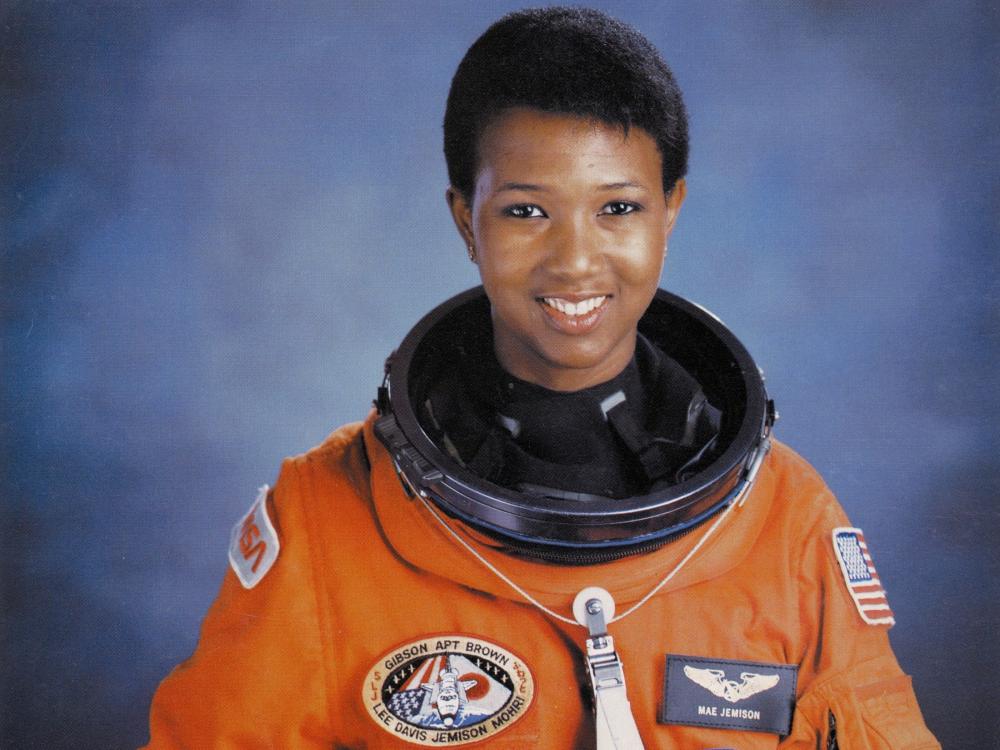
Mae Jemison
Mae Jemison, the first African American woman to become an astronaut, has always been an overachiever. She was one of seven crew aboard the Space Shuttle Endeavour, on a mission named STS-47. The youngest of three children, Jemison was born on October 17, 1956, in Decatur, Alabama, but moved to Chicago, Illinois, at the age of three. Jemison became convinced she wanted to pursue a career in biomedical engineering during her time at Morgan Park High School. A determined student, Jemison received a scholarship to attend Stanford University at the age of just 16, where she studied degrees in chemical engineering and African and African-American studies. At Stanford, Jemison served as head of the Black Students Union.
After graduating, she continued her education at Cornell University Medical College in New York, getting her medical degree in 1981. Knowing she wanted to work in the developing world, and ultimately work on biomedical engineering research, she applied to serve as a Peace Corps Volunteer, and became a medical officer in Sierra Leone and Liberia from 1983 to 1985. She also pursued graduate courses in engineering and was one of 15 accepted out of around 2000 applicants.
Following her return to the United States in 1985, Jemison made a career change and decided to follow a dream she had nurtured for a long time. That October, she applied for NASA’s astronaut training program. The Challenger disaster of January 1986 delayed the selection process, but when she reapplied a year later, Jemison was one of the 15 candidates chosen from a field of about 2,000. On June 4, 1987, Jemison became the first Black woman to be admitted into the NASA astronaut training program.
She completed her training in 1988, and served in 1992 as a mission specialist on the space shuttle Endeavour. On September 12, 1992, 36 years old, Mae C. Jemison became the first African American woman in space when she joined the Space Shuttle Endeavour crew and spent eight days in space. As a science mission specialist, her responsibility was to conduct motion sickness and bone cell experiments on the crew during the mission. As mission specialist, she was responsible for conducting scientific experiments exploring weightlessness, motion sickness and bone cells while on the shuttle.
The following year, Jemison left NASA after serving as an astronaut for six years in total and founded the technology consultancy “The Jemison Group,” followed by a non-profit organisation called the Dorothy Jemison Foundation for Excellence in honour of her mother. Through her foundation, Jemison is now leading the US government-funded 100 Year Starship project, which aims to help develop the technology needed to achieve interstellar space flight within a century. Dr. Jemison is a member of the National Academy of Medicine. She has garnered many of the nation’s highest national, academic, and institutional honors for her public service as an astronaut, scientist, healthcare provider, and educator.