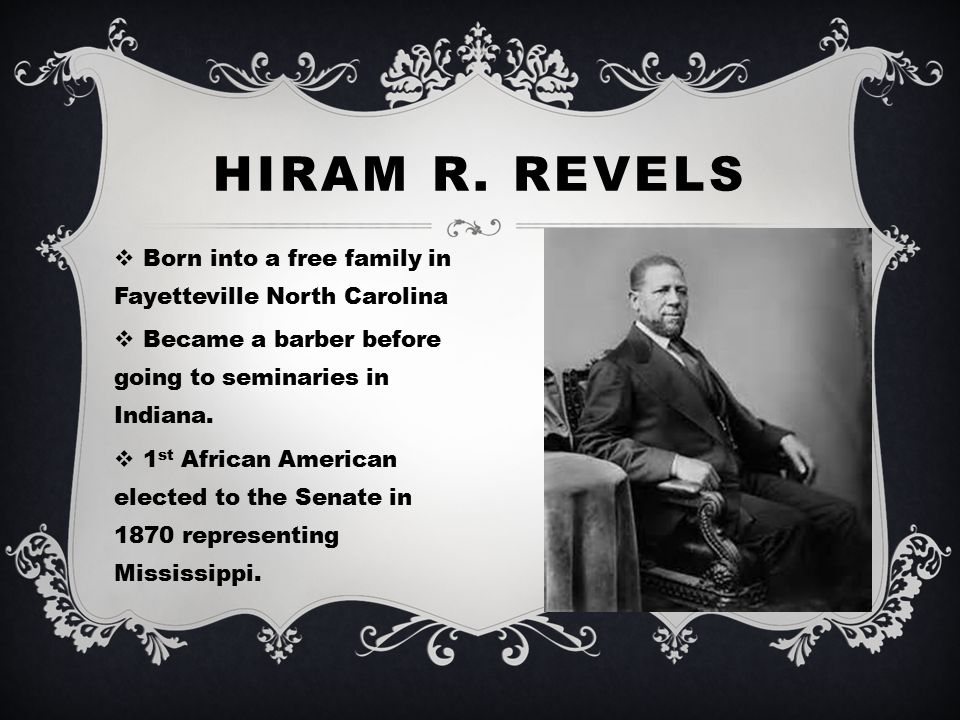
Hiram Rhodes Revels was the first African American to serve in the United States Senate. He was elected by the Mississippi legislature as a Republican in 1870 and 1871 during the Reconstruction era. Revels was born in 1827, Fayetteville, North Carolina. In 1845, he was ordained as a minister in the African Methodist Episcopal Church, working as an itinerant preacher and educator in Kansas, Kentucky, and Tennessee. Revels also served in the Civil War as a chaplain and he was at the battles of Vicksburg and Jackson in Mississippi. After the Union authorized establishment of the United States Colored Troops, he helped recruit and organize two Black regiments in Maryland and Missouri.
In 1865, Revels left the AME Church, the first independent Black denomination in the US, and joined the Methodist Episcopal Church. He was assigned briefly to churches in Leavenworth, Kansas, and New Orleans, Louisiana. After the war, he settled in Natchez, Mississippi, continuing his educational and religious works. In 1866, he was called as a permanent pastor at a church in Natchez, Mississippi, where he settled with his wife and five daughters. He became an elder in the Mississippi District of the Methodist Church, where he continued his ministerial work, and founded schools for Black children.
During Reconstruction, Revels garnered enough community support to win election to the position of alderman in 1868, during the first phase of Reconstruction in 1868. In 1869 he was elected to represent Adams County in the Mississippi State Senate. The next year in 1870, Revels was elected by a vote of 81 to 15 in the Mississippi legislature. He would finish the term of one of the state’s two seats in the U.S. Senate, which had been left vacant since the Civil War. Senator Charles Sumner of Massachusetts made the closing argument for Revels' admission, declaring: "All men are created equal, says the great Declaration, and now a great act attests to this verity. Today we make the Declaration a reality."
However, when Revels arrived in Washington in late January 1870, it was clear he would have opposition from people who objected to a Black person serving in the U.S. Senate. There were still a handful of Southern Democrats in Congress and they raised several barriers. The first argument was that a Senate candidate had to be a United States citizen for at least nine years before assuming office. This logic pointed to the Supreme Court’s controversial Dred Scott decision from 1857, that Blacks Americans weren’t American citizens. Revels had only been a citizen since the 14th Amendment was ratified in 1868.
Another argument was that Mississippi was still under military rule and a civilian government needed to confirm Revel’s election. The issue came to a head on February 23, 1871, when Mississippi was officially admitted back into the Union, and a floor vote came up to seat Revels in the Senate. Republicans cut off objections from the southern Democrats, and the vote was 48-8 to let Revels take his Senate seat, becoming the first Black man to serve in the U.S senate. In his maiden speech to the Senate on March 16, 1870, he argued for the reinstatement of the Black legislators of the Georgia General Assembly. They had been illegally ousted by the White Democratic Party representatives.
Revels was praised for his well-crafted speeches and diplomatic approach to a tense congressional environment. In his brief career as senator, Revels advocated compromise and moderation. He vigorously supported racial equality and worked to reassure his fellow senators about the capability of Black Americans. Revels chose not to seek more time in the Senate, and he left Washington in March 1871. Instead, Revels accepted appointment as the first president of Alcorn Agricultural and Mechanical College (now Alcorn State University) in 1871.
Revels remained active in the religious and educational communities for the rest of his life. Revels retired in 1882 and returned to his former church in Holly Springs. He also edited the Southwestern Christian Advocate newspaper, the official organ of the AME Church. In 1875, Blanche Kelso Bruce, also of Mississippi and of African American descent, was elected to the Senate and served a full six-year term. . Another eight decades passed before Senator Edward Brooke of Massachusetts followed in Revels and Bruce’s historic footsteps to take office in 1967.