-
Road To
Brown vs Board of Education -
Plessy vs Ferguson
Decision -
Overturning
Plessy vs. Ferguson -
Briggs vs Elliot
-
Clarendon County
-
Supreme Court
Decision -
Thurgood Marshall
The Road to the Brown vs Board of Education is the brief story of how school segregation was banned. While there were cases from the States of Kansas, South Carolina, Virginia, and Delaware, that were consolidated in the Brown vs Board of Education, here I focused on the Clarendon County, South Carolina case. They were all strong cases, but the South Carolina was in many regards the strongest of the four cases in Brown vs Board of Education. The South Carolina case was the first where a challenge to the constitutionally of segregated schools was issued.
Before the Brown case, there was Plessy vs. Ferguson case in 1896. In the Plessy case, the Supreme Court decided by a 7-1 margin that “separate but equal” public facilities could be provided to different racial groups. In his majority opinion, Justice Henry Billings Brown pointed to schools as an example of the legality of segregation. The lone dissenter was Justice John Marshall Harlan.
Charles Houston Hamilton lead attorney for the NAACP Legal Defense fund and Dean of Howard School of law, believed NAACP attorneys could attack segregation. He used the Fourteenth Amendment’s promise that no state shall deny any person equal protection of the laws. Houston planned for NAACP attorneys to attack Plessy v. Ferguson, and South Carolina’s schools proved that separate was nowhere near equal.
The "Briggs v. Elliott" case began as a simple request to provide bus transportation. In addition the parents of the children in Clarendon County wanted their schools to come up to standard, the same as the White schools. But the NAACP lawyers decided all education lawsuits should seek the final relief of “non-segregation.” So, in May of 1951, the NAACP lawyers, now led by Hamilton's protégé, Thurgood Marshall, argued the Briggs case in front of three federal judges. As expected they lost.
On appeal the "Briggs v. Elliott" case headed to the U.S. Supreme Court, the first of five lawsuits to challenge segregation in what became Brown v. Board of Education of Topeka, Kansas. On May 17, 1954, Warren read the final decision. The Supreme Court was unanimous in its decision that segregation must end. In its next session, it would tackle the issue of how that would happen. “We conclude that in the field of public education the doctrine of ‘separate but equal’ has no place. Separate educational facilities are inherently unequal,” Warren said.
But this was not the end. The Court wanted to hear arguments in its next term about how and when. On May 31, 1955, in its second ruling, known as Brown II, the Supreme Court left implementation vague, giving local authorities primary responsibility to admit plaintiffs to public schools “with all deliberate speed.”
Separate But Equal: Plessy v. Ferguson
Although the Declaration of Independence stated that “All men are created equal,” due to the institution of slavery, this statement was not to be grounded in law in the United States until after the Civil War (and, arguably, not completely fulfilled for many years thereafter). In 1865, the Thirteenth Amendment was ratified and finally put an end to slavery. Moreover, the Fourteenth Amendment (1868) strengthened the legal rights of newly freed slaves by stating, among other things, that no state shall deprive anyone of either “due process of law” or of the “equal protection of the law.” Finally, the Fifteenth Amendment (1870) further strengthened the legal rights of newly freed slaves by prohibiting states from denying anyone the right to vote due to race.
Despite these Amendments, Blacks were often treated differently than Whites in many parts of the country, especially in the South. In fact, many state legislatures enacted laws that led to the legally mandated segregation of the races. In other words, the laws of many states decreed that Blacks and Whites could not use the same public facilities, ride the same buses, attend the same schools, etc. These laws came to be known as Jim Crow laws. Although many people felt that these laws were unjust, it was not until the 1890s that they were directly challenged in court.
On June 7th 1892, a man named Homer Plessy, who was of seven-eighths Caucasian bought a ticket on the East Louisiana Railroad and took a seat in the white coach of the segregated train. When asked to move, he refused and was arrested and jailed. Plessy, contending that the Louisiana law separating Blacks from Whites on trains violated the “equal protection clause” of the Fourteenth Amendment to the U.S. Constitution, decided to fight his arrest in court. By 1896, his case had made it all the way to the United States Supreme Court. By a vote of 8-1, the Supreme Court ruled against Plessy. In the case of Plessy v. Ferguson, Justice Henry Billings Brown, writing the majority opinion, stated that:
“The object of the [Fourteenth] amendment was undoubtedly to enforce the equality of the two races before the law, but in the nature of things it could not have been intended to abolish distinctions based upon color, or to endorse social, as distinguished from political, equality. . . If one race be inferior to the other socially, the Constitution of the United States cannot put them upon the same plane.” The lone dissenter, Justice John Marshal Harlan, interpreting the Fourteenth Amendment another way, stated, “Our Constitution is color-blind, and neither knows nor tolerates classes among citizens.” Justice Harlan pointed out that those Reconstruction Amendments banned racial discrimination and the Thirteenth and Fourteenth Amendments removed the “race line from our systems of government,” and challenged the majority opinion itself as unconstitutional. Justice Harlan’s dissent would become a rallying cry for those in later generations that wished to declare segregation unconstitutional.
Sadly, as a result of the Plessy decision, in the early twentieth century the Supreme Court continued to uphold the legality of Jim Crow laws and other forms of racial discrimination. In the case of Cumming v. Richmond (Ga.) County Board of Education (1899), for instance, the Court refused to issue an injunction preventing a school board from spending tax money on a white high school when the same school board voted to close down a Black high school for financial reasons.
Moreover, in Gong Lum v. Rice (1927), the Court upheld a school’s decision to bar a person of Chinese descent from a “White” school. The Plessy v. Ferguson verdict enshrined the doctrine of “separate but equal” as a constitutional justification for segregation, ensuring the survival of the Jim Crow South for the next half-century. It would not be until the landmark case Brown v. Board of Education in 1954, at the dawn of the civil rights movement, that the majority of the Supreme Court would essentially concur with Harlan’s opinion in Plessy v. Ferguson.
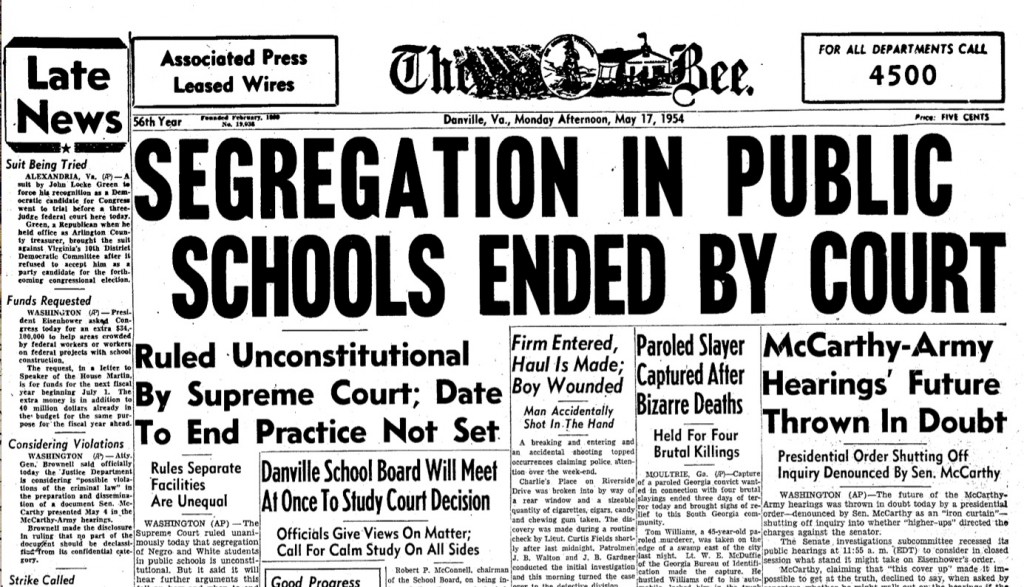
Court Bans School Segregation: Plessy v. Ferguson Overturned
In the Brown vs Board of Education of Topeka case the U.S. Supreme Court ruled unanimously (9–0) that racial segregation in public schools violated the Fourteenth Amendment to the Constitution. It prohibited the states from denying equal protection of the laws to any person within their jurisdictions. The decision declared that separate educational facilities for White and Black students were inherently unequal. They demanded states to desegregate all public schools “with all deliberate speed”. It thus rejected as inapplicable to public education the “separate but equal” doctrine, advanced by the Supreme Court in Plessy v. Ferguson (1896).
Although the 1954 decision strictly applied only to public schools, it implied that segregation was not permissible in other public facilities. Considered one of the most important rulings in the Court’s history, Brown v. Board of Education helped inspire the American civil rights movement of the late 1950s and ’60s. In 1954, large portions of the United States had racially segregated schools, made legal by Plessy v. Ferguson (1896), which held that segregated public facilities were constitutional so long as the Black and White facilities were equal to each other.
However, by the mid-twentieth century, civil rights groups set up legal and political, challenges to racial segregation. Segregation laws began cropping up across the country. Kansas, despite being a free state, allowed for segregation of elementary schools in cities with populations of 15,000 or more as early as 1879. Parents began to challenge these laws as early as 1881. By 1950, 11 court challenges to segregated schools had reached the Kansas State Supreme Court. Unfortunately, none of them were successful. In the early 1950s, NAACP lawyers brought class action lawsuits on behalf of Black schoolchildren and their families seeking court orders to compel school districts to let Black students attend White public schools.
One of these class actions, Brown v. Board of Education was filed against the Topeka, KS. The first plaintiff was Oliver Brown, an African American welder and assistant pastor, who brought the case against the Topeka Board of Education. The board refused to allow Olivier Brown’s daughter and the other Black children to attend the White school located in their neighborhoods. Brown claimed that Topeka’s racial segregation violated the Constitution’s Equal Protection Clause because the city’s Black and White schools were not equal to each other and never could be.
The federal district court dismissed his claim, ruling that the segregated public schools were “substantially” equal enough to be constitutional under the Plessy doctrine. The judges denied relief on the grounds that the Black and White schools in Topeka were equal with respect to buildings, transportation, curricular, and educational qualifications of teachers. Brown appealed to the Supreme Court, which consolidated and then reviewed all the school segregation actions together. Thurgood Marshall, was chief counsel for the plaintiffs. In October 1952 the Court consolidated the Brown lawsuits filed by the NAACP. The Brown v Board of Education comprised five cases: Brown itself, Briggs v. Elliot (filed in South Carolina), Davis v. County School Board of Prince Edward County (filed in Virginia), Gebhardt v. Belton (filed in Delaware), and Boiling v. Sharpe (filed in Washington D.C.).
Brown v. Board of Education was argued on December 9, 1952. The attorney for the plaintiffs was Thurgood Marshall, who later became the first African American to serve on the Supreme Court (1967–91). The case was reargued on December 8, 1953, to address the question of whether the framers of the Fourteenth Amendment would have understood it to be inconsistent with racial segregation in public education. The decision in Brown v. Board of Education forced the desegregation of public schools in 21 states and intensified resistance in the South. This was particularly evident among White supremacist groups and government officials sympathetic to the segregationist cause.
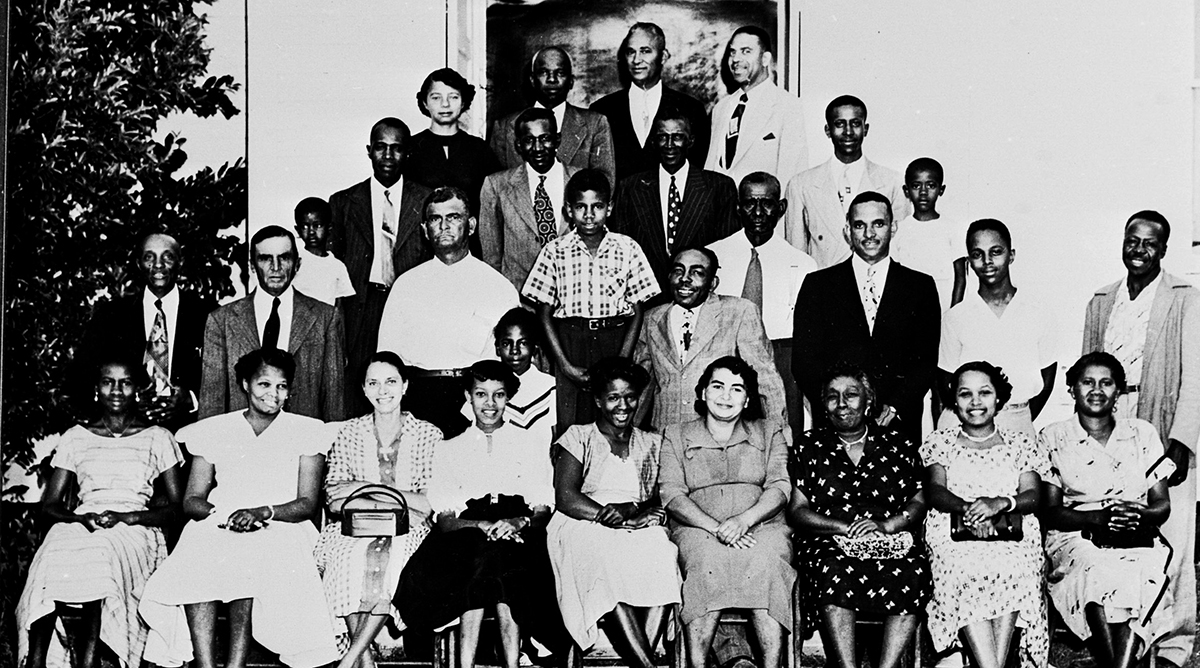
Rev. J.A DeLaine, Harry Briggs and other petitioners.
The legal action in Summerton, South Carolina began in 1947. Ironically the push to take action derived from a fortuitous encounter between Rev. James Hinton, president of the South Carolina NAACP and Rev. J.A. DeLaine a local school teacher. The NAACP leader, through a speech attended by DeLaine, issued a challenge to find the courage to test the legality of the discriminatory practices aimed at African American school children. Clarendon County county had provided schools for White students complete with running water, electricity, libraries, classrooms for each grade level, and transportation to and from school. Meanwhile they provided few if any of those same accommodations for Black students.
Rev. J.A. DeLaine was teaching in St. Paul Rural Primary School and also serving several small churches as an A.M.E. Minister. (Initially schools for the Black children in Clarendon County began in their churches and gradually moved to separate buildings. Therefore, many schools and churches had the same names such as Liberty Hill A.M.E. and Liberty Hill Elementary.) The Black parents in Clarendon County started with a simple request, a school bus. The district had more than 30 buses for White students, yet none for Black students.
Many Black students had to walk, sometimes as far as eight miles each way to school. Rev. DeLaine approached Clarendon County school officials but failed to secure school buses. School officials justified their refusal by claiming that since the Black community did not pay (collectively) much in taxes it would be unfair to expect White citizens to provide transportation for African American school children. Even a letter writing campaign launched by Rev. DeLaine yielded no assistance from state educational officials.
Because of the urgent need Black parents collected donations within their community and purchased a second-hand school bus. The continual repairs on the bus proved to be too costly for the parents. Again frustration prompted Rev. DeLaine to seek relief from the District Superintendent L.B. McCord. It was hoped that since McCord was a fellow minister he would be sympathetic. However, he refused to even consider Rev. DeLaine’s request. Remembering the words of Rev. Hinton, the NAACP state president, DeLaine knew it was time to take legal action.
On March 16, 1948 local attorney Harold Boulware together with Thurgood Marshall, filed in U.S. District Court the case of Levi Pearson v. County Board of Education. Their case was dismissed on the technical matter of where Mr. Pearson paid his taxes. Levi Pearson’s property spanned more than one district. He paid taxes in both districts, and sent children to school in both districts, but his house sat in only one district while the lawsuit was in another. The court ruled that Pearson had no legal standing because he paid taxes in District 5 and his children attended school in districts 22 and 26.
This did not stop Rev. DeLaine. He sent a petition for the community to sign to begin a new court case and by November 1949 he had obtained enough signatures to file a second case. The national office of the NAACP agreed to sponsor their case. It would give Clarendon’s African Americans not just buses but would seek educational equality. In May of 1950 with the help of the NAACP Legal Defense Fund, the case of Briggs v. Elliott was filed. The Briggs case was named for Harry Briggs, who brought suit against R.W. Elliott, the president of the school board for Clarendon County, South Carolina.
Harry and Eliza Briggs signed first for “educational advantages and facilities equal in all respects to that which is provided for whites,” followed by children Harry Jr., Thomas Lee and Katherine. By the end, 107 parents and their children had signed the petition to sue the school district in federal court. Two months later, it was decided by the petitioners and the national NAACP board that rather than simply pursue equalization of facilities and obtaining buses, but to attack segregation head on.
A three-judge panel at the U.S. District Court was presented with substantial psychological evidence and expert testimony presented on African American school conditions. The court ruled against the petitioners and ordered schools to be equalized, focusing on equalization and ignoring the broader question of the constitutionality of segregation. In a lone dissenting opinion from the Briggs decision, Judge Julius Waring adamantly opposed segregation in public education. Gov. James F. Byrne, a former U.S. Supreme Court associate justice, had already began the process of “equalizing” schools, statewide.
He instituted a 3-cent sales tax to be put toward building of equal school buildings as an effort to preserve segregation by eliminating the NAACP’s argument of unequal education. In his own words, Byrne believed “This is a white man’s country and will always remain a white man’s country.” The states action resulted in an NAACP appeal to the U.S. Supreme Court. The Briggs case became part of the Brown vs Board litigation. The Briggs case evoked an extreme reaction. All of the petitioners suffered swift and severe hardships for their courage. Harry Briggs, the lead plaintiff, lost his job as a gas station attendant.
Rev. DeLaine saw his home burned to the ground. Federal Judge Walter Waring, who sided with the petitioners concerns, was forced to leave the state by a joint resolution of the South Carolina House of Representatives. The Briggs v. Elliot case is remembered as a pivotal moment in the struggle for racial equality and educational justice. It exposed the systemic inequalities in the American education system. It is fitting to note, that Harry and Eliza Briggs, Reverend Joseph A. DeLaine, and Levi Pearson were awarded Congressional Gold Medals posthumously in 2003. It was long overdue and in some ways, too little.
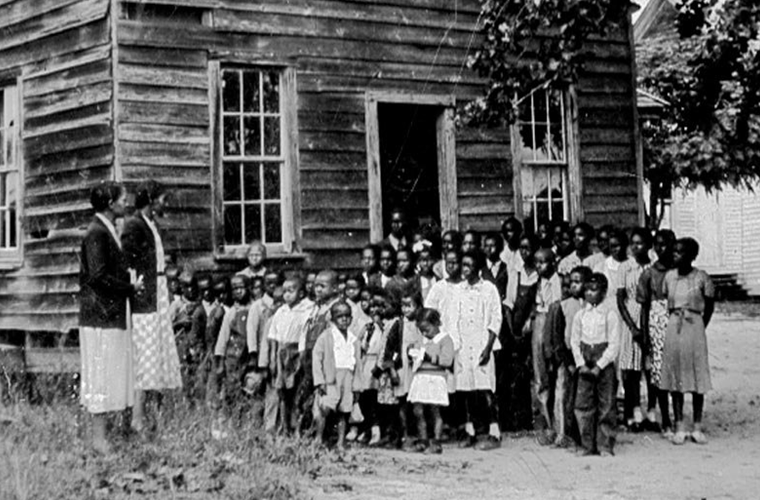
Clarendon County School Children
In November 1950 Marshall presented the case of the twenty plaintiffs from Clarendon County to the federal district court in Charleston. During the pretrial hearing he was encouraged by federal judge J. Waites Waring of Charleston not to argue for a “separate but equal” education, or one that would only equalize African American schools in a segregated system. Judge Waring encouraged him instead to present a case arguing for schools for African American children that would truly be equal by asking for an end to segregation in the state’s public schools.
Taking Waring’s advice, on 28th May 1951 Marshall returned to the federal court and presented his case for ending segregation in the state’s public schools. Thurgood Marshall, Robert Carter, and Spottswood Robinson brought the case before a three-judge panel at the federal courthouse in Charleston, South Carolina. The defendant was Roderick W. Elliott, a local sawmill owner and the school board chairman. The plaintiff was Harry Briggs and the case was named Briggs vs. Elliott. Marshall, Carter and Robinson argued that segregated schools harmed Black children psychologically and violated the Fourteenth Amendment’s guarantee of equal protection under the law.
They introduced evidence showing how the Black schools in Clarendon County were grossly unequal to those for Whites in facilities, teacher-to-student ratios, class sizes, and expenditures per student. The average South Carolina school district was spending $221 per White student and only $45 per Black student in its schools. Clarendon County, spent $179 per White student and only $42 per Black student. The attorneys representing the state of South Carolina sought to defuse this argument by announcing that Governor James F. Byrnes was going to introduce a new sales tax to raise money to improve the state’s African American schools. But Marshall also presented testimony from the sociologist Kenneth Clark documenting the harmful effects of segregation on the lives and psyches of African American children in South Carolina.
The case was heard by a three-judge district court panel, consisting of Fourth Circuit Judge John Parker, District Judge J. Waties Waring, and District Judge George Bell Timmerman. As expected the Marshall team lost the case. Two of the three-judge panel, citing the Plessy v. Ferguson decision of 1896, held that separate-but-equal facilities were constitutional and ruled against the plaintiffs. Only Judge Waring sided with the plaintiffs. The court found that the educational facilities afforded by appellees for Negro pupils are not equal to those provided for White children. In so holding, Judge Parker denied the injunction to abolish segregation and granted the injunction to equalize educational facilities.
The District Court did not issue an injunction abolishing racial distinctions as prayed by the appellants, but did order appellees to proceed at once to furnish educational facilities for Black children equal to those furnished White pupils. The District Court ordered that appellees report to that court within six months as to action taken by them to carry out the court’s order. The Briggs case was appealed to the United States Supreme Court, where it became part of the famous Brown case. NAACP attorneys Robert Carter and Thurgood Marshall argued the case on behalf of its South Carolina plaintiffs, while former U.S. solicitor general John W. Davis represented the state in its defense of its segregated school system.
On May 17, 1954, the U.S. Supreme Court ruled in favor of the plaintiffs and declared, unanimously, segregation in public schools unconstitutional. In the intervening year, the District of Columbia and some school districts in other states had voluntarily begun to desegregate their schools. However, state-sanctioned opposition to desegregation was already well under way in Alabama, Georgia, Mississippi, South Carolina, and Virginia, where the Court’s decision had been declared “null, void, and no effect.” After 1954, not only was there continued segregation at the elementary level, but it had also crept into the middle, junior, and senior high grades as well.
Across the South, schools were closed and public education was suspended. Public funds were disbursed to parents to subsidize the education of their children in private schools. Some states even went so far as to impose sanctions on anyone who implemented desegregation. Due to the designation of this landmark case as the “Brown case” or the “Brown decision” in American legal history, the sacrifices of these South Carolinians have frequently been overlooked in the nation’s history books. They filed the first major case to challenge the constitutionally of segregated schools.
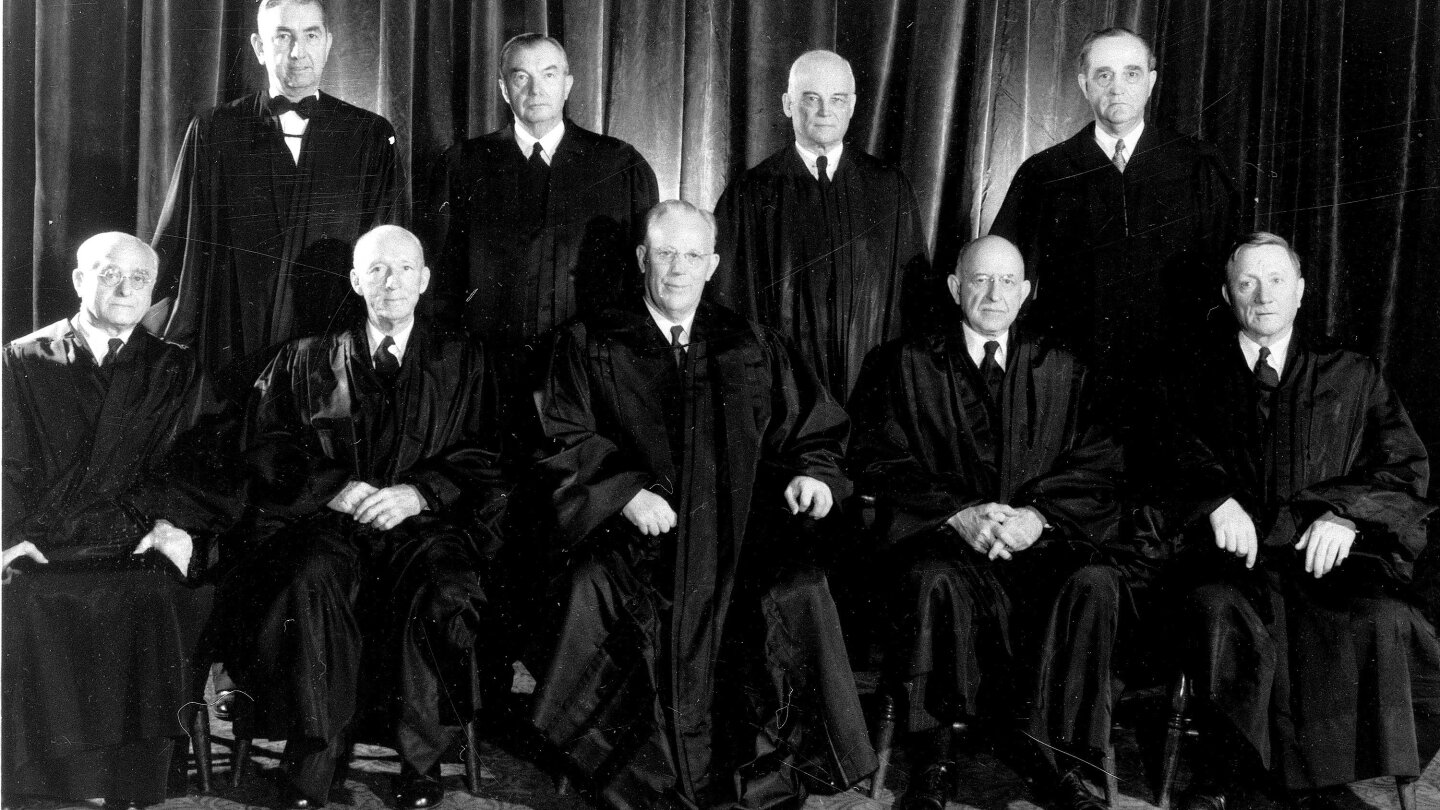
Chief Justice Earl Warren and the Supreme Court of 1954
At first, the justices were divided on how to rule on school segregation, with Chief Justice Fred M. Vinson holding the opinion that the Plessy verdict should stand. Two justices—Robert Jackson and Stanley Reed—had concerns about the Supreme Court making a decision that would be better left to Congress. There were also questions about Marshall’s arguments, which referred much to the sociological evidence about the damage caused by segregation (and not as much to prior case law).
Unable to come to a decision by June 1953 (the end of the Court’s 1952-1953 term), the Court decided to rehear the case in December 1953. But in September 1953, before Brown v. Board of Education was to be heard, Chief Justice Vinson died. President Dwight D. Eisenhower replaced him with Earl Warren, then governor of California. Thanks to the astute leadership of Chief Justice Warren the Court came to a unanimous ruling in Brown, in which the Court overturned the Plessy “separate but equal doctrine.“
The decision held that racial segregation of children in public schools violated the Equal Protection Clause of the Fourteenth Amendment, which states that “no state shall make or enforce any law which shall … deny to any person within its jurisdiction the equal protection of the laws.” The Court noted that Congress, when drafting the Fourteenth Amendment in the 1860s, did not expressly intend to require integration of public schools. On the other hand, that Amendment did not prohibit integration. In any case, the Court asserted that the Fourteenth Amendment guarantees equal education today.
Public education in the 20th century, said the Court, had become an essential component of a citizen’s public life, forming the basis of democratic citizenship, normal socialization, and professional training. In this context, any child denied a good education would be unlikely to succeed in life. Where a state, therefore, has undertaken to provide universal education, such education becomes a right that must be afforded equally to both Blacks and Whites.
Were the Black and White schools “substantially” equal to each other, as the lower courts had found? After reviewing psychological studies showing Black girls in segregated schools had low racial self-esteem, the Court concluded that separating children on the basis of race creates dangerous inferiority complexes that may adversely affect Black children’s ability to learn. The Court concluded that, even if the tangible facilities were equal between the Black and White schools, racial segregation in schools is “inherently unequal” and is thus always unconstitutional.
On May 17, 1954, the U.S. Supreme Court ruled unanimously (9–0) that racial segregation in public schools violated the Fourteenth Amendment to the Constitution. It prohibits the states from denying equal protection of the laws to any person within their jurisdictions. The decision declared that separate educational facilities for White and Black students were inherently unequal. Judge Warren wrote that “in the field of public education the doctrine of ‘separate but equal ‘ has no place,” as segregated schools are “inherently unequal.” This historic decision marked the end of the “separate but equal” precedent set by the Supreme Court nearly 60 years earlier in Plessy vs Ferguson. At least in the context of public schools, Plessy v. Ferguson was overruled.
Just over one year later, on May 31, 1955, Warren read the Court’s unanimous decision, now referred to as Brown II, instructing the states to begin desegregation plans “with all deliberate speed.” Despite two unanimous decisions and careful, if vague, wording, there was considerable resistance to the Supreme Court’s ruling in Brown v. Board of Education. Supporters of judicial restraint believed the Court had overstepped its constitutional powers by essentially writing new law. The Warren Court stayed this course for the next 15 years, deciding cases that significantly affected not only race relations, but also the administration of criminal justice, the operation of the political process, and the separation of church and state. The decision served as a catalyst for the expanding civil rights movement during the decade of the 1950s.
However, minority groups and members of the civil rights movement were buoyed by the Brown decision even without specific directions for implementation. Proponents of judicial activism believed the Supreme Court had appropriately used its position to adapt the basis of the Constitution to address new problems in new times. Opposition to Brown I and II reached an apex in Cooper v. Aaron (1958), when the Court ruled that states were constitutionally required to implement the Supreme Court’s integration orders. Widespread racial integration of the South was achieved by the late 1960s and 1970s. In the meantime, the equal protection ruling in Brown spilled over into other areas of the law and into the political arena as well.
These cases come to us from the States of Kansas, South Carolina, Virginia, and Delaware. They are premised on different facts and different local conditions, but a common legal question justifies their consideration together in this consolidated opinion.
In each of the cases, minors of the Negro race, through their legal representatives, seek the aid of the courts in obtaining admission to the public schools of their community on a nonsegregated basis. In each instance, they had been denied admission to schools attended by white children under laws requiring or permitting segregation according to race. This segregation was alleged to deprive the plaintiffs of the equal protection of the laws under the Fourteenth Amendment. In each of the cases other than the Delaware case, a three-judge federal district court denied relief to the plaintiffs on the so-called “separate but equal” doctrine announced by this Court in Plessy v. Ferguson, 163 U.S. 537. Under that doctrine, equality of treatment is accorded when the races are provided substantially equal facilities, even though these facilities be separate. In the Delaware case, the Supreme Court of Delaware adhered to that doctrine, but ordered that the plaintiffs be admitted to the white schools because of their superiority to the Negro schools.
The plaintiffs contend that segregated public schools are not “equal” and cannot be made “equal,” and that hence they are deprived of the equal protection of the laws. Because of the obvious importance of the question presented, the Court took jurisdiction. Argument was heard in the 1952 Term, and reargument was heard this Term on certain questions propounded by the Court.
Reargument was largely devoted to the circumstances surrounding the adoption of the Fourteenth Amendment in 1868. It covered exhaustively consideration of the Amendment in Congress, ratification by the states, then-existing practices in racial segregation, and the views of proponents and opponents of the Amendment. This discussion and our own investigation convince us that, although these sources cast some light, it is not enough to resolve the problem with which we are faced. At best, they are inconclusive. The most avid proponents of the post-War Amendments undoubtedly intended them to remove all legal distinctions among “all persons born or naturalized in the United States.” Their opponents, just as certainly, were antagonistic to both the letter and the spirit of the Amendments and wished them to have the most limited effect. What others in Congress and the state legislatures had in mind cannot be determined with any degree of certainty.
An additional reason for the inconclusive nature of the Amendment’s history with respect to segregated schools is the status of public education at that time. In the South, the movement toward free common schools, supported by general taxation, had not yet taken hold. Education of white children was largely in the hands of private groups. Education of Negroes was almost nonexistent, and practically all of the race were illiterate. In fact, any education of Negroes was forbidden by law in some states. Today, in contrast, many Negroes have achieved outstanding success in the arts and sciences, as well as in the business and professional world. It is true that public school education at the time of the Amendment had advanced further in the North, but the effect of the Amendment on Northern States was generally ignored in the congressional debates. Even in the North, the conditions of public education did not approximate those existing today. The curriculum was usually rudimentary; ungraded schools were common in rural areas; the school term was but three months a year in many states, and compulsory school attendance was virtually unknown. As a consequence, it is not surprising that there should be so little in the history of the Fourteenth Amendment relating to its intended effect on public education.
In the first cases in this Court construing the Fourteenth Amendment, decided shortly after its adoption, the Court interpreted it as proscribing all state-imposed discriminations against the Negro race. The doctrine of “separate but equal” did not make its appearance in this Court until 1896 in the case of Plessy v. Ferguson, supra, involving not education but transportation. American courts have since labored with the doctrine for over half a century. In this Court, there have been six cases involving the “separate but equal” doctrine in the field of public education. In Cumming v. County Board of Education, 175 U.S. 528, and Gong Lum v. Rice, 275 U.S. 78, the validity of the doctrine itself was not challenged. In more recent cases, all on the graduate school level, inequality was found in that specific benefits enjoyed by white students were denied to Negro students of the same educational qualifications. Missouri ex rel. Gaines v. Canada, 305 U.S. 337; Sipuel v. Oklahoma, 332 U.S. 631; Sweatt v. Painter, 339 U.S. 629; McLaurin v. Oklahoma State Regents, 339 U.S. 637. In none of these cases was it necessary to reexamine the doctrine to grant relief to the Negro plaintiff. And in Sweatt v. Painter, supra, the Court expressly reserved decision on the question whether Plessy v. Ferguson should be held inapplicable to public education.
In the instant cases, that question is directly presented. Here, unlike Sweatt v. Painter, there are findings below that the Negro and white schools involved have been equalized, or are being equalized, with respect to buildings, curricula, qualifications and salaries of teachers, and other “tangible” factors. Our decision, therefore, cannot turn on merely a comparison of these tangible factors in the Negro and white schools involved in each of the cases. We must look instead to the effect of segregation itself on public education.
In approaching this problem, we cannot turn the clock back to 1868, when the Amendment was adopted, or even to 1896, when Plessy v. Ferguson was written. We must consider public education in the light of its full development and its present place in American life throughout the Nation. Only in this way can it be determined if segregation in public schools deprives these plaintiffs of the equal protection of the laws.
Today, education is perhaps the most important function of state and local governments. Compulsory school attendance laws and the great expenditures for education both demonstrate our recognition of the importance of education to our democratic society. It is required in the performance of our most basic public responsibilities, even service in the armed forces. It is the very foundation of good citizenship. Today it is a principal instrument in awakening the child to cultural values, in preparing him for later professional training, and in helping him to adjust normally to his environment. In these days, it is doubtful that any child may reasonably be expected to succeed in life if he is denied the opportunity of an education. Such an opportunity, where the state has undertaken to provide it, is a right which must be made available to all on equal terms.
We come then to the question presented: Does segregation of children in public schools solely on the basis of race, even though the physical facilities and other “tangible” factors may be equal, deprive the children of the minority group of equal educational opportunities? We believe that it does.
In Sweatt v. Painter, supra, in finding that a segregated law school for Negroes could not provide them equal educational opportunities, this Court relied in large part on “those qualities which are incapable of objective measurement but which make for greatness in a law school.” In McLaurin v. Oklahoma State Regents, supra, the Court, in requiring that a Negro admitted to a white graduate school be treated like all other students, again resorted to intangible considerations: “. . . his ability to study, to engage in discussions and exchange views with other students, and, in general, to learn his profession.” Such considerations apply with added force to children in grade and high schools. To separate them from others of similar age and qualifications solely because of their race generates a feeling of inferiority as to their status in the community that may affect their hearts and minds in a way unlikely ever to be undone. The effect of this separation on their educational opportunities was well stated by a finding in the Kansas case by a court which nevertheless felt compelled to rule against the Negro plaintiffs:
Segregation of white and colored children in public schools has a detrimental effect upon the colored children. The impact is greater when it has the sanction of the law, for the policy of separating the races is usually interpreted as denoting the inferiority of the negro group. A sense of inferiority affects the motivation of a child to learn. Segregation with the sanction of law, therefore, has a tendency to [retard] the educational and mental development of negro children and to deprive them of some of the benefits they would receive in a racially integrated school system.
Whatever may have been the extent of psychological knowledge at the time of Plessy v. Ferguson, this finding is amply supported by modern authority. Any language in Plessy v. Ferguson contrary to this finding is rejected.
We conclude that, in the field of public education, the doctrine of “separate but equal” has no place. Separate educational facilities are inherently unequal. Therefore, we hold that the plaintiffs and others similarly situated for whom the actions have been brought are, by reason of the segregation complained of, deprived of the equal protection of the laws guaranteed by the Fourteenth Amendment. This disposition makes unnecessary any discussion whether such segregation also violates the Due Process Clause of the Fourteenth Amendment.
Because these are class actions, because of the wide applicability of this decision, and because of the great variety of local conditions, the formulation of decrees in these cases presents problems of considerable complexity. On reargument, the consideration of appropriate relief was necessarily subordinated to the primary question — the constitutionality of segregation in public education. We have now announced that such segregation is a denial of the equal protection of the laws. In order that we may have the full assistance of the parties in formulating decrees, the cases will be restored to the docket, and the parties are requested to present further argument on Questions 4 and 5 previously propounded by the Court for the reargument this Term The Attorney General of the United States is again invited to participate. The Attorneys General of the states requiring or permitting segregation in public education will also be permitted to appear as amici curiae upon request to do so by September 15, 1954, and submission of briefs by October 1, 1954.
It is so ordered.
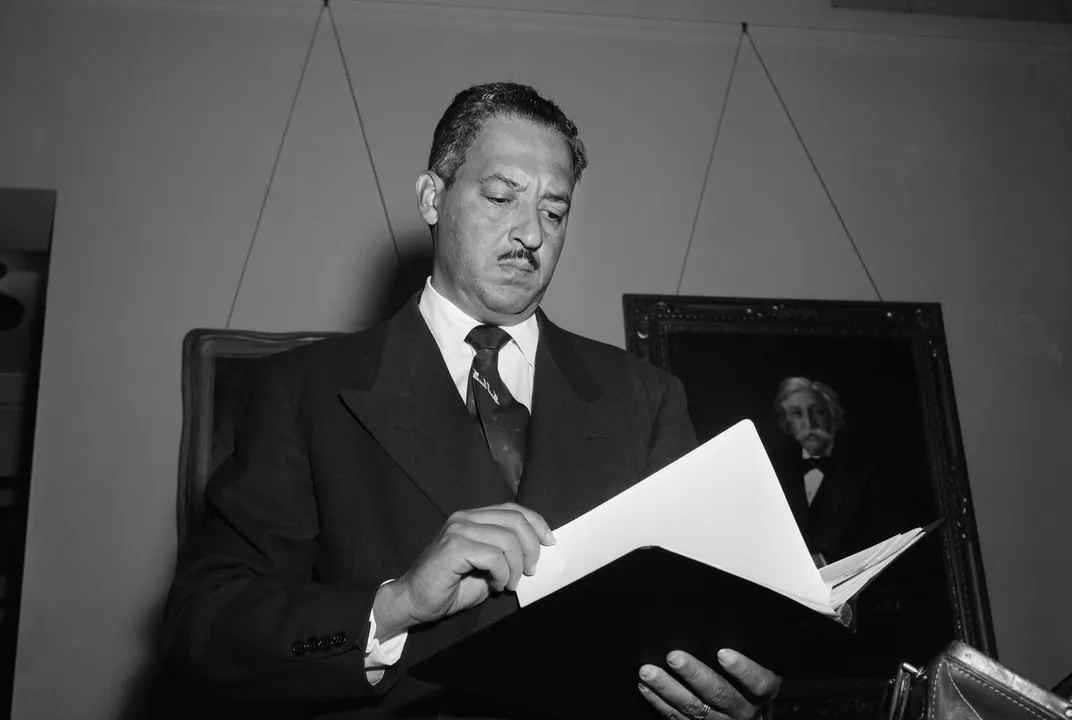
How Thurgood Marshall Paved the Road to ‘Brown v. Board of Education’
In May 1950, lawyer Thurgood Marshall faced a question that confronts so many activists in pursuit of a goal: Should they continue to play the long game, pressing for incremental social change, or has the time come to attempt a big leap forward, despite the risks? For Marshall, the goal was equal opportunity for Black students in America’s schools. In the 1930’s under NAACP chief legal counsel Charles Hamilton Houston (then Dean of Howard Law School) steady leadership, the NAACP enacted a careful case-by-case, year-over-year strategy. Their goal was to undermine the doctrine of separate but equal established by the Supreme Court’s 1896 Plessy v. Ferguson decision. The NAACP attorneys argued for equal resources rather than attempt to abolish segregation outright.
The campaign began in 1935 where Charles Hamilton Houston, had brilliantly developed as a three-pronged strategy to improve African American education in the South. First, Houston wanted to ensure that African American teachers in the southern states received salaries equal to those of white teachers. Second, he wanted to ensure that the southern states provided transportation for African American students to and from their schools. Third, he wanted to ensure that the southern states provided graduate and professional education and training for Black students. Houston’s strategy was based on using the “separate but equal“ doctrine established in the 1896 Plessy v. Ferguson decision to force the southern states to provide African American students an education that was truly equal to that of White students. It did not challenge the doctrine directly or demand integration.
Now Houston was gone, felled by a heart attack a month earlier, in April of 1950. Other NAACP leaders felt a more aggressive approach was required. They were ready for a full, frontal assault on the constitutionality of segregated schools. Hamilton’s colleague Thurgood Marshall had to decide how to proceed. At the height of summer, he convened a meeting at the NAACP’s headquarters in New York City. They inaugurated a new era of NAACP litigation. There would be no more nudging against Plessy and other segregationist statutes; the time had come to try to topple them completely. It was an exceedingly ambitious goal given the state of American race relations at the halfway mark of the century. In the country’s history, no one had ever filed a case directly challenging public school segregation.
At 42, Marshall was a pragmatist with hard-won knowledge of America’s judicial system. He was on the lookout for a case outside of the deep South, where NAACP lawyers had better chances for success with more open-minded judges and juries. But in the meantime there was Clarendon County, South Carolina. To Marshall, Clarendon County was a perfect opportunity to litigate for equal facilities, transportation and other resources for the county’s Black children. But it would be foolhardy to push for full desegregation. Marshall knew how slim the odds were of victory in South Carolina. He also understood how dangerous bringing a legal challenge there would be for the case’s plaintiffs, who would bear the full brunt of White supremacist retaliation for even daring to suggest integration.
Marshall’s hand was forced, however, by the presiding judge, J. Waties Waring. Waring, a white Charlestonian, was the rarest of birds: a Southern activist jurist who supported civil rights. The two first met in 1944 when Marshall argued Duvall v. Seignous, a case about disparities in teacher salaries, before the judge’s bench. Marshall arrived in Clarendon County to argue Briggs v. Elliott in November 1950. Marshall agreed to represent the plaintiffs because their case represented an opportunity for the NAACP to continue its campaign against unequal, segregated education for African Americans in the southern states. The suit had come to be named after its lead plaintiffs, navy veteran Harry Briggs and his wife, Eliza Briggs.
But Waring challenged Marshall to refile the case as a direct attack on the constitutionality of segregation. The new suit could claim that separate educational opportunities, even if materially equal, were a denial of the Briggs’ plaintiffs’ 14th Amendment rights. Neither man was under any illusions that the case would succeed; losing seemed inevitable. But, Waring argued, by bringing this challenge in federal court, a loss guaranteed the case would hopscotch over the U.S. Court of Appeals and be placed directly on the Supreme Court’s docket.
The stakes were immense. If the NAACP were to lose this appeal before the highest court in the land, Plessy v. Ferguson would be reaffirmed and decades of dogged, meticulous work would be lost. It might be decades more before there would be another opportunity to challenge segregation head on. Marshall was conflicted, but decided to move forward with Waring’s plan. The Briggs v. Elliott was the first case in the twentieth century to challenge the constitutionality of racially segregated schools. Briggs v. Elliott would now be heard before a three-judge panel including Waring.
Arguing before a three-judge panel, which included Waring and two staunch segregationists, Judges John J. Parker and George Bell Timmerman, Marshall lost Briggs v. Elliott as expected. Two of the three judges who heard the case agreed that Clarendon County’s Black students received an inferior education and called for the inequities to be corrected. But they held that the decision to segregate schools remained with the state. Judge Waring wrote in his dissent that he would have instead have ordered desegregation under the precedents set by Supreme Court cases ordering desegregation of law schools. In the words of the dissent, “Segregation is per se inequality.”
Judge Waring supported his argument and offered a dissenting opinion against segregated schools in South Carolina. As Judge Waring had foreseen, however, the loss ensured a Supreme Court appeal. Ultimately, that appeal was consolidated with four other cases that, three years later, led to the landmark 1954 Brown v. Board of Education decision. In Brown, the Supreme Court overturned Plessy v. Ferguson and held that segregation in public schools violated the 14th Amendment. Under Brown II, school districts were instructed “to move with all deliberate speed,” to comply with the Supreme Court’s orders.
This case has been brought for the express and declared purpose of determining the right of the State of South Carolina, in its public schools, to practice segregation according to race.
The plaintiffs are all residents of Clarendon County, South Carolina which is situated within the Eastern District of South Carolina and within the jurisdiction of this court. The plaintiffs consist of minors and adults there being forty-six minors who are qualified to attend and are attending the public schools in School District 22 of Clarendon County; and twenty adults who are taxpayers and are either guardians or parents of the minor plaintiffs. The defendants are members of the Board of Trustees of School District 22 and other officials of the educational system of Clarendon County including the superintendent of education. They are the parties in charge of the various schools which are situated within the aforesaid school district and which are affected by the matters set forth in this cause.
The plaintiffs allege that they are discriminated against by the defendants under color of the Constitution and laws of the State of South Carolina whereby they are denied equal educational facilities and opportunities and that this denial is based upon difference in race. And they show that the school system of this particular school district and county (following the general pattern that it is admitted obtains in the State of South Carolina) sets up two classes of schools; one for people said to belong to the white race and the other for people of other races but primarily for those said to belong to the Negro race or of mixed races and either wholly, partially, or faintly alleged to be of African or Negro descent.
These plaintiffs bring this action for the enforcement of the rights to which they claim they are entitled and on behalf of many others who are in like plight and condition and the suit is denominated a class suit for the purpose of abrogation of what is claimed to be the enforcement of unfair and discriminatory laws by the defendants. Plaintiffs claim that they are entitled to bring this case and that this court has jurisdiction under the Fourteenth Amendment of the Constitution of the United States and of a number of statutes of the United States, commonly referred to as civil rights statutes. The plaintiffs demand relief under the above referred to sections of the laws of the United States by way of a declaratory judgment and permanent injunction.
It is alleged that the defendants are acting under the authority granted them by the Constitution and laws of the State of South Carolina and that all of these are in contravention of the Constitution and laws of the United States. The particular portions of the laws of South Carolina are as follows:
Article XI, Section 5 is as follows: "Free public schools. The General Assembly shall provide for a liberal system of free public schools for all children between the ages of six and twenty-one years * * *."
Article XI, Section 7 is as follows: "Separate schools shall be provided for children of the white and colored races, and no child of either race shall ever be permitted to attend a school provided for children of the other race."
Section 5377 of the Code of Laws of South Carolina is as follows: "It shall be unlawful for pupils of one race to attend the schools provided by boards of trustees for persons of another race."
It is further shown that the defendants are acting under the authority of the Constitution and laws of the State of South Carolina providing for the creation of various school districts, and they have strictly separated and segregated the school facilities, both elementary and high school, according to race. There are, in said school district, three schools which are used exclusively by Negroes: to wit, Rambay Elementary School, Liberty Hill Elementary School, and Scotts Branch Union (a combination of elementary and high school). There are in the same school district, two schools maintained for whites, namely, Summerton Elementary School and Summerton High School. The last named serves some of the other school districts in Clarendon County as well as No. 22.
It appears that the plaintiffs filed a petition with the defendants requesting that the defendants cease discrimination against the Negro children of public school age; and the situation complained of not having been remedied or changed, the plaintiffs now ask this court to require the defendants to grant them their rights guaranteed under the Fourteenth Amendment of the Constitution of the United States and they appeal to the equitable power of this court for declaratory and injunctive relief alleging that they are suffering irreparable injuries and that they have no plain adequate or complete remedy to redress the wrongs and illegal acts complained of other than this suit. And they further point out that large numbers of people and persons are and will be affected by the decision of this court in adjudicating and clarifying the rights of Negroes to obtain education in the public school system of the State of South Carolina without discrimination and denial of equal facilities on account of their race.
The defendants appear and by way of answer deny the allegations of the complaint as to discrimination and inequality and allege that not only are they acting within the laws of the State in enforcing segregation but that all facilities afforded the pupils of different races are adequate and equal and that there is no inequality or discrimination practiced against these plaintiffs or any others by reason of race or color. And they allege that the facilities and opportunities furnished to the colored children are substantially the same as those provided for the white children. And they further base their defense upon the statement that the Constitutional and statutory provisions under attack in this case, that is to say, the provisions requiring separate schools because of race, are a reasonable exercise of the State's police power and that all of the same are valid under the powers possessed by the State of South Carolina and the Constitution of the United States and they deny that the same can be held to be unconstitutional by this Court.
The issues being so drawn and calling for a judgment by the United States Court which would require the issuance of an injunction against State and County officials, it became apparent that it would be necessary that the case be heard in accordance with the statute applicable to cases of this type requiring the calling of a three-judge court. Such a court convened and the case was set for a hearing on May 28, 1951.
The case came on for a trial upon the issues as presented in the complaint and answer. But upon the call of the case, defendants' counsel announced that they wished to make a statement on behalf of the defendants making certain admissions and praying that the Court make a finding as to inequalities in respect to buildings, equipment, facilities, curricula and other aspects of the schools provided for children in School District 22 in Clarendon County *540 and giving the public authorities time to formulate plans for ending such inequalities.
In this statement defendants claim that they never had intended to discriminate against any of the pupils and although they had filed an answer to the complaint, some five months ago, denying inequalities they now admit that they had found some; but rely upon the fact that subsequent to the institution of this suit, James F. Byrnes, the Governor of South Carolina, had stated in his inaugural address that the State must take steps to provide money for improving educational facilities and that thereafter, the Legislature had adopted certain legislation. They stated that they hoped that in time they would obtain money as a result of the foregoing and improve the school situation.
This statement was allowed to be filed and considered as an amendment to the answer.
By this maneuver, the defendants have endeavored to induce this Court to avoid the primary purpose of the suit. And if the Court should follow this suggestion and fail to meet the issues raised by merely considering this case in the light of another "separate but equal" case, the entire purpose and reason for the institution of the case and the convening of a three-judge court would be voided. The 66 plaintiffs in this cause have brought this suit at what must have cost much in effort and financial expenditures. They are here represented by 6 attorneys, all, save one, practicing lawyers from without the State of South Carolina and coming here from a considerable distance. The plaintiffs have brought a large number of witnesses exclusive of themselves. As a matter of fact, they called and examined 11 witnesses. They said that they had a number more coming who did not arrive in time owing to the shortening of the proceedings and they also stated that they had on hand and had contemplated calling a large number of other witnesses but this became unnecessary by reason of the foregoing admissions by defendants.
It certainly appears that large expenses must have been caused by the institution of this case and great efforts expended in gathering data, making a study of the issues involved, interviewing and bringing numerous witnesses, some of whom are foremost scientists in America. And in addition to all of this, these 66 plaintiffs have not merely expended their time and money in order to test this important Constitutional question, but they have shown unexampled courage in bringing and presenting this cause at their own expense in the face of the long established and age-old pattern of the way of life which the State of South Carolina has adopted and practiced and lived in since and as a result of the institution of human slavery.
If a case of this magnitude can be turned aside and a court refused to hear these basic issues by the mere device of admission that some buildings, blackboards, lighting fixtures and toilet facilities are unequal but that they may be remedied by the spending of a few dollars, then, indeed people in the plight in which these plaintiffs are, have no adequate remedy or forum in which to air their wrongs. If this method of judicial evasion be adopted, these very infant plaintiffs now pupils in Clarendon County will probably be bringing suits for their children and grandchildren decades or rather generations hence in an effort to get for their descendants what are today denied to them. If they are entitled to any rights as American citizens, they are entitled to have these rights now and not in the future.
And no excuse can be made to deny them these rights which are theirs under the Constitution and laws of America by the use of the false doctrine and patter called "separate but equal" and it is the duty of the Court to meet these issues simply and factually and without fear, sophistry and evasion. If this be the measure of justice to be meted out to them, then, indeed, hundreds, nay thousands, of cases will have to be brought and in each case thousands of dollars will have to be spent for the employment of legal talent and scientific testimony and then the cases will be turned aside, postponed or eliminated by devices such as this.
We should be unwilling to straddle or avoid this issue and if the suggestion made by these defendants is to be adopted as the *541 type of justice to be meted out by this Court, then I want no part of it.And so we must and do face, without evasion or equivocation, the question as to whether segregation in education in our schools is legal or whether it cannot exist under our American system as particularly enunciated in the Fourteenth Amendment to the Constitution of the United States.
Before the American Civil War, the institution of human slavery had been adopted and was approved in this country. Slavery was nothing new in the world. From the dawn of history we see aggressors enslaving weak and less fortunate neighbors. Back through the days of early civilization man practiced slavery. We read of it in Biblical days; we read of it in the Greek City States and in the great Roman Empire. Throughout medieval Europe, forms of slavery existed and it was widely practiced in Asia Minor and the Eastern countries and perhaps reached its worst form in Nazi Germany. Class and caste have, unfortunately, existed through the ages. But, in time, mankind, through evolution and progress, through ethical and religious concepts, through the study of the teachings of the great philosophers and the great religious teachers, including especially the founder of Christianity mankind began to revolt against the enslavement of body, mind and soul of one human being by another. And so there came about a great awakening.
The British who had indulged in the slave trade, awakened to the fact that it was immoral and against the right thinking ideology of the Christian world. And in this country, also, came about a moral awakening. Unfortunately, this had not been sufficiently advanced at the time of the adoption of the American Constitution for the institution of slavery to be prohibited. But there was a struggle and the better thinking leaders in our Constitutional Convention endeavored to prohibit slavery but unfortunately compromised the issue on the insistent demands of those who were engaged in the slave trade and the purchase and use of slaves. And so as time went on, slavery was perpetuated and eventually became a part of the life and culture of certain of the States of this Union although the rest of the world looked on with shame and abhorrence.
As was so well said, this country could not continue to exist one-half slave and one-half free and long years of war were entered into before the nation was willing to eradicate this system which was, itself, a denial of the brave and fine statements of the Declaration of Independence and a denial of freedom as envisioned and advocated by our Founders.
The United States then adopted the 13th, 14th and 15th Amendments and it cannot be denied that the basic reason for all of these Amendments to the Constitution was to wipe out completely the institution of slavery and to declare that all citizens in this country should be considered as free, equal and entitled to all of the provisions of citizenship.
The Fourteenth Amendment to the Constitution of the United States is as follows:
"Section 1. All persons born or naturalized in the United States, and subject to the jurisdiction thereof, are citizens of the United States and of the State wherein they reside. No State shall make or enforce any law which shall abridge the privileges or immunities of citizens of the United States; nor shall any State deprive any person of life, liberty, or property, without due process of law; nor deny to any person within its jurisdiction the equal protection of the laws."
It seems to me that it is unnecessary to pore through voluminous arguments and opinions to ascertain what the foregoing means. And while it is true that we have had hundreds, perhaps thousands, of legal opinions outlining and defining the various effects and overtones on our laws and life brought about by the adoption of this Amendment, one of ordinary ability and understanding of the English language will have no trouble in knowing that when this Amendment was adopted, it was intended to do away with discrimination between our citizens.
The Amendment refers to all persons. There is nothing in there that attempts to separate, segregate or discriminate against any persons because of their being of *542 European, Asian or African ancestry. And the plain intendment is that all of these persons are citizens. And then it is provided that no State shall make or enforce any law which shall abridge the privileges of citizens nor shall any state deny "to any person within its jurisdiction the equal protection of the laws".
The Amendment was first proposed in 1866 just about a year after the end of the American Civil War and the surrender of the Confederate States government. Within two years, the Amendment was adopted and became part of the Constitution of the United States. It cannot be gainsaid that the Amendment was proposed and adopted wholly and entirely as a result of the great conflict between freedom and slavery. This will be amply substantiated by an examination and appreciation of the proposal and discussion and Congressional debates (see Flack on Adoption of the 14th Amendment) and so it is undeniably true that the three great Amendments were adopted to eliminate not only slavery, itself, but all idea of discrimination and difference between American citizens.
Let us now come to consider whether the Constitution and Laws of the State of South Carolina which we have heretofore quoted are in conflict with the true meaning and intendment of this Fourteenth Amendment. The whole discussion of race and ancestry has been intermingled with sophistry and prejudice. What possible definition can be found for the so-called white race, Negro race or other races? Who is to decide and what is the test? For years, there was much talk of blood and taint of blood. Science tells us that there are but four kinds of blood: A, B, AB and O and these are found in Europens, Asiatics, Africans, Americans and others. And so we need not further consider the irresponsible and baseless references to preservation of "Caucasian blood".
So then, what test are we going to use in opening our school doors and labeling them "white" and "Negro"? The law of South Carolina considers a person of one-eighth African ancestry to be a Negro. Why this proportion? Is it based upon any reason: anthropological, historical or ethical? And how are the trustees to know who are "whites" and who are "Negroes"? If it is dangerous and evil for a white child to be associated with another child, one of whose great-grandparents was of African descent, is it not equally dangerous for one with a one-sixteenth percentage? And if the State has decided that there is danger in contact between the whites and Negroes, isn't it requisite and proper that the State furnish a series of schools one for each of these percentages? If the idea is perfect racial equality in educational systems, why should children of pure African descent be brought in contact with children of one-half, one-fourth, or one-eighth such ancestry? To ask these questions is sufficient answer to them.
The whole thing is unreasonable, unscientific and based upon unadulterated prejudice. We see the results of all of this warped thinking in the poor under-privileged and frightened attitude of so many of the Negroes in the southern states; and in the sadistic insistence of the "white supremacists" in declaring that their will must be imposed irrespective of rights of other citizens. This claim of "white supremacy", while fantastic and without foundation, is really believed by them for we have had repeated declarations from leading politicians and governors of this state and other states declaring that "white supremacy" will be endangered by the abolition of segregation. There are present threats, including those of the present Governor of this state, going to the extent of saying that all public education may be abandoned if the courts should grant true equality in educational facilities.
Although some 73 years have passed since the adoption of the Fourteenth Amendment and although it is clearly apparent that its chief purpose, (perhaps we may say its only real purpose) was to remove from Negroes the stigma and status of slavery and to confer upon them full rights as citizens, nevertheless, there has been a long and arduous course of litigation through the years. With some setbacks here and there, the courts have generally and progressively recognized the true meaning of the Fourteenth Amendment and have, from time to time, stricken down the attempts *543 made by state governments (almost entirely those of the former Confederate states) to restrict the Amendment and to keep Negroes in a different classification so far as their rights and privileges as citizens are concerned.
A number of cases have reached the Supreme Court of the United States wherein it became necessary for that tribunal to insist that Negroes be treated as citizens in the performance of jury duty. See Strauder v. West Virginia, where the Court says 100 U.S. at page 307, 25 L. Ed. 664; "* * * What is this but declaring that the law in the States shall be the same for the black as for the white; that all persons, whether colored or white, shall stand equal before the laws of the States, and, in regard to the colored race, for whose protection the amendment was primarily designed, that no discrimination shall be made against them by law because of their color? The words of the amendment, it is true, are prohibitory, but they contain a necessary implication of a positive immunity, or right, most valuable to the colored race, the right to exemption from unfriendly legislation against them distinctively as colored exemption from legal discriminations, implying inferiority in civil society, lessening the security of their enjoyment of the rights which others enjoy, and discriminations which are steps towards reducing them to the condition of a subject race."
Many subsequent cases have followed and confirmed the right of Negroes to be treated as equals in all jury and grand jury service in the states. The Supreme Court has stricken down from time to time statutes providing for imprisonment for violation of contracts. These are known as peonage cases and were in regard to statutes primarily aimed at keeping the Negro "in his place".
In the field of transportation the court has now, in effect declared that common carriers engaged in interstate travel must not and cannot segregate and discriminate against passengers by reason of their race or color.
Frequent and repeated instances of prejudice in criminal cases because of the brutal treatment of defendants because of their color have been passed upon in a large number of cases. Discrimination by segregation of housing facilities and attempts to control the same by covenants have also been outlawed. In the field of labor employment and particularly the relation of labor unions to the racial problem, discrimination has again been forbidden.
Perhaps the most serious battle for equality of rights has been in the field of exercise of suffrage. For years, certain of the southern states have attempted to prevent the Negro from taking part in elections by various devices. It is unnecessary to enumerate the long list of cases, but from time to time courts have stricken down all of these various devices classed as the "grandfather clause", educational tests and white private clubs.
*544 The foregoing are but a few brief references to some of the major landmarks in the fight by Negroes for equality. We now come to the more specific question, namely, the field of education. The question of the right of the state to practice segregation by race in certain educational facilities has only recently been tested in the courts. The cases of Missouri ex rel. Gaines v. Canada, 305 U.S. 337, 59 S. Ct. 232, 83 L. Ed. 208 and Sipuel v. Board of Regents, 332 U.S. 631, 68 S. Ct. 299, 92 L. Ed. 247, decided that Negroes were entitled to the same type of legal education that whites were given. It was further decided that the equal facilities must be furnished without delay or as was said in the Sipuel case, the state must provide for equality of education for Negroes "as soon as it does for applicants of any other group". But still we have not reached the exact question that is posed in the instant case.
We now come to the cases that, in my opinion, definitely and conclusively establish the doctrine that separation and segregation according to race is a violation of the Fourteenth Amendment. I, of course, refer to the cases of Sweatt v. Painter, 339 U.S. 629, 70 S. Ct. 848, 94 L. Ed. 1114, and McLaurin v. Oklahoma State Regents, 339 U.S. 637, 70 S. Ct. 851, 94 L. Ed. 1149. These cases have been followed in a number of lower court decisions so that there is no longer any question as to the rights of Negroes to enjoy all the rights and facilities afforded by the law schools of the States of Virginia, Louisiana, Delaware, North Carolina and Kentucky. So there is no longer any basis for a state to claim the power to separate according to race in graduate schools, universities and colleges.
The real rock on which the defendants base their case is a decision of the Supreme Court of the United States in the case of Plessy v. Ferguson, 163 U.S. 537, 16 S. Ct. 1138, 41 L. Ed. 256. This case arose in Louisiana and was heard on appeal in 1895. The case related to the power of the State of Louisiana to require separate railroad cars for white and colored passengers and the Court sustained the State's action. Much discussion has followed this case and the reasoning and decision has been severely criticized for many years.
And the famous dissenting opinion by Mr. Justice Harlan has been quoted throughout the years as a true declaration of the meaning of the Fourteenth Amendment and of the spirit of the American Constitution and the American way of life. It has also been frequently pointed out that when that decision was made, practically all the persons of the colored or Negro race had either been born slaves or were the children of slaves and that as yet due to their circumstances and surroundings and the condition in which they had been kept by their former masters, they were hardly looked upon as equals or as American citizens. The reasoning of the prevailing opinion in the Plessy case stems almost completely from a decision by Chief Justice Shaw of Massachusetts, which decision was made many years before the Civil War and when, of course, the Fourteenth Amendment had not even been dreamed of.
But these arguments are beside the point in the present case. And we are not called upon to argue or discuss the validity of the Plessy case.
Let it be remembered that the Plessy case decided that separate railroad accommodations might be required by a state in intra-state transportation. How similar attempts relating to inter-state transportation have fared have been shown in the foregoing discussion and notes.[12] It has *545 been said and repeated here in argument that the Supreme Court has refused to review the Plessy case in the Sweatt, McLaurin and other cases and this has been pointed to as proof that the Supreme Court retains and approves the validity of Plessy.
It is astonishing that such an argument should be presented or used in this or any other court. The Supreme Court in Sweatt and McLaurin was not considering railroad accommodations. It was considering education just as we are considering it here and the Supreme Court distinctly and unequivocally held that the attempt to separate the races in education was violative of the Fourteenth Amendment of the Constitution. Of course, the Supreme Court did not consider overruling Plessy. It was not considering railroad matters, had no arguments in regard to it, had no business or concern with railroad accommodations and should not have even been asked to refer to that case since it had no application or business in the consideration of an educational problem before the court. It seems to me that we have already spent too much time and wasted efforts in attempting to show any similarity between traveling in a railroad coach in the confines of a state and furnishing education to the future citizens of this country.
The instant case which relates to lower school education is based upon exactly the same reasoning followed in the Sweatt and McLaurin decisions. In the Sweatt case, it was clearly recognized that a law school for Negro students had been established and that the Texas courts had found that the privileges, advantages and opportunities offered were substantially equivalent to those offered to white students at the University of Texas. Apparently, the Negro school was adequately housed, staffed and offered full and complete legal education, but the Supreme Court clearly recognized that education does not alone consist of fine buildings, class room furniture and appliances but that included in education must be all the intangibles that come into play in preparing one for meeting life.
As was so well said by the Court: "* * * Few students and no one who has practiced law would choose to study in an academic vacuum, removed from the interplay of ideas and the exchange of views with which the law is concerned." And the Court quotes with approval from its opinion in Shelley v. Kramer, supra: "* * * Equal protection of the laws is not achieved through indiscriminate imposition of inequalities." The Court further points out that this right to a proper and equal education is a personal one and that an individual is entitled to the equal protection of the laws. And in closing, the Court, referring to certain cases cited, says: "In accordance with these cases, petitioner may claim his full constitutional right: legal education equivalent to that offered by the State to students of other races. Such education is not available to him in a separate law school as offered by the State."
In the companion case of McLaurin v. Oklahoma State Regents, McLaurin was a student who was allowed to attend the same classes, hear the same lectures, stand the same examinations and eat in the same cafeteria; but he sat in a marked off place and had a separate table assigned to him in the library and another one in the cafeteria. It was said with truth that these facilities were just as good as those afforded to white students. But the Supreme Court says that even though this be so:
"These restrictions were obviously imposed in order to comply, as nearly as could be, with the statutory requirements of Oklahoma. But they signify that the State, in administering the facilities it affords for professional and graduate study, sets McLaurin apart from the other students. The result is that appellant is handicapped in his pursuit of effective graduate instruction. Such restrictions impair and inhibit his ability to study, to engage in discussions and exchange views with other students, and, in general, to learn his profession.
"Our society grows increasingly complex, and our need for trained leaders increases correspondingly. Appellant's case represents, perhaps, the epitome of that need, *546 for he is attempting to obtain an advanced degree in education, to become, by definition, a leader and trainer of others. Those who will come under his guidance and influence must be directly affected by the education he receives. Their own education and development will necessarily suffer to the extent that his training is unequal to that of his classmates. State-imposed restrictions which produce such inequalities cannot be sustained."
The recent case of McKissick v. Charmichael, 4 Cir., 187 F.2d 949, 953, wherein the question of admission to the law school of the University of North Carolina was decided follows and amplifies the reasoning of the Sweatt and McLaurin cases. In the McKissick case, officials of the State of North Carolina took the position that they had adopted a fixed and continued purpose to establish and build up separate schools for equality in education and pointed with pride to the large advances that they had made. They showed many actual physical accomplishments and the establishment of a school which they claimed was an equal in many respects and superior in some respects to the school maintained for white students.
The Court of Appeals for the 4th Circuit in this case, speaking through Judge Soper, meets this issue without fear or evasion and says: "These circumstances are worthy of consideration by any one who is responsible for the solution of a difficult racial problem; but they do not meet the complainants' case or overcome the deficiencies which it discloses. Indeed the defense seeks in part to avoid the charge of inequality by the paternal suggestion that it would be beneficial to the colored race in North Carolina as a whole, and to the individual plaintiffs in particular, if they would cooperate in promoting the policy adopted by the State rather than seek the best legal education which the State provides. The duty of the federal courts, however, is clear. We must give first place to the rights of the individual citizen, and when and where he seeks only equality of treatment before the law, his suit must prevail. It is for him to decide in which direction his advantage lies."
In the instant case, the plaintiffs produced a large number of witnesses. It is significant that the defendants brought but two. These last two were not trained educators. One was an official of the Clarendon schools who said that the school system needed improvement and that the school officials were hopeful and expectant of obtaining money from State funds to improve all facilities. The other witness, significantly named Crow, has been recently employed by a commission just established which, it is proposed, will supervise educational facilities in the State and will handle monies if, as and when the same are received sometime in the future. Mr. Crow did not testify as an expert on education although he stated flatly that he believed in separation of the races and that he heard a number of other people say so, including some Negroes, but he was unable to mention any of their names. Mr. Crow explained what was likely and liable to happen under the 1951 State Educational Act to which frequent reference was made in argument on behalf of the defense.
It appears that the Governor of this state called upon the legislature to take action in regard to the dearth of educational facilities in South Carolina pointing out the low depth to which the state had sunk. As a result, an act of the legislature was adopted (this is a part of the General Appropriations Act adopted at the recent session of the legislature and referred to as the 1951 School Act). This Act provides for the appointment of a commission which is to generally supervise educational facilities and imposes sales taxes in order to raise money for educational purposes and authorizes the issuance of bonds not to exceed the sum of $75,000,000, for the purpose of making grants to various counties and school districts to defray the cost of capital improvement in schools.
The Commission is granted wide power to accept applications for and approve such grants as loans. It is given wide power as to what schools and school districts are *547 to receive monies and it is also provided, that from the taxes there are to be allocated funds to the various schools based upon the enrollment of pupils. Nowhere is it specifically provided that there shall be equality of treatment as between whites and Negroes in the school system. It is openly and frankly admitted by all parties that the present facilities are hopelessly disproportional and no one knows how much money would be required to bring the colored school system up to a parity with the white school system. The estimates as to the cost merely of equalization of physical facilities run anywhere from forty to eighty million dollars. Thus, the position of the defendants is that the rights applied for by the plaintiffs are to be denied now because the State of South Carolina intends (as evidenced by a general appropriations bill enacted by the legislature and a speech made by its Governor) to issue bonds, impose taxes, raise money and to do something about the inadequate schools in the future. There is no guarantee or assurance as to when the money will be available.
As yet, no bonds have been printed or sold. No money is in the treasury. No plans have been drawn for school buildings or order issued for materials. No allocation has been made to the Clarendon school district or any other school districts and not even application blanks have, as yet, been printed. But according to Mr. Crow, the Clarendon authorities have requested him to send them blanks for this purpose if, as and when they come into being. Can we seriously consider this a bona-fide attempt to provide equal facilities for our school children?
On the other hand, the plaintiffs brought many witnesses, some of them of national reputation in various educational fields. It is unnecessary for me to review or analyze their testimony. But they who had made studies of education and its effect upon children, starting with the lowest grades and studying them up through and into high school, unequivocally testified that aside from inequality in housing appliances and equipment, the mere fact of segregation, itself, had a deleterious and warping effect upon the minds of children.
These witnesses testified as to their study and researches and their actual tests with children of varying ages and they showed that the humiliation and disgrace of being set aside and segregated as unfit to associate with others of different color had an evil and ineradicable effect upon the mental processes of our young which would remain with them and deform their view on life until and throughout their maturity. This applies to white as well as Negro children. These witnesses testified from actual study and tests in various parts of the country, including tests in the actual Clarendon School district under consideration.
They showed beyond a doubt that the evils of segregation and color prejudice come from early training. And from their testimony as well as from common experience and knowledge and from our own reasoning, we must unavoidably come to the conclusion that racial prejudice is something that is acquired and that that acquiring is in early childhood. When do we get our first ideas of religion, nationality and the other basic ideologies?
The vast number of individuals follow religious and political groups because of their childhood training. And it is difficult and nearly impossible to change and eradicate these early prejudices, however strong may be the appeal to reason. There is absolutely no reasonable explanation for racial prejudice. It is all caused by unreasoning emotional reactions and these are gained in early childhood. Let the little child's mind be poisoned by prejudice of this kind and it is practically impossible to ever remove these impressions however many years he may have of teaching by philosophers, religious leaders or patriotic citizens. If segregation is wrong then the place to stop it is in the first grade and not in graduate colleges.
From their testimony, it was clearly apparent, as it should be to any thoughtful person, irrespective of having such expert testimony, that segregation in education *548 tion can never produce equality and that it is an evil that must be eradicated. This case presents the matter clearly for adjudication and I am of the opinion that all of the legal guideposts, expert testimony, common sense and reason point unerringly to the conclusion that the system of segregation in education adopted and practiced in the State of South Carolina must go and must go now.
Segregation is per se inequality. As heretofore shown, the courts of this land have stricken down discrimination in higher education and have declared unequivocally that segreation is not equality. But these decisions have pruned away only the noxious fruits. Here in this case, we are asked to strike its very root. Or rather, to change the metaphor, we are asked to strike at the cause of infection and not merely at the symptoms of disease. And if the courts of this land are to render justice under the laws without fear or favor, justice for all men and all kinds of men, the time to do it is now and the place is in the elementary schools where our future citizens learn their first lesson to respect the dignity of the individual in a democracy.
To me the situation is clear and important, particularly at this time when our national leaders are called upon to show to the world that our democracy means what it says and that it is a true democracy and there is no under-cover suppression of the rights of any of our citizens because of the pigmentation of their skins. And I had hoped that this Court would take this view of the situation and make a clear cut declaration that the State of South Carolina should follow the intendment and meaning of the Constitution of the United States and that it shall not abridge the privileges accorded to or deny equal protection of its laws to any of its citizens. But since the majority of this Court feel otherwise, and since I cannot concur with them or join in the proposed decree, this opinion is filed as a dissent.