


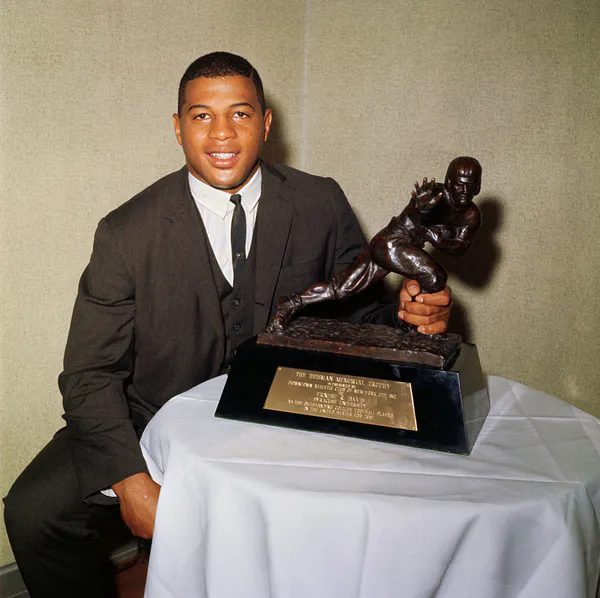


Ernie Davis was the first Black player to win the Heisman Trophy and the first to be drafted number one by a National Football League team. Ernie Davis was born on December 14, 1939, in New Salem, a small town in the coal-rich southwest corner of Pennsylvania. Ernie’s father was killed in an accident before Ernie was born. When Ernie was fourteen months old, his mother left him to live with his grandparents in nearby Uniontown, Pennsylvania, while she searched for a job to support her only child. Although Ernie’s grandfather worked as a coal miner, it was difficult for him to support the family. He had twelve children of his own, and the family lived in poverty. Ernie dreamed, as a child, of becoming a professional athlete. His heroes were baseball star Stan Musial and Chicago Bears quarterback Johnny Lujack, men whose athletic skills had helped them escape the coal mines and steel mills of western Pennsylvania, where Ernie grew up.
Davis suffered from a bad stuttering problem, but he nevertheless received adequate care, and later credited those difficult early years with installing in him the virtues of discipline and family. When Ernie was twelve years old, his mother settled in Elmira, New York, a community that became his adopted home. Even as early as grade school, Ernie displayed the talents that eventually led to greatness. He could run faster, throw harder, and kick farther than anyone else in the school. Davis first showed off his excellence in athletics at Elmira High school. As a student at Elmira Free Academy, Davis was a high-school All-American in football and basketball. Davis led the school’s basketball team to 52 consecutive victories, and some felt his natural gifts were best suited for the hardwood. Many believed that he was a better basketball player than a football player, and his basketball statistics were certainly impressive.
However, Davis’ first love was football. Davis also excelled in the classroom. Colleges coast to coast closely watched Ernie’s athletic ability. Scholarship offers came from over 50 schools, including Notre Dame, Air Force, and UCLA. Many colleges, particularly those in the South, did not offer scholarships to Black players. Although he had always dreamed of playing halfback for Notre Dame, Ernie chose to attend Syracuse University from among the thirty colleges that offered him a football scholarship, because he felt that Syracuse provided him with the best opportunity to run with the football. After being persuaded by Jim Brown, a Syracuse alumnus, who felt that he had a better opportunity to play as a sophmore than at any other school, Davis choose Syracuse. Davis played football for coach Ben Schwartzwalder at Syracuse University from 1959 to 1961, and went on to national fame in each of those three seasons, twice winning first-team All-American honors. During his time at Syracuse, Davis wore the same number, 44, as had legendary Orangeman Jim Brown.
Davis didn’t play during his freshman season at Syracuse, as was the rule at the time, though he dominated practices with his speed and power. In his sophomore year, Ernie gained 686 yards and scored 64 points. Those numbers represented totals greater than the combined totals of all ten of Syracuse’s opponents that year. Playing both offense and defense, Ernie led the Orangemen to the NCAA Division I-A football national championship. Syracuse bullied other teams, outscoring opponents 390-59, enroute to an undefeated season, capping an 11–0 season with a 23-14 win over the University of Texas in the 1960 Cotton Bowl. Even though Davis was hampered by a strained hamstring, he scored 16 of Syracuse’s points on 2 touchdowns and 2 two-point conversions, and set up the other touchdown with a pass interception. This was the first of three All-America selections. That same year, a sports writer called him the "Elmira Express". Elmira Star-Gazette sports writer Al Mallette coined the phrase. Davis was voted Most Valuable Player of the 1960 Cotton Bowl.
When Ernie and his team went to Dallas, Texas, for the Cotton Bowl, they faced unfair treatment. At a banquet after the 1960 game, Ernie and his Black teammates were allowed to finish their meals at the banquet. When dessert was brought, a gentleman quietly approached them and told them they would have to leave when the doors were opened to the public for a dance. This was because the facility was segregated. The three got up to leave and when his White teammates wanted to leave with them to show support, but they were told it would cause more problems. This shows the challenges Black athletes faced during that time. In his junior year, 1960, he set a record of 7.8 yards per carry and was the third leading rusher in the country with 877 yards, having rushed for 100 yards in six of nine games. The 1960 Syracuse Orangemen finished with a record of 7–2 and did not play in a post-season bowl game.
In 1961, Davis accomplished another milestone when he became the first Black athlete to be awarded the Heisman Trophy following his senior-year season at Syracuse, when he finished with 823 rushing yards and 15 touchdowns. Davis capped his college career with 140 rushing yards in an MVP performance at the 1961 Liberty Bowl and finished with 2,386 total rushing yards on 6.6 yards per carry and 35 touchdowns, all school records. The Orangemen finished with a record of 8–3, closing the season with a 15–14 victory over the Miami Hurricanes in the Liberty Bowl. President John F. Kennedy had followed Davis' career and requested to meet him while he was in New York to receive the trophy. Ernie set an example of excellence for others both on and off the field. His grandfather, who had raised him until he was twelve years old, had been a strict disciplinarian, and Ernie’s character reflected this upbringing.
Davis was selected No.1 overall in the 1962 NFL draft, becoming the first Black football player to be taken first overall. He was selected by the Washington Redskins, and he was also drafted by the Buffalo Bills of the American Football League. Redskins founder and owner George Preston Marshall was an avowed racist who kept the Redskins entirely White long after the other teams had integrated. He openly admitted that his unwillingness to sign a Black player was an effort to appeal to his mostly Southern fan base (they had been the southernmost team in the league for a quarter century). The signing only came when Interior Secretary Stewart Udall issued an ultimatum to Marshall: sign a Black player by the start of the 1962 season, or he would revoke the Redskins' 30-year lease on D.C. Stadium (now Robert F. Kennedy Memorial Stadium). The stadium was a federally-owned facility. Basically, Secretary Udall, was the Redskins's landlord. Marshall could not bring himself to draft a Black player, so he left the decision to general manager and head coach Bill McPeak, who picked Davis.
Davis refused to play for Marshall's Redskins and demanded a trade. A deal with Cleveland was engineered by Browns coach Paul Brown. The Redskins traded the rights to Davis to the Cleveland Browns for Bobby Mitchell and first-round draft pick Leroy Jackson. This was a great move for Ernie. He wanted to play where his classmate John Brown would be his roommate and Jim Brown, whom he admired, was already playing. Ernie signed a three-year contract with the Browns for $200,000. This was a huge amount for a rookie player back then. It was the most money any NFL rookie had ever received. Davis never played a game for the Browns, however, as he was diagnosed with leukemia before the College All-Star Game in July 1962. He underwent a variety of treatments in an attempt to return to football. When his cancer went into remission that fall, it seemed only a matter of time before he made his pro debut.
The rift between Coach Brown and owner Art Modell worsened when Modell brought in doctors who said Davis was well enough to play and Brown still refused to allow it. At one point, Davis was cleared to play his rookie season by one doctor, who said he wasn't contagious or at risk because it was a blood disease. However coach Cleveland coach Paul Brown feared for Davis' health and kept him on the sidelines. This contributed to Modell's decision to replace Paul Brown before the 1963 season. Davis was allowed to practice on the field without physical contact and helped Brown draw up game plans but he never played a meaningful down. His only appearance at Cleveland Stadium came at a pre-season game on August 18, 1962, in which he ran onto the field as a spotlight followed him. The disease would prove incurable, and Davis died at age 23 on May 18, 1963, never having played a professional football game.
Although Davis never played a down in the NFL, the Cleveland Browns retired his No. 45 jersey worn only in practice. Both the House and the Senate eulogized him, and his wake was held in The Neighborhood House in Elmira, New York, where more than 10,000 mourners including almost the entire Cleveland Browns football team. There were lines of mourners two blocks long waiting to pay their respects. In 1963, when President Kennedy heard Davis would be honored by his high school with a school holiday, the president sent a telegram reading: "Seldom has an athlete been more deserving of such a tribute. Your high standards of performance on the field and off the field reflect the finest qualities of competition, sportsmanship and citizenship. The nation has bestowed upon you its highest awards for your athletic achievements. It's a privilege for me to address you tonight as an outstanding American, and as a worthy example of our youth. I salute you". Davis was posthumously inducted into the College Football Hall of Fame in 1979. In 1987, in spite of never having played a down in professional football, Ernie was voted into the Pro Football Hall of Fame. Davis is remembered for his sportsmanship, the grace with which he handled the racial intolerance of his time, and his courage in facing a disease that ultimately claimed his life. His life was short, but he left behind a lasting legacy.