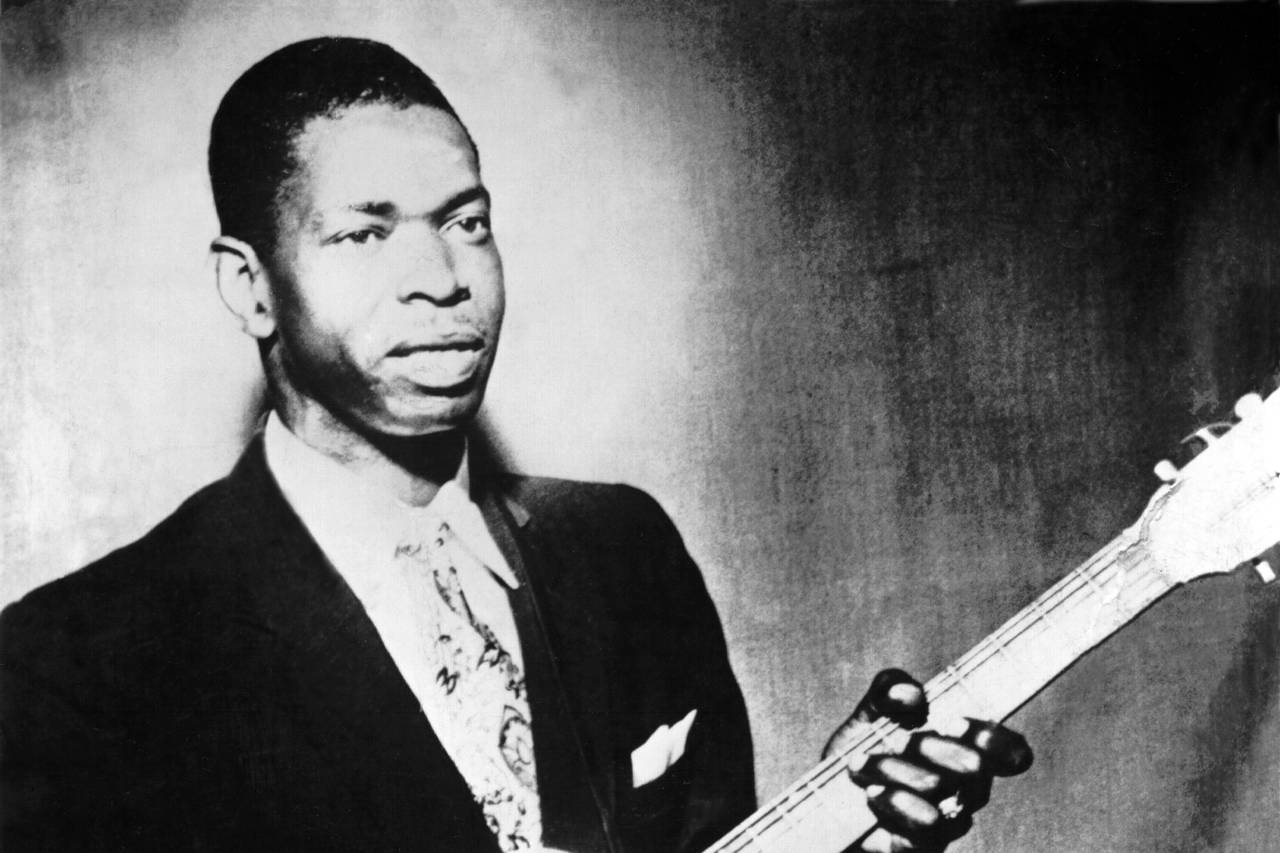
Elmore James was born Elmore Brooks in Richland, Mississippi, 50 miles north of Jackson. When Elmore James was twelve years old, he started making music using a one string instrument. He began performing dances for audiences when he was a teenager. He began playing semi-professionally under such names as "Cleanhead" and "Joe Willie James," alongside musicians such as the first Sonny Boy Williamson, and Howling Wolf. James played guitar in his teens and toured the Mississippi Delta with Robert Johnson, the principal influence on his music, in the late 1930s.
During World War II James joined the United States Navy and was stationed in Guam. Upon his discharge Elmore returned to central Mississippi and eventually settled in Canton. He began recording with Trumpet Records in nearby Jackson in January 1951 as sideman to the second Sonny Boy Williamson and others. Johnson’s boogie bass runs and slide guitar style were integral to James’ approach to the guitar. He later became a mainstay of Chicago blues in the 1950s. He recorded several versions of his 1952 hit “Dust My Broom” and repeated that song’s opening guitar chorus on many later recordings.
The single was released without James' approval, reaching the number 9 position on the R&B charts in 1952. His "I Believe" was another hit a year later. During this period he lived both in Chicago and Mississippi. Characteristically, his singing was harsh, including shouted phrases, and his vivid slide guitar replies featured heavy amplifier reverberation. His most-praised work began in 1958 and included the slow blues songs “The Sky Is Crying” and “It Hurts Me Too”. James continued to record substantial blues tunes, such as "Look On Yonder Wall," "Done Somebody Wrong," and "Shake Your Moneymaker," all of which are among the most famous of blues recordings.
James played a wide variety of "blues" (which often crossed over into other styles of music) similar to that of Muddy Waters, Howlin' Wolf and some of B. B. King's work, but distinguished by his guitar's unique tone, coming from a modified hollow-body acoustic guitar that sounded like an amped-up version of the more "modern" solid-body guitars. Elmore James embodied the dramatic style changes in the blues associated both with the mass migration of rural Mississippians to Chicago and with evolving electronic technology during the 1940s and ’50s.
While his voice was not nearly so powerful as other Chicago blues men such as Muddy Waters and Howling Wolf, James more than made up for this by an unmatched intensity. If other singers could use their voices to hit their listeners in the solar plexus, James could use his to make his audience's hair stand on end. While Elmore James' status as a slide guitarist is well known, his influence as a pioneer of rock and roll is not to be underestimated. James' records were listened to with rapt attention by a generation of young musicians who would go on to become the top early rock and roll artists.