If you’ve ever lived without a washing machine, then you’ll appreciate the invention by Ellen F. Elgin. She revolutionized the chore of laundry with the invention of the clothes wringer for washing machines and, in the process, made her mark on Black Americans and women’s history. Little has been recorded about Eglin’s early life, which is was a common theme among many early Black women inventors. Ellen F. Eglin was born in the state of Maryland in February 1836. As a young adult, she worked as a clerk in the local census office and also spent time as a domestic. As a housekeeper, Eglin passed several hours engaged in backbreaking laundry work.
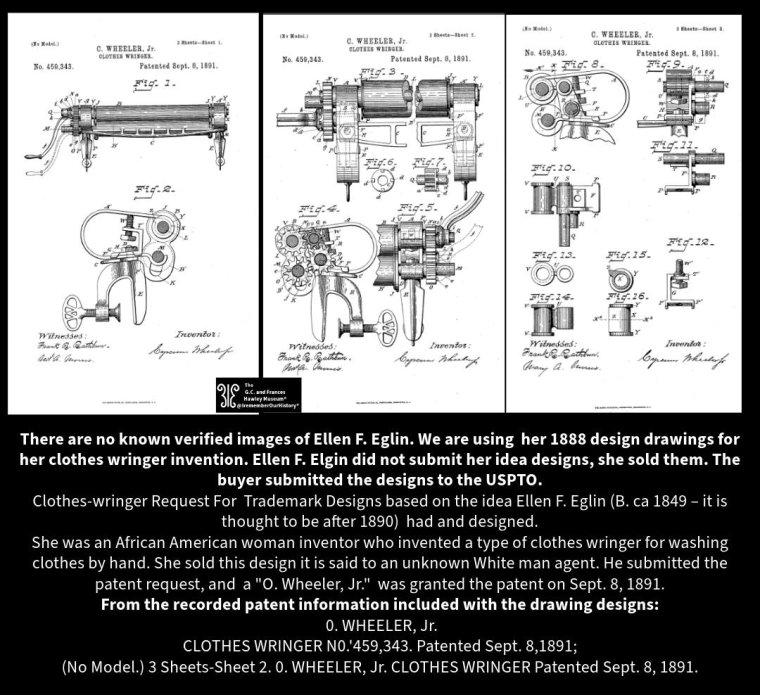
The task of scrubbing clothes by hand on a washboard and then wringing out the water afterwards ignited Eglin’s desire to improve the laundry process, which sparked the idea of a new invention. In 1888, Eglin invented a clothes wringer, making the job of hanging and drying easier. The invention was an improvement to existing clothes wringers, as the speed of the rollers could be increased or decreased “by a suitable system of spur-gearing.” Her machine had two wooden rollers attached to a crank; after being washed and rinsed, wet clothes were fed between these rollers and an immense amount of water was squeezed out.
Clothing and heavier bedding could then be washed and dried faster by first feeding them through two rollers to wring out the water. Although the design was perceived as a popular product well into the 20th century, Eglin received almost no credit or financial success of her own invention. At the time, few innovators could claim the rights to their inventions and Eglin’s race further complicated her success. In a different time and place, Eglin might have received a fortune for her invention, but she sold her idea to a White agent for $18.00 because she feared she wouldn’t be able to find a manufacturer to produce her invention, once they found out that she was Black.
In the April 1890 issue of Woman Inventor, the first publication about women inventors in the United States or Europe, Eglin gave her reasons for selling her invention:
“You know I am Black and if it was known that a Negro woman patented the invention, White ladies would not buy the wringer. I was afraid to be known because of my color in having it introduced into the market, that is the only reason.“
By 1900, Eglin’s invention found a home with the American Wringer Company. The company grew rich from profits earned from Eglin’s invention. Eglin’s wringer is still used for mops today.
By 1900, Ellen F. Elgin’s invention found a home with the American Wringer Company. The company grew rich from profits earned from Eglin’s invention. Eglin’s wringer is still used for mops today. After selling her clothes-wringer, Eglin was planning on creating another invention and planned to patent it in her own name, so that her identity as a Black female inventor would be known. She wanted something that would inspire African American women of the upcoming generation. Part of Eglin’s plan included presenting her new design at the Women’s International Industrial Inventors Congress (WIIIC). Unfortunately, the mystery invention was never documented.
Before the invention of the clothes-wringer, women washed their clothes in rivers or other bodies of water using rocks and stones. Others scrubbed the fabrics with their hands. Soap, washing boards and tubs made things easier, but Eglin’s clothes wringer aided in removing the soap and the water and to some extent, the dirt. Although Commercial “washing machines” or “wringers” existed as early as 1861 in England, American women either had no knowledge of or access to these machines. Eglin’s clothes wringer was a product of her imagination and it saved women hours of back-breaking work. Until the first electric washers hit the market, people used Ellen F. Elgin’s wringer to get the very last scintilla of extra water out of their clothes.