Born January 18th, 1938 in Houston, Texas and raised in Oakland, California, Curt Flood played in the same high school outfield with Vada Pinson and Frank Robinson. Flood was signed in 1956 by the Cincinnati Reds. He made a handful of appearances for the team in 1956–57 before being traded to the Cardinals in December 1957. For the next twelve seasons he became a fixture in center field for St. Louis; although he struggled at the plate from 1958–1960, his defensive skill was apparent. He earned his first All-Star selection in 1964 while leading the NL in hits and batting .311. His 679 at bats led the NL again and were the fifth highest total in league history to that point. In 1967 he had his highest batting mark with a .335 average, in helping the Cardinals to another championship.
During most of Flood’s career, the MLBPA, the players’ union, was a toothless tiger. Players had no rights to determine the conditions of their employment. That began to change when the MLBPA hired Marvin Miller, who’d been the steelworkers union’s chief economist and negotiator, as its first full-time director in 1966. In 1969, despite the lower pitching mound instituted that season which saw a general rise in batting average league wide, Flood's batting average slipped to .285. Early in the season his conflict with the Cardinals involved his desire for a $90,000 salary which infuriated the team’s owner. Flood also missed an important public function in May, drawing the wrath of the front office and a $250 fine.
Curt Flood’s battle with MLB started after the 1969 season. On October 7, 1969, the Cardinals traded Flood – along with Tim McCarver, Byron Browne, and Joe Hoerner, to the Philadelphia Phillies for Dick Allen, Jerry Johnson, and Cookie Rojas. This move clashed with Flood’s values as he harbored concerns over playing in Philadelphia. The Phillies reportedly offered Flood a $10,000 raise, to $100,000. He didn’t want to move to what he called “the nation’s northernmost Southern city.” The team’s fan base also had a reputation for being hostile and racist. In the baseball world, moreover in the sports world, Philadelphia was seen as a racist city that was tough on Black ballplayers, even those like Allen who was one of the best at the time. So it was no wonder that Curt Flood, a superstar center fielder for the St. Louis Cardinals, balked when he learned that he’d been traded to Philly.
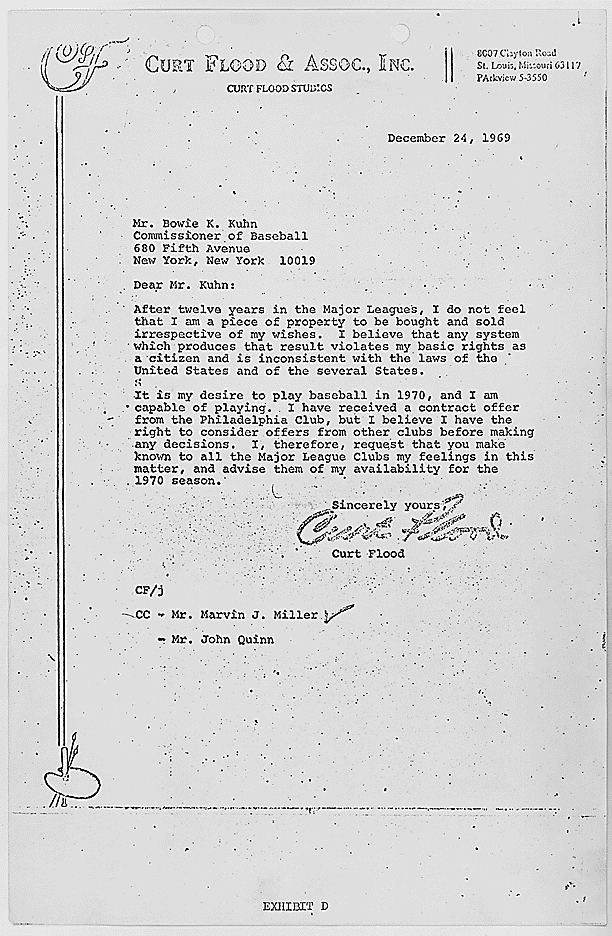
This move clashed with Flood’s values as he harbored concerns over playing in Philadelphia that he was willing to forfeit his $90,000 contract in order to become a free agent. In a letter to Baseball Commissioner Bowie Kuhn, (click on the Flood letter below), Flood demanded that the commissioner declare him a free agent. Commissioner Bowie Kuhn denied Flood's request for free agency, citing the propriety of the reserve clause and its inclusion in Flood's 1969 contract.” So Flood, decided to take action, and launched a legal battle against MLB. The reserve clause, gave a team the right to trade a player without his permission. Although the concept of the reserve clause was initially intended to promote stability within MLB, it quickly evolved into an oppressive mechanism that restricted player movement and bargaining power.
Despite their pivotal role in generating immense revenues, players lacked control and equitable compensation for their contributions. For most of MLB’s existence, players were bound contractually to their respective teams through this clause, effectively closing from their freedom to negotiate with other clubs once their contracts expired. As a result, teams could renew a player’s contract year after year without their consent, retaining their rights indefinitely. As a result, teams could renew a player’s contract year after year without their consent, retaining their rights indefinitely. This system was exceptionally beneficial to team owners, who controlled players’ fate, careers, and earnings. The problem with the reserve clause,’ Flood said ‘is that it ties a man to one owner for the rest of his life. There is no other profession in the history of mankind, except slavery, in which one man was tied to another for life'.
Flood wanted to sue for his freedom. Marvin Miller, the head of the MLBPA, cautioned him that even if he won a lawsuit, the owners would blacklist him as a player and as a future coach or manager. Flood turned to Marvin Miller, the executive director of the players union. Miller backed him all the way. They discussed the possibility of suing major league baseball to overturn baseball’s 1922 exemption from the Sherman Anti-Trust Act. Miller warned Flood that given the courts’ history of bias towards the owners and their monopoly, the odds were heavily against Flood winning, and that a lawsuit would be both expensive and time consuming. He also noted that the owners would likely blackball Flood, even if he won.
Despite Miller’s warnings, on December 13, 1969, Flood went to the MLBPA’s executive committee meeting in Puerto Rico to discuss suing major league baseball in a challenge to the reserve clause. After Flood’s meeting with the MLBPA, its executive committee voted unanimously to back Flood (including paying his legal expenses). On January 16, 1970, Flood filed a $1 million lawsuit against Bowie Kuhn and Major League Baseball, alleging violation of federal antitrust laws. Even though Flood was making $90,000 at the time, he likened the reserve clause to slavery. Sportswriters at the time scoffed at Flood’s assertion the reserve clause enslaved him. Sportscaster Howard Cosell once asked Flood how someone earning $90,000 a year – one of the top salaries in the game then – could feel like a slave. “A well-paid slave is nonetheless a slave,” he responded.
Flood claimed that the reserve clause violated antitrust laws and the Thirteenth Amendment, which forbade involuntary servitude. His bravery in standing up against baseball hierarchy gained him recognition while simultaneously costing him his MLB career. Threats, alienation from peers, and financial struggles were prevalent through his fight. Years of dedication led Flood to pursue this avenue despite knowing the odds stacked against him. Flood acted not merely for himself but the countless players relying on the hope for systemic change. Despite Flood’s immense trial efforts, both the District and Appeals Courts ruled against him. Ultimately, Flood’s case reached the U.S. Supreme Court as “Flood v. Kuhn (407 U.S. 258)”, providing the highest possible platform for debate.
Flood said, “What I want out of this thing is to give every ballplayer the chance to be a human being and to take advantage of the fact that we live in a free and democratic society and he should have some choice.” Among those testifying on his behalf were former players Jackie Robinson and Hank Greenberg, and former owner Bill Veeck. Notably, Carl Yastrzemski stated that: "Personally, I am against what Curt Flood is trying to do because it would ruin the game." Although the player representatives had voted unanimously to support the suit, rank-and-file players were strongly divided, with many fervently supporting the management position. Flood's attorney, former Supreme Court Justice Arthur Goldberg, asserted that the reserve clause depressed wages and limited players to one team for life. Major League Baseball's counsel countered that Commissioner Kuhn acted in the way he did "for the good of the game."
Ultimately, the Supreme Court, acting on stare decisis "to stand by things decided". The U.S. Supreme Court, which ruled against him in a 5 to 3 written by Justice Harry Blackmun. Justice Blackmun deferred to a previous Supreme Court ruling in 1922 that declared professional baseball was “entertainment” and not a business, and thus exempt from the Constitution’s Commerce Clause. Blackmun argued that it was up to Congress, not the courts, to decide whether baseball was an interstate business. Justice William Douglas dissented, joined by Justice William Brennan. Associate Justice Thurgood Marshall also dissented, Marshall compared baseball’s reserve system to involuntary servitude. Justice Lewis Powell did not participate in the case due to his ownership of stock in Anheuser-Busch, which owned the Cardinals.
Despite the loss in the Supreme Court, Flood’s defeat, however, led to victory. The baseball player's union continued to push to eliminate the reserve clause. It was finally struck down, when using the new grievance procedure, Catfish Hunter became baseball’s first free agent after the 1974 season when an arbitrator ruled that Oakland A’s owner Charley Finley had breached Hunter’s contract by refusing to set up a lifetime annuity. Hunter signed with the Yankees for $3.75 million. The following year, Andy Messersmith and Dave McNally played an entire season without new contracts (in an attempt to “play out” their options), and arbitrator Peter Seitz declared them free agents. Messersmith and McNally opened the floodgates. In July 1976, the union and the baseball team owners agreed to a contract that included free agency, to players with at least six years of experience, ushering in the lucrative contracts.
Although he was unsuccessful, it led ultimately to the clause’s demise. It wasn't too long after that other players challenged the reserve clause, and players today are reaping the benefits with arbitration and free agency. Baseball was shaken. Five years later, a federal court effectively killed the reserve clause. By taking a stand for what he believed in, Major League Baseball implemented the 10/5 rule, which allows any player with ten years of MLB service, the last five with the same team, to veto any trade. Although true free agency wasn't granted to players until years later, Flood took a bold stand, so that today's ballplayers could make the millions they do. Flood ignited essential dialogue and exhibited unprecedented resolve against an institution revered for exploiting athletes.
As players gained the autonomy to pursue fair market value for their skills and talents—Flood’s impact transcended baseball. This cost Curt Flood the rest of his playing career. Although Flood said in 1970 he did not expect to play professional baseball again, in 1971 Flood was traded to the Washington Senators, and agreed to a contract with the team. However, the drain of the lawsuit, sitting out the previous season, and his alleged frequent drinking had made him a shell of the player he was in St. Louis. He left the Senators in late April of 1971 and retired from baseball. After his retirement Flood became a broadcaster for the Oakland Athletics and later worked for the Oakland Department of Sports and Aquatics as commissioner of a sandlot baseball league.
Years after Flood’s crusade, Congress recognized his contribution to the sport when it passed the Curt Flood Act of 1998, which chiseled away at the sport’s antitrust exemption by making actions affecting major league baseball players’ employment subject to antitrust laws. Flood’s legacy continues to benefit players more than ever, even if his name has been lost to history. Players today owe much to Flood’s courage. His courage and determination made him a trailblazer for players’ rights. Flood’s heroic professional move against Major League Baseball and his personal sacrifices will never be forgotten. For this brave and unselfish action, in my opinion, Curt Flood deserves a plaque in Cooperstown, his absence from the Hall of Fame is disgraceful and is long overdue. Curt Flood passed away in 1997 at the age of 59, but his legacy as a trailblazer in baseball remains influential.