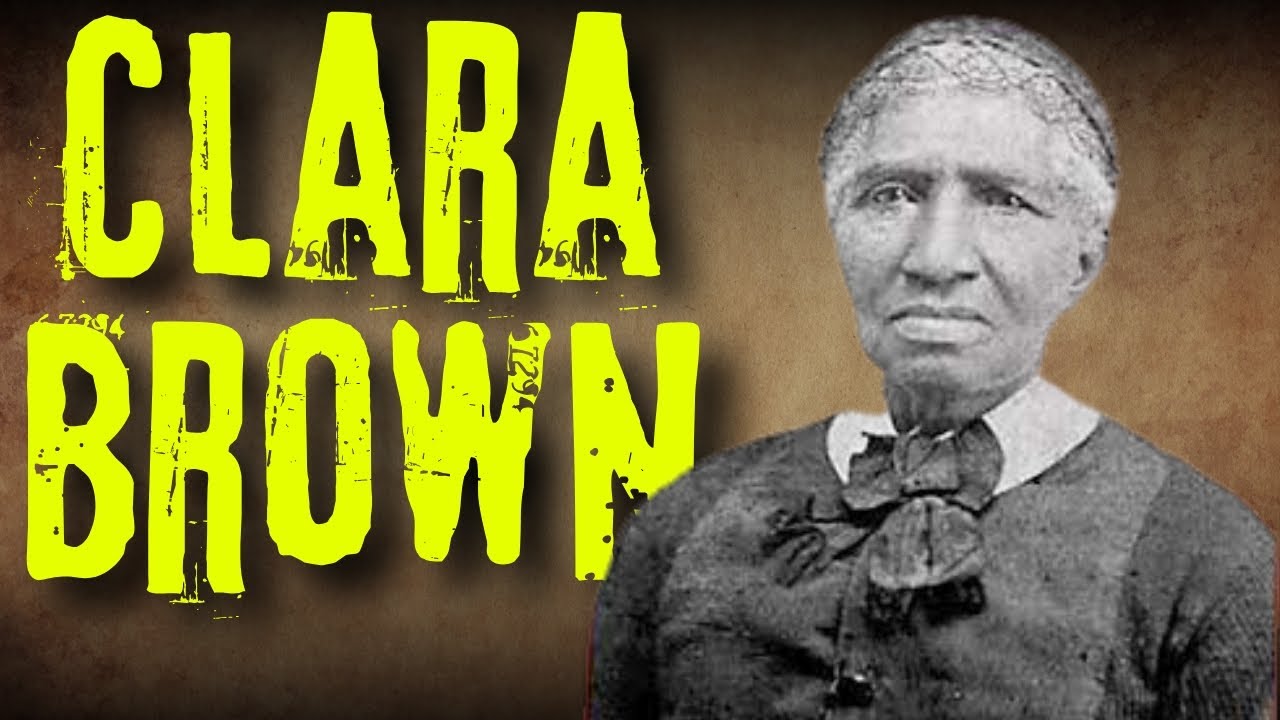
Clara Brown was an enslaved woman that became a leading pioneer of Colorado. Brown was born in Virginia in 1800 or 1803. As with most slaves, exact birth records were not kept. Clara was forced to move west when her enslaver decided to seek better opportunities in the western territories. Clara was about 6 years old when she made the difficult journey to Russellville, Logan County, Kentucky. It is unclear how Clara was first introduced to religion. What is known is that religious belief became a central part of Clara’s identity. She devoted her life to doing God’s work, and her faith guided her actions and brought her comfort in challenging times.
When Clara was about 18 years old, she married a man owned by her enslavers. She gave birth to four children. By thirty five years of age she had four children. One of her daughters drowned when she was only 8 years old. Unfortunately, this tragedy was soon followed by another. In 1835, Clara’s enslaver died. His children had no interest in running his farm or owning enslaved people. Her family was separtated at a slave auction and were taken by different masters to various parts of the country. Clara was purchased by George Brown and thus became “Clara Brown”. She tried unsuccessfully to find members of her family.
In 1857, she contributed $100.00 toward her own freedom when her master died, and at the age of 55, resumed her search once again, vowing to search for her ten-year-old daughter, Eliza Jane. At the age of 56, Clara Brown was granted her freedom, as stipulated in George Brown's will, but was required by law to leave Kentucky. As in some other states, Kentucky did not allow free Black people to reside within the state. So she moved to St. Louis, MO. St. Louis was a bustling western city with many opportunities for people to build new lives. But Missouri also had many laws that restricted the lives of free Black people.
In 1858, Clara moved again, to Leavenworth, KS. In Leavenworth, Clara bought the tools she needed to start a business as a laundress. Doing laundry was hard work, but it allowed Clara to support herself without having to answer to anyone else. Also in 1858 gold was discovered in Colorado and prospectors were headed there to claim their fortune. Thousands of people hurried west, hoping to get rich quickly in what became known as the Colorado Gold Rush. Clara joined a wagon train and worked her way west as a cook and laundress to Denver, Colorado. The wagon train provided some safety and security for a single woman traveling alone.
Mostly walking the seven hundred miles to reach her destination she joined a great number of men. Brown settled in the mining town now called Central City, Colorado which was barely more than a mining camp when Clara first arrived, but this was helpful to Clara. In a more established town, a Black woman living alone would have been treated like a second-class citizen. There were very few women in Central City. Clara Brown worked as a laundress, nurse, cook, and midwife. Her hard work earned her respect and admiration from the community, something that might not have been possible in many other places. Clara’s popularity helped her achieve financial success.
Brown's income grew substantially when she expanded her laundry business after taking a partner. By 1866 she had accumulated a small fortune worth $10,000.00. With the money she made, she invested in properties and mines in nearby towns. She then rented her properties to prospectors for extra income. By 1864 she owned seven houses in Central City and sixteen lots in Denver. She also owned property in nearby Georgetown and Boulder. She was one of the wealthiest people in Central City. Known as "Aunt Clara" for her emotional and financial support, Brown was a founding member of a Sunday school, made her home available for prayer services and generously supported the community.
Aunt Clara turned her home into a refuge for the impoverished pouring into the camp. It served as a hospital for the physically ill, a church for those who needed spiritual solace and a hotel for those with no place to stay. When the Civil War ended in 1865, 4,000,000 Black people were emancipated from slavery. But there was no clear plan for how they could support themselves and build new lives. Clara took a personal interest in recently freed Black Americans, because she had once been in their position. She traveled to Kentucky and Tennessee, where she paid for 26 Black men, women, and children to make the overland journey to Central City, not by foot as she had, but in horse drawn wagons.
Clara Brown gave these settlers practical and financial help as they started their new lives in Colorado. She is further credited with the courage of trying to bring law and order to a frontier mining community where prostitution, shoot-outs and murders were common. Clara was known for her philanthropy in the community. Clara denied herself any luxuries, and chose instead to help fund non-profit causes such as the construction of a local church. She was known as the 'Angel of the Rockies' and made her mark as Colorado's first Black settler and a prosperous entrepreneur. At the end of the Civil War, Brown could freely travel and liquidated all of her investments to travel back to Kentucky to find her daughter.
Although she was unsuccessful, she paid the way for 16 or more relatives and others who were former slaves to move to Colorado. She helped them find work once they were settled. The governor of Colorado sent Brown to Kansas in 1879 to gather information to help former slaves "build a community and farm the land." Clara’s generosity drained her personal wealth. At eighty years of age, Brown's funds were depleted through charitable contributions. She also started to suffer from the effects of old age. In her time of need, Clara’s community came together to support her. Brown moved to Denver when she could no longer sustain the higher altitude and lived in the home of a friend.
An association founded to support the earliest Colorado settlers in their old age added “Aunt Clara” to their roster. At the peak of her success, she had offered a $1,000 reward for any information that would reunite her with her daughter. But for years she heard nothing. Clara had never given up hope that she would one day be reunited with her children. In February 1882, however, 82 year old Clara Brown received news that her daughter, Eliza Jane had been located in Iowa. In 1884, 84-year-old Brown traveled to Iowa to reunite with her 56-year-old daughter, Eliza Jane and her granddaughter, Candy. She never found any of her other family. In remembrance of her pioneering role in Colorado history, she was voted into the Society of Colorado Pioneers.