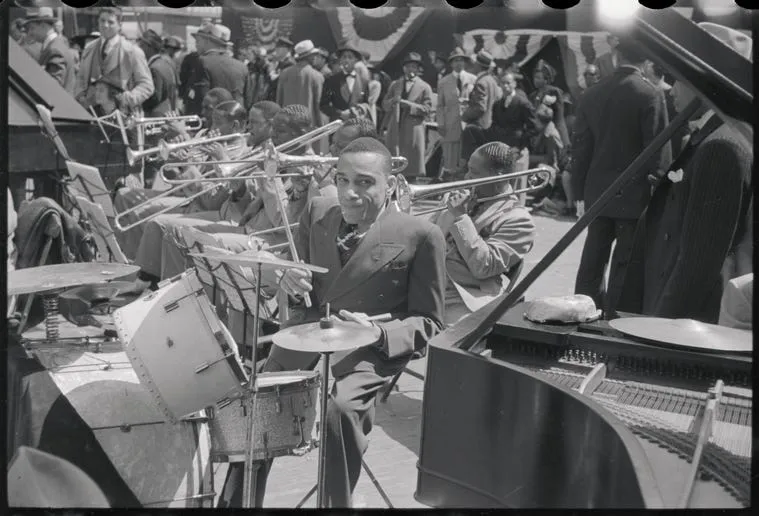
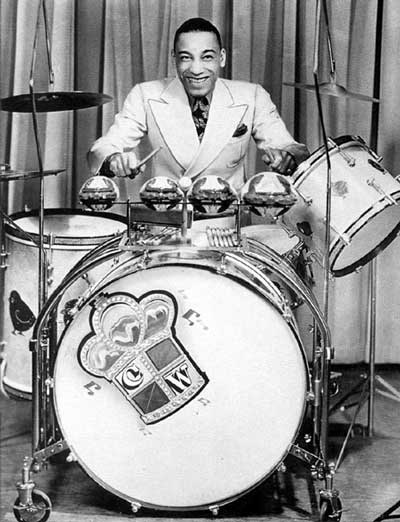
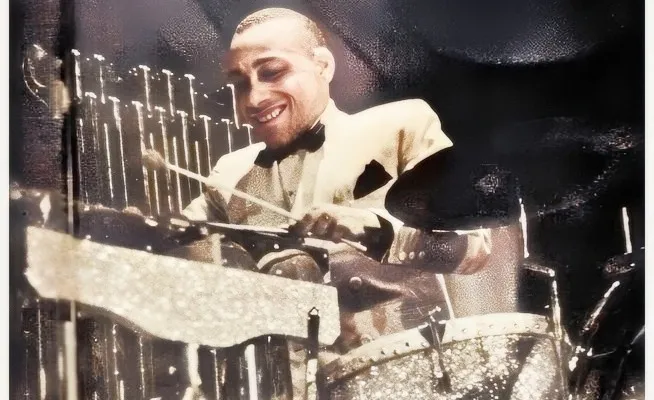
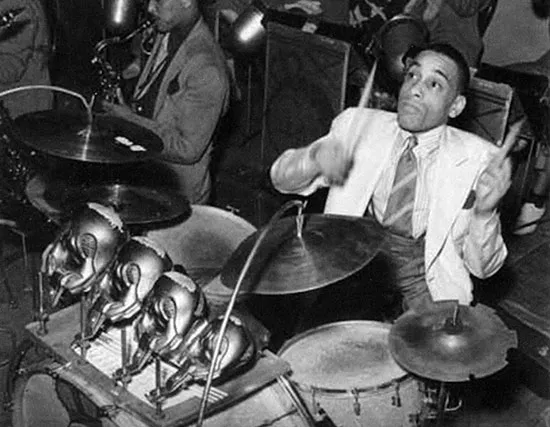
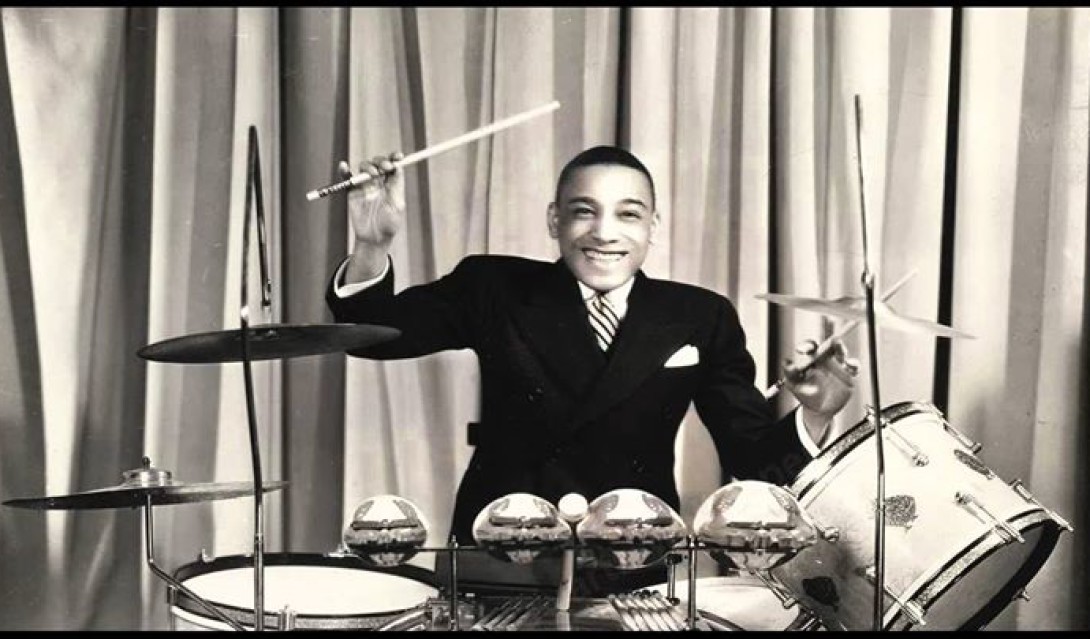
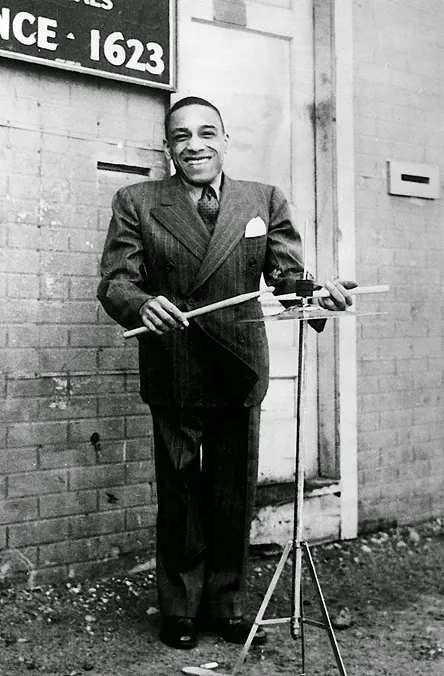
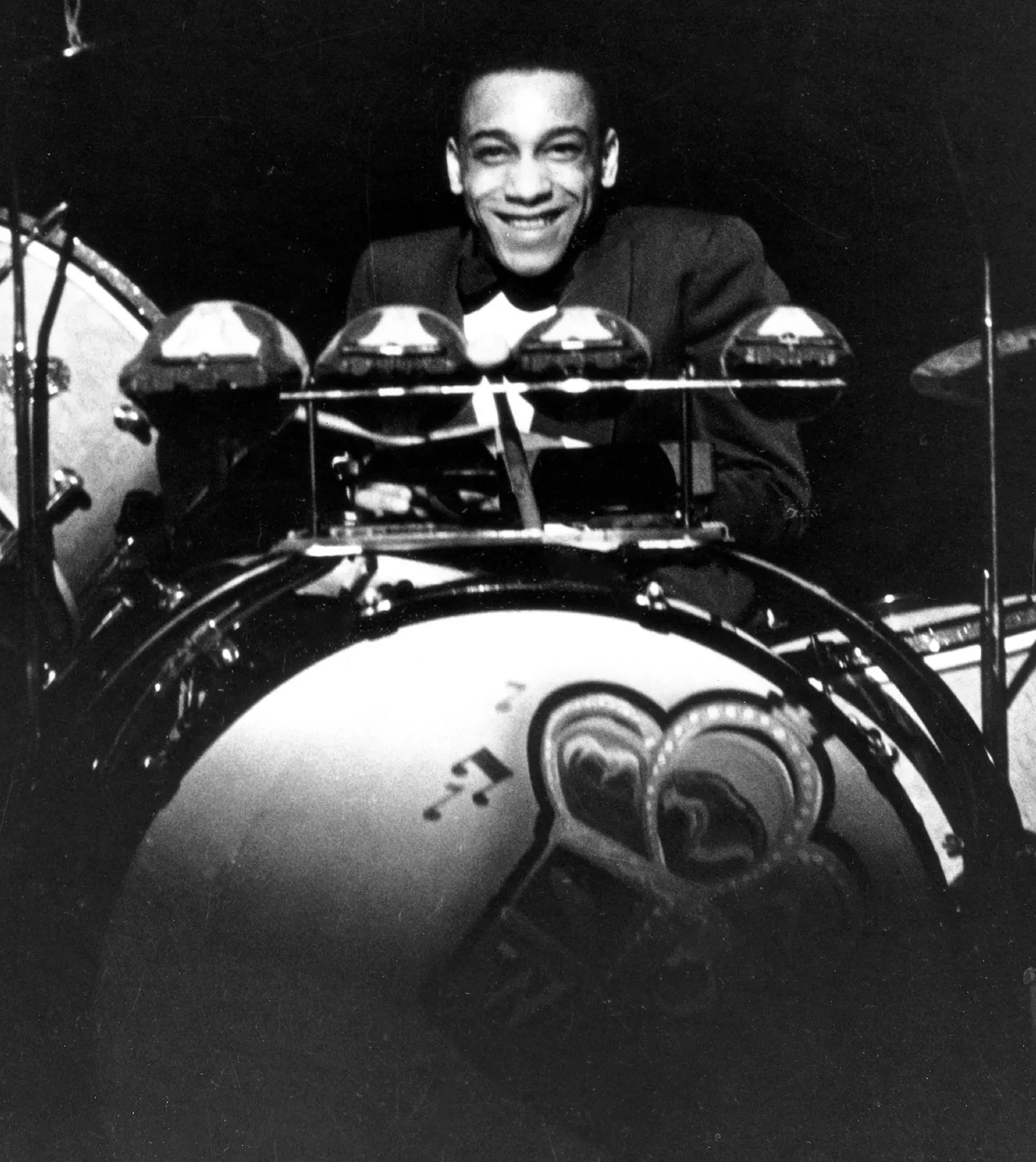
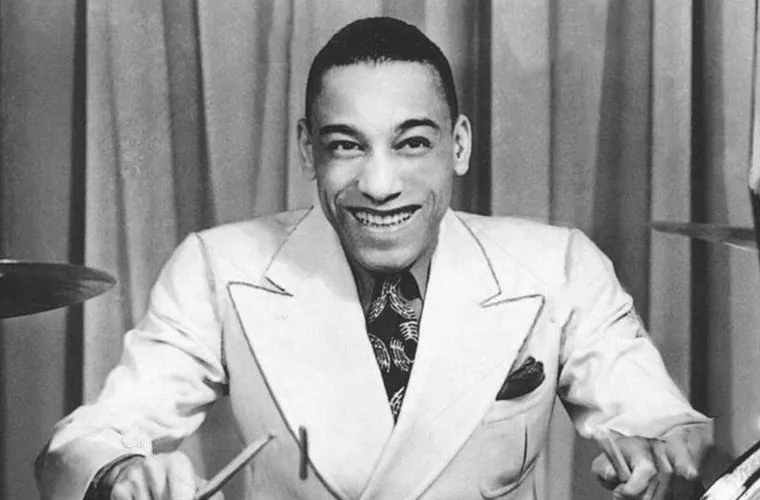

William Henry Webb aka Chick Webb was born February 10, 1905, in Baltimore, Maryland. There are some discrepancies surrounding his actual birth year, which has been reported both as 1905 and 1909. After his father’s passing, Webb moved with his mother and sisters into the home of his maternal grandparents. He showed interest in drumming as a toddler, initially using pots and pans, then different surfaces found around his neighborhood to drum out rhythms. He suffered from tuberculosis at a young age, leaving him with short stature and a badly deformed spine, which caused him to appear hunchbacked and the “kids called him ‘Chicken’—shortened to “Chick”— because of the way he walked. The idea to a play a music instrument came from his doctor, who believed it would help “loosen up” his bones. But drums—even drumsticks—were too expensive, so William used wooden spoons and pots and pans to make music.
As a child, Webb worked as a newspaper boy to help support himself and purchase drums. By age eleven, he was playing professionally. He worked as a street musician before joining the Jazzola Orchestra, playing drums with the band on aboard the Chesapeake Bay excursion boat steamers. In the Jazzola Orchestra, he met lifelong friend and musical sideman John Truehart, a talented Baltimore-born banjo player and guitarist. He had dropped out of school at an early age yet thrived as a musician by memorizing all of the band arrangements. As a teenager, Chick was hired to play in local bands. Realizing that in order to support himself he had to go where the music was, Chick at the age of 17, moved to New York City, eventually settling in the bustling and hip Harlem community in the borough of Manhattan. Jazz drummer Tommy Benford gave Webb drum lessons when he moved to New York in 1924. There he played for Ed Dowell’s band.
They played throughout the five boroughs and on tours outside his adopted home, New York City. Chick quickly established a name for himself and often sat in on sessions with players like Duke Ellington. By the mid-1920s, with the suggestion of Ellington, he led his own band, which included Benny Carter, Jimmy Harrison and Johnny Hodges. Shortly after he formed his own quintet, and played for five months at the Black Bottom Club. Considered a virtuoso drummer with no equal, Webb never learned to read music and instead memorized the arrangements played by the band and conducted from a platform in the center. Two years later, Chick formed and led the jazz band, the Jungle Band, which became the Harlem Stompers, an eight-piece band that eventually expanded to eleven pieces before being renamed the Chick Webb Orchestra. Following a five-month stint at the Black Bottom Club, Ellington booked Webb at the Paddock Club.
When the upbeat swing movement hit the scene, Chick Webb adapted quickly, leading his band to be one of the premier musical collectives. Harlem was the home of swing and Webb soon was at the head, drumming mightily and setting the tone. “Battle of the Bands” musical competitions spread like wildfire and in 1928, the management at the Savoy Ballroom offered Chick the opportunity to lead his band as the popular nightspot’s house band. The Savoy was a ballroom that stretched the entire length of 140th and 141st Streets. Known by Har-lemites as “theTrack,” the Savoy accommodated 4,000 dancers and some of the best jazz orchestras of the period. The proposed arrangement was cemented after they saw how Webb’s band slayed the bands of King Oliver and Fletcher Henderson. In 1929, Webb’s Jungle Band recorded “Dog Bottom” and “Jungle Man” with Brunswick Records. During this time, Webb led bands in various clubs.
Also that same year, he alternated between tours and residencies, performing at numerous venues including Howard University’s Howard Theatre, the Harlem Opera House, the Apollo Theater, the Savoy Ballroom-Chicago, the Savoy Ballroom-Harlem, Radio City Music Hall, the Cotton Club, the Roseland, and the Strand Roof. During 1929, Webb was featured in the short film, "After Seben". Their theme song and the one that is associated with the Chick Webb Orchestra, was “Stomping at the Savoy”. Which is what they did best, flat out swingin’ man! In legendary cutting sessions there, Webb’s crowd-pleasing style and power overwhelmed such bands as Count Basie’s, Fletcher Henderson’s and Benny Goodman’s. After his contract expired at the Savoy, Webb booked his band at the Rose Danceland on 125th Street in December of 1927. Instead of staying at the Rose Danceland, however, Webb took a job playing behind vaudeville dancers.
Ill-suited for the engagement, the band not only lost the job, but outraged the owners of the Rose Danceland, who became embittered at the financial loss incurred by Webb’s sudden departure. The lack of steady work and the erratic management by Webb forced several musicians to leave the band. Among them were key soloists like Hodges, who joined Ellington. Webb’s return to the Savoy in 1931 proved triumphant. Steady employment at the Savoy enabled Webb to assemble a formidable musical lineup with trombonist Jimmy Harrison and saxophonists Benny Carter, Edgar Sampson, and Don Redman. By 1931 the band was on an extended engagement contract at the Savoy, which would last for the next five years. They also did road tours and other dates at clubs such as the Casino de Paris, but it was the Savoy, where they would get a name. He became one of the best-regarded bandleaders and drummers of the new "swing" style.
Though Harlem was considered the mecca of Black jazz musicians and the world capital of swing, Jim Crow laws, racism, and segregation prevailed. Some New York venues catered to White clientele only and would only hire all-White bands. Webb broke through those barriers and paved the way for drummer-led bands. He was the leader of the most popular house band at the integrated Savoy Ballroom and consistently drew large crowds. As the Savoy Ballroom's house band, Webb gained a reputation for winning more than his share of the club’s “Battle of the Bands” against such giants as the Benny Goodman and Count Basie orchestras to be crowned “The King of Swing”. “Battle of the Bands” was a huge crowd-draw during this time. Two bands would take turns on the bandstand playing their hottest arrangements with the dancefloor crowd acting as judges and picking the winner. Chick’s band was considered to be among the best.
Webb’s band emerged successful on record as well. In 1934 they released an album for Columbia Records under the name Chick Webb’s Savoy Orchestra. He introduced “Stompin’ at the Savoy” in 1934, composed by alto saxophonist and arranger Edgar Sampson in 1933. Later Andy Razaf added the lyrics. Under the Decca label, the band had hits with “If Dreams Come True”, “Blue Lou”, and “Don’t Be That Way”. He became known as the one of the best band leaders and drummers of the new Swing style of music. Some of his best known songs are ”Harlem Congo," Hallelujah," and "Undecided." Their popularity was unmatched throughout the country, they toured and played regularly for national radio broadcasts. Webb’s leading soloists were Johnny Hodges, Benny Carter, Louis Jordan, and Taft Jordan. Webb was an excellent musician but no great showman, so Jordan took over the announcements when he started singing for the band.
In 1935, Webb hired the teen-aged Ella Fitzgerald, who would soon be known as the First Lady of Swing, after she won a talent contest at the Apollo Theatre. At first reluctant to hire the young singer, Webb soon added Fitzgerald to the band’s payroll. The singer became an instant success with Harlem crowds. Webb rebuilt his show around the singer. The same year he hired Fitzgerald, the Chick Webb Orchestra was featured on NBC’s national radio program, “Good Time Society.” He became one of the first bandleaders to sign with Decca Recording Company and was the first jazz artist to be featured at the Metropolitan Opera House. The Chick Webb Orchestra was the first Black band to host a national radio show and the first Black band to play at the Park Central Hotel in Harlem. The band had a string of hits on the Decca label that was capped off by their biggest ever when Ella wrote “A Tisket A Tasket” in 1938.
Webb recorded 60 numbers featuring Fitzgerald. Chick realized that he had a seismic star in Ella Fitzgerald. Chick began taking a backseat and allowing her talents to prevail. On May 11, 1937, the Chick Webb Orchestra won the Savoy Ballroom’s battle of the bands, coined the “Battle of the Century,” against the Benny Goodman Band. Close to 5,000 people crowded inside the Savoy and thousands more waited outside to witness the historic battle. White audiences had previously crowned Goodman the King of Swing. Webb, however, proved that he was the true King. By the night’s end, with no real voting process except the crowd’s applause, Webb was declared the winner. Goodman’s own sensational drummer Gene Krupa bowed down to Webb in tribute. Krupa, years later recalling the event, wrote, “That night when we battled Chick at the Savoy – he just cut me to ribbons — made me feel awfully small…that man was dynamic”
On January 16, 1938, the Chick Webb Orchestra won the battle against the Count Basie Orchestra. The Savoy was so crowded that night that hundreds of fans of both bands had to be turned away at the door. That same year, Webb was awarded an honorary doctorate by Yale University. Although Webb could not read music, he memorized everything and cued the band with his drums from a raised platform. “The King of the Savoy” reigned supreme over jazz drummers during the Harlem Renaissance. Chick brought the role of the drummer into the forefront as an important instrument, as the technology of drums and cymbals themselves improved. He was the consummate showman and with his fluid and rhythmic style, he was perfectly suited for the swing era. He raised the standard for drummer awareness, and paved the way for drummer led bands. His dynamic drumming and easily recognized compositions earned him and his band an enthusiastic following. During tours with his orchestra, he would periodically return to Baltimore for hospitalization and treatment for his ongoing ailments.
As Webb's health began to decline in 1938 he refused to give up touring so that his band could remain employed. He continually booked the band to play extensive tours and theater engagements. Chick disregarded his own discomfort and fatigue, which often found him passing out from physical exhaustion. In the early months of 1939, Webb began to collapse after shows, his face often bearing a grayish, sickly complexion. While playing on a riverboat outside Washington, D.C., he fell ill and had to be rushed to Johns Hopkins—the same Baltimore hospital where he had received treatment some 25 years earlier. Webb received a major operation could not be saved, finally succumbing to spinal tuberculosis, leaving a musical legacy that would live on for generations. Upon his death Fitzgerald took over the orchestra for two years until it became too much for her, and the orchestra disbanded, casting Ella into her solo career.
His contributions as a drummer/bandleader changed the course of music in America. Through the years, he was admired by his peers, but largely forgotten by the public. Chick Webb was hugely admired by drummers such as Buddy Rich, Gene Krupa, Louie Bellson, “Papa” Jo Jones, Art Blakey, Kenny Clarke, and Max Roach for his power, clarity and impeccable rhythm. Drummer Buddy Rich cited Webb's powerful technique and virtuoso performances as heavily influential on his own drumming, and even referred to Webb as "the daddy of them all". Its swing, precision, and popularity made it the standard of excellence to which other big bands aspired. His keen ability to swing in a way that truly complimented the other musicians or singers around him was second to none. Webb’s impact on the music scene was profound. He was unique as a modern-thinking swing drummer bandleader shaping the arrangements from the drum throne. Webb put the drums front and center in jazz orchestration with a versatile style that expanded the percussive range of the drum kit by re-imagining the interplay between cymbals, bass, tom-tom, and snare drums. Also, he incorporated drum parts and solos into Big Band arrangements. Spectacular technique and wide dynamic range were never captured properly on any of his recordings, but as legend has it he was something to behold when he held court at the Savoy.