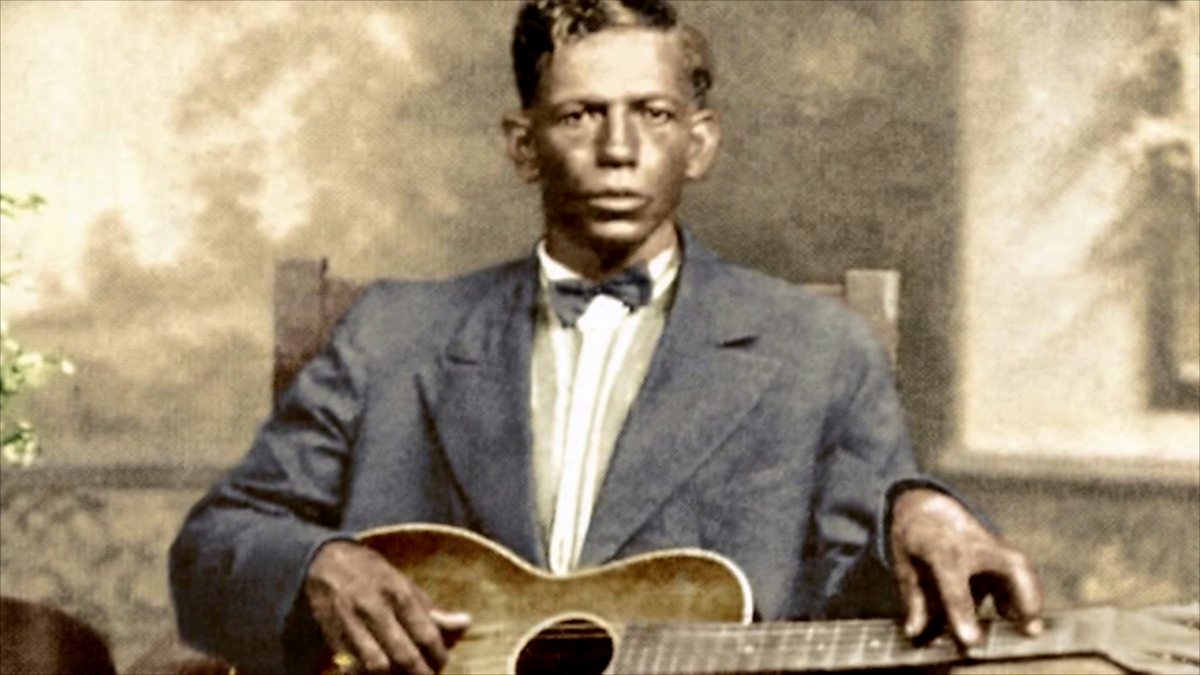
Charley Patton
Charley Patton, one of the most important figure in the pioneering era of Delta blues, helped define not only the musical genre but also the image and lifestyle of the rambling Mississippi bluesman. Patton has been called the “Founder of the Delta Blues” He blazed a trail as the music’s preeminent entertainer and recording artist during the first third of the 20th century. Born between Bolton and Edwards, Mississippi, in April 1891, Patton was of mixed Black, White and Native American ancestry.
In 1900, his family moved 100 miles north to the Delta and the Will Dockery Plantation. There Patton fell under the spell of guitarist Henry Sloan and would follow him to gigs. He showed an early predilection for making music, and he learned to play the guitar as a very young child. But Patton grew up in a hardworking farming and religious family, and his father considered playing the guitar a sin. Despite frequent punishments for playing music, Patton continued performing ragtime, folk songs, and spirituals at picnics and parties.
Patton spent most of his time moving from plantation to plantation, entertaining field hands at jukehouse dances and country stores, acquiring numerous wives and girlfriends along the way. The emotional sway he held over his audiences caused him to be tossed off of more than one plantation, because workers would leave crops unattended to listen to him play. When Patton was growing up, he was determined to leave the racism of the South. His lyrics described some of the themes of his life.
He was tired of living a sharecropper’s lifestyle. Patton also told about the brutal and harsh conditions that African Americans lived under in the South. The song “Down the Dirt Road Blues” shows just how Patton felt about changing his life. An accomplished and inventive guitarist and lyricist, he was a flamboyant showman as well, spinning his guitar, playing it behind his head and slapping it for rhythmic effect. After the turn of the decade Patton began playing with Willie Brown, a guitarist who would later become a regular on his recordings.
Within a few years, Patton had become a central figure in the local music scene and served as a mentor to many of the area’s budding bluesmen. By 1926, a young Robert Johnson had begun following Patton and Brown to gigs trying to learn from the veteran guitarists. Patton made his first recording in June 1929, cutting fourteen songs for the Paramount label, all issued on 78s. Such was the success of his initial session that he was invited four months later to Paramount’s new studio in Grafton, Wisconsin, where he recorded twenty-eight additional tunes.
The bluesman returned in the spring of 1930 to record his final four songs for the label, including “Moon Going Down.” During several of his Paramount sessions, Patton was accompanied by Willie Brown, as well as by singer and fiddle player, Henry “Son” Sims. Patton’s final sessions, in January and February 1934, found the bluesman recording in New York City for Vocalion Records. In the nearly 70 recordings he made between 1929 and 1934, Patton sang in a gravelly, strained, sometimes unintelligible voice.
His most popular and influential record was the Paramount release that paired “Pony Blues”with “Banty Rooster Blues.” Other Patton songs were noteworthy for their references to specific people, places and topical events in the Delta. “High Water Everywhere,” a dramatic two-part account of the death and despair wrought by the great 1927 flood, is often regarded as his masterpiece.
Patton’s music influenced nearly every blues artist of the 20th century. For decades after his death, Patton’s legacy could be heard in clubs and studios across America, eventually crossing the Atlantic to the UK, Europe, and beyond. In the middle of the century, when Delta artists moved north, they blended Patton’s traditions with amplifiers, creating a modern style that inspired R&B and rock ’n’ roll.