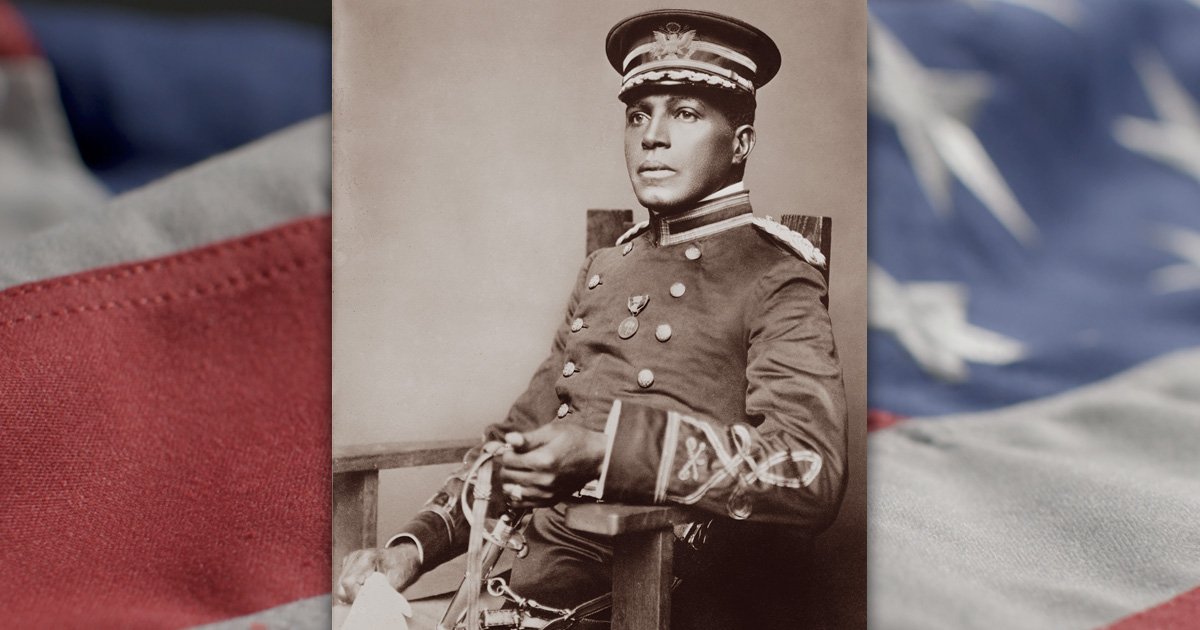
Charles Young was the third Black graduate of the United States Military Academy, class of 1889, in spite of the hatred, bigotry and discrimination he encountered as an undergraduate. Charles Young was born into slavery on March 12, 1864, in May's Lick, Kentucky, a small village near Maysville. As a youth, Charles Young attended the all-White high school in Ripley, Ohio, the only one available, shortly after his parents relocated from Kentucky. He graduated at age 16 at the top of his class. His father had escaped bondage to join the Union Army during the Civil War, and Young later followed in his father's military footsteps.
After encouragement from his father, Young took entrance exams for West Point but was not selected to attend despite having the second highest score. It wasn’t until a candidate dropped out the following year that Young received his acceptance letter. Young took a competitive examination for appointment as a cadet at United States Military Academy at West Point. He achieved the second highest score in the district in 1883 and reported to the academy in 1884. Young had a miserable time at West Point.
Charles Rhodes, a White cadet in Young’s class, remembered him as “a rather awkward, overgrown lad, large-boned and robust in physique, and of a nervous, impulsive temperament.” Rhodes recalled that Young’s “life was lonesome” at West Point––hardly a surprise, as most White cadets refused to associate with Blacks and subjected them to racial slurs, cruel slights and hostile treatment beyond the normal hazing. In 1889, he became the third Black graduate from the academy following Henry Ossian Flipper and John Hanks Alexander.
After graduating from the academy, it was three months before he received an assignment because at the time, Black officers were not allowed to command White troops. Young graduated in 1889. His first assignment after graduation was with the Buffalo Soldiers in the 10th Cavalry in Nebraska, and then in the 9th and 10th Cavalries in Fort Robinson, Nebraska, and Fort Duchesne, Utah. While stationed at Fort Duchesne, Utah, Young mentored Sergeant Major Benjamin O. Davis, Sr. who later became the first African American to attain the rank of General.
With the outbreak of the Spanish-American War, he was reassigned as Second Lieutenant to training duty at Camp Algers, Virginia. Between 1889 and 1907 Young served in western posts and rose to the rank of captain. In 1894 Lieutenant Young was assigned to Wilberforce College in Ohio, to lead the new military sciences department. Young organized the military training program which grew to over 100 cadets by the turn of the century. Few such programs existed at civilian colleges or universities and none at African-American institutions.
While at Wilberforce, Young befriended W.E.B. Du Bois, a classics professor who would become one of the leading Black American intellectuals of the early 20th century. After leaving Wilberforce, Du Bois and Young continued to correspond, and Du Bois considered Young one of the “talented tenth”—those individuals whom Du Bois and other prominent Black intellectuals believed would lead the struggle for racial justice in America. In 1903, Captain Young was in command of the 10th Cavalry, who were segregated at the Presidio of San Francisco.
He was assigned "Acting Superintendent" of Sequoia National Parks in California for the summer. He was the first Black military attaché, became the first military attaché to Haiti and the Dominican Republic on the island of Hispaniola in 1904. Charles Young was very valuable to America in foreign posts because of his excellent command of foreign languages. He spoke fluent French, German, and Spanish. Captain Charles Young was sent to the Philippines to join his 9th regiment and command a squadron of two troops in 1908. Returning to the United States in May 1909, he took command of 2nd Squadron, 9th Cavalry.
In 1912 Young was promoted to major and was once again selected for Military Attaché duty, this time to Liberia. He also taught military sciences and tactics at Wilberforce University in Ohio in between his military duties. In 1916, Major Young was awarded the National Association for the Advancement of Colored People's (NAACP) prestigious Spingarn Medal, in recognition of his "Services in organizing the Liberian Constabulary and roads in the Republic of Liberia." During the 1916 Pershing's Punitive Expedition into Mexico, Young was praised for his leadership in the pursuit of the bandit Pancho Villa, who had murdered American citizens.
Commanding a squadron of the 10th United States Cavalry, he led a cavalry pistol charge against the Villista forces, routing the opposing forces without losing a single man. The swift action saved the wounded General Beltran and his men, who had been outflanked. After the campaign, Young was promoted to Lieutenant Colonel, on July 1, 1916, the first African American to attain the rank or its equivalent. He was assigned as commander of Fort Huachuca, the base in Arizona of the Tenth Cavalry, nicknamed the "Buffalo Soldiers", until mid 1917.
The War Department instead removed Young from active duty, claiming it was due to his high blood pressure. Young was placed temporarily on the inactive list. In July 1917, Young was medically retired and promoted to a full Colonel in recognition of his distinguished Army service. He was the first Black man to achieve the rank of colonel in the United States Army, and highest-ranking Black officer in the Regular Army. Young and his supporters asked for reconsideration of his retirement. To his bitter disappointment – he was not permitted to serve in the field during World War I. Charles Young died in 1922 during a visit to Nigeria. W. E. B. Du Bois, who spoke at Young's eulogy, claimed that "the life of Charles Young was a triumph of tragedy."