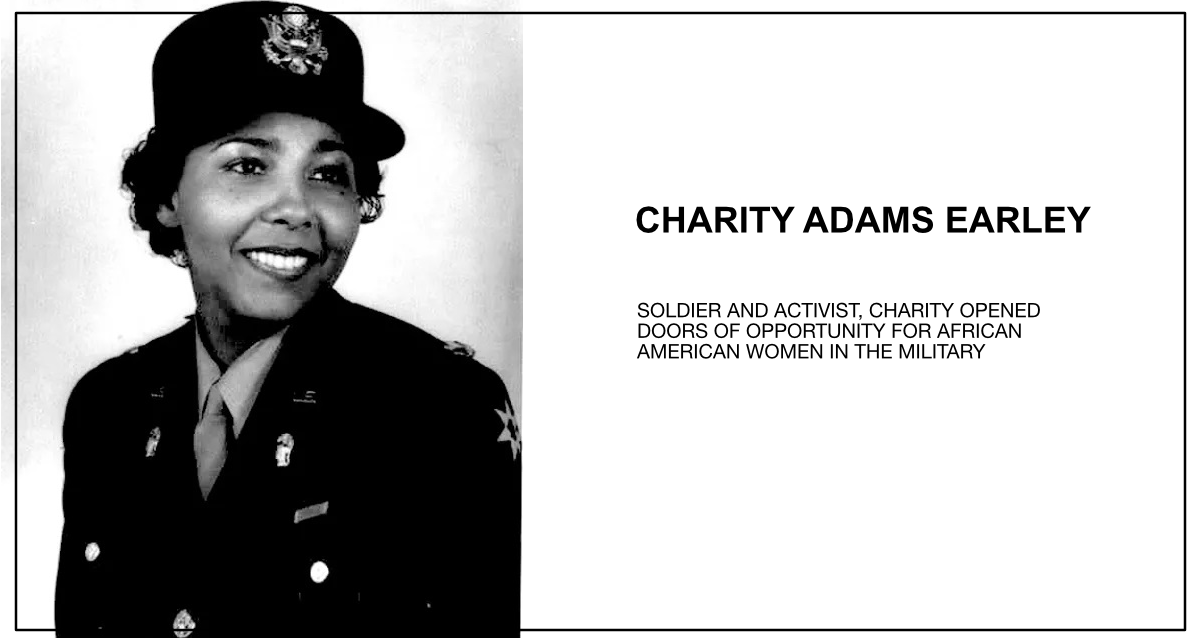
The first Black woman officer in the Women's Army Corps and commander of the 6888th Central Postal Directory Battalion, Charity Adams Earley, paved the way for Black women in the military. Growing up in the south, Adams experienced the hardships of segregation. Adams was born in Kittrell, North Carolina on December 5, 1918, but grew up in Columbia, South Carolina. Her father was ordained as a Methodist minister and her mother a schoolteacher. Charity was the oldest of four children and she started elementary school as a second grader. She graduated from Booker T. Washington High School as valedictorian in 1934.
Graduating top of her class enabled her to gain a scholarship, so that she could attend Wilberforce University in Ohio. Adams majored in Mathematics, Physics, and Latin, and minored in History. She became a member of the National Association for the Advancement of Colored People (NAACP), the Women’s self-government association, and Delta Sigma Theta sorority. Adams graduated with her BA in Arts in 1938. After graduation, she returned to Columbia where she taught mathematics at the local high school while studying part-time for a M.A. degree in psychology at the Ohio State University.
In 1942, Adams was encouraged to apply for a position in the newly formed Women’s Army Auxiliary Corps. Adams enlisted in the U.S. Army's Women's Army Auxiliary Corps (WAAC) in July 1942. She was commissioned on August 29, 1942. At the time, the U.S. Army was still segregated, so she was placed in a company with fellow female Black women officers and stationed at Fort Des Moines. She still faced discrimination, but was not afraid to speak up and fight for desegregation in the Army. In 1943, she was assigned to be the training supervisor at base headquarters.
In September 1943 she was promoted to the rank of Major, making her the highest-ranking Black female officer at the facility. She was placed in charge of the first WAC African American unit. In early 1944, Adams was reassigned as the Training Center control officer in charge of improving efficiency and job training. She also had other responsibilities, such as surveying officer (finding lost property) and summary court officer. One of the first battles Adams fought for equality was when the Army proposed segregating the training regiment. When she was told she would head one of the segregated regiments, she refused.
On another occasion, when a general stated, "I'm going to send a White first lieutenant down here to show you how to run this unit," then Major Adams responded, "over my dead body, sir." The general threatened to court-martial her for disobeying orders. She then began to file charges against him for using "language stressing racial segregation" and ignoring a directive from Allied headquarters. They both dropped the matter. When the Red Cross tried to donate equipment for a new segregated recreation center, Adams refused it because her unit had been sharing the recreation center with White units.
In December of 1944, Adams was selected to serve as commanding officer to the first and only battalion of Black Women’s Army Corps. Her most prominent role was leading the first Black women unit of the army on a tour of duty overseas during World War II. They were stationed in Birmingham, England. Adams encouraged her battalion to socialize with White men coming back from the front and even the residents of wherever they were stationed. She wanted to create comradeship between enlisted personal and ease the tensions of racism. Many of the men were reluctant to do so at first, but gradually some of them did.
The women also began to socialize with the citizens and broke through prejudices on both sides. Major Adams was put in charge of a postal directory service unit. Another part of her job included raising the morale of women. Adams achieved this by creating beauty parlors for the women to relax and socialize. In March 1945, she was appointed the commanding officer of the first battalion of African-American women, the 6888th Central Postal Directory Battalion. They faced life threatening conditions soon after they set sail for Europe. On their 2 week trek across the Atlantic Ocean they survived brushes with German U Boats.
They were stationed first in Birmingham, England, and three months later, they were moved to Rouen, France, then to Paris. Once the exhausted women arrived in England there was no time for relaxing and settling in. They were hurriedly assigned to their quarters and directed to their posts. Their assignment was to sort and redirect the delivery of the millions of backlogged letters and packages that had all but ceased to be delivered before their arrival. Not hearing from your loved ones was detrimental. Quickly something had to be done. The WAC was aware that the lack of mail to the frontline was lowering the morale of soldiers.
The 6888th Central Postal Directory Battalion's (nicknamed “Six Triple Eight,”) motto was "No Mail, Low Morale." They had their work cut out for them, but Maj. Charity Adams worked hard to keep her unit motivated and organized. Adams’ unit was given six months to complete the task. Adams had several issues to deal with at her Birmingham base if she wanted her battalion to function efficiently. The first hurdle was the 6888th Headquarters; it was dimly lit and plagued by the damp and cold of the English winter. This discomfort made it difficult for her WAC's to cope with months of accumulated mail caused by a personnel shortage.
Her second problem was the mobility of the troops; they were often on their way to somewhere else before their mail could catch up with them. She quickly divided her 800+ women into five companies working three around-the-clock shifts. Then she organized lists to categorize the activities of each military service, to trace elusive recipients, to distinguish between people with common names, and to try different destinations for companies on the move. Despite the frigid conditions, the 6888th, under the command of Major Adams, was able to sort and distribute all the mail and packages in only three months- half the time it was expected to complete the work.
Next Adams and the rest of the 6888th were transferred to facilities in Rouen and Paris, France, again organizing mail which had gone undelivered. Earley estimated that the unit handled approximately 65,000 pieces of post per day. When asked about her trailblazing achievements, she responded, "I just wanted to do my job". For her work in the WAC, Earley was promoted to lieutenant colonel on December 26, 1945. The first Black woman to become Lieutenant Colonel. This rank was the highest possible promotion for any women in the WAC. In March 1946, she requested to be relieved from active duty.
Upon her discharge from the military, "The National Council of Negro Women Inc." presented Earley with a scroll of honor for distinguished service to the military. Upon her return home, she completed her master’s degree in psychology from Ohio State University and worked for the Veterans Administration in Cleveland, Ohio. She moved to Nashville, Tennessee and was the director of student personnel at Tennessee State University. She then moved to Georgia and became the director of student personnel and assistant professor of education at Georgia State College. Charity Adams married medical student Stanley A. Earley Jr in 1949, and the couple moved to Switzerland while he completed medical school.
She learned to speak German and then began taking psychology courses there. The couple returned to the U.S. in 1952, and settled in Dayton, Ohio. Most of her post-war life was devoted to community service in Ohio. She served on multiple boards including the Dayton, Ohio, American Red Cross chapter. She volunteered for United Way, the United Negro College Fund, the National Urban League, and the YWCA. Charity also co-directed the Black Leadership Development Program, which provides community leadership training for African Americans. Admitting that sometimes she was a 'token' woman or Black, she also said that she was highly qualified for all the positions she held.
Segregation remained the official policy in the US military throughout World War II, but individual protests like Earley’s contributed to a growing chorus of voices calling for a racially integrated military. President Harry S. Truman finally abolished segregation in the armed forces in 1948 when he signed Executive Order 9981. Lt. Col. Adams-Earley’s story is one of perseverance, excellence, and trailblazing achievement. In 1989, Charity published a book about her military experiences, "One Woman's Army: A Black Officer Remembers the WAC". As the first Black female officer in the WAC and a leader of the historic 6888th Battalion, her contributions is an inspiration to all.