Medal of Honor Recipients - Spanish-American war
Six Black soldiers earned the Medal of Honor during the Spanish–American War:
five Buffalo Soldiers of the 10th Cavalry Regiment and one United States Navy sailor
Born October 10, 1872, in City Point, Virginia, Robert Penn was raised in an agricultural community and worked as a field hand before enlisting in the U.S. Navy. Fireman First Class Robert Penn served aboard the USS Iowa during the bombardment of San Juan, Puerto Rico, and the blockage of Santiago de Cuba. He was the only African-American sailor aboard the USS Iowa at the time.
On July 20, 1898, Penn was serving as a Fireman First Class on the USS Iowa (BB-4) off the coast of Santiago de Cuba when a boiler accident occurred. Robert Penn repaired the boiler by balancing on wood and coal buckets above the boiling water, saving his fellow sailors, and rescuing the USS Iowa. For his actions during the incident, Penn was issued the Medal of Honor five months later, on December 14, 1898. After leaving the U.S. Navy, he moved to Las Animas, Colorado.
His citation read "Performing his duty at the risk of serious scalding at the time of the blowing out of the manhole gasket on board the vessel, Penn hauled the fire while standing on a board thrown across a coal bucket 1 foot above the boiling water which was still blowing from the boiler."
William H. Thompkins was born on October 3, 1872. Thompkins joined the army from Cleveland, Ohio, in August 1889. At the start of the Spanish-American War, the U.S. military worked directly with Cuban revolutionaries to fight Spanish forces on the island. In June of 1898, a large expedition was planned to smuggle guns, supplies and Cuban soldiers to support the revelutionaries in Cuba.
On June 30, 1898, after several attempts to land safely on Cuba's coastline, they spotted an accessible area clear of reefs and rocks near Tayabacoa, Cuba. The shore and outpost appeared to be abandoned from what they could see. A small landing party of American and Cuban troops aboard the U.S.S. Peoria were dispatched to do reconnaissance on the outpost. A Spanish force consisting of about one hundred entrenched men and some artillery, unleashed a storm of rifle and artillery fire and sunk the boat.
Over several hours, Spanish defense repulsed four rescue attempts. However, upon nightfall, Thompkins and four other soldiers led the daring search and rescue of the wounded troops for the fifth, and final time. They rowed a boat ashore under heavy enemy fire, retrieved the bodies of American and Cuban soldiers, and returned to their transport ship without taking any additional losses. On June 10, 1899, Corporal William H. Thompkins, plus the other rescuers were awarded the Medal of Honor for their gallantry.
Black soldiers eagerly welcomed the Spanish American War. They included Regular Army troops and several African American volunteers and National Guard units, such as the 9th Volunteer Infantry, 8th Illinois and 23rd Kansas. Chaplain George Prioleau saw the war as an opportunity for the soldiers to prove themselves. "The men are anxious to go. The country will then hear and know of their bravery. The American Negro is always ready and willing to take up arms to fight and lay down his life in defense of his country's honor." Another soldier viewed the war as a chance to strike a blow against Jim Crow. "We left our homes, wives, mothers, sisters and friends to break down that infernal race prejudice and to have a page in history ascribed to us."
Although the Spanish American War was ostensibly fought to liberate Caribbean and Philippine islanders from Spanish oppression, the participation of Black soldiers was very controversial in the Black community. The choice to serve in the Spanish-American War was not a simple one. Within the Black community, many spoke out both for and against involvement in the war. Many Black Americans felt that because they were not offered the true rights of citizenship it was not their burden to volunteer for war. Others, in contrast, argued that participation in the war offered an opportunity for Black Americans to prove themselves to the rest of the country.
Some African-Americans argued that an oppressed people should not take up arms on behalf of their oppressors. Others maintained that impressive fighting by African-American soldiers would improve the standing of their race. The Army did not want Black officers during the war, creating a major contention with the Black community. African-Americans who answered the calls to duty and did enlist, found themselves among White racism in the Army and the victims of anti-Black violence. Despite emancipation nearly 40-year before, Blacks routinely were deprived of their rights by federal and state laws. Institutional discrimination was reinforced by savage murder and terror of African Americans primarily in the South.
Articles in the Black press during the war showed a diversity of opinion in the African American community. On the other hand, Black Americans were interested in demonstrating their ability to defend the founding principles of their nation by involving themselves in war. Despite this interest in participation, most Blacks rarely got the opportunity to enter into war zones. On top of that, they were unhappy with the way they were being treated in their own country, but this did not make any of them resort to violent means.
Nearly ten thousand Black American men also volunteered for service, despite the segregated conditions and additional hardships they faced, which included violent uprisings at some American bases before they departed for Cuba. In order to prepare for the invasion of Cuba, the Buffalo Soldiers were posted to the southeastern United States for the first time in their history. Originally lodged near Tampa, Florida, where overt racial discrimination was the norm, local White citizens refused "to make any distinction between the colored troops and the colored civilians."
They tolerated no infractions of local discriminatory laws and racial customs. One such incident deserves attention. Drunken Whites from an Ohio volunteer regiment amused themselves by holding a contest. The contest was to fire their weapons at a two-year old Black child and put a bullet through his baggy shirt without harming him. When word reached men of the 24th and 25th encamped nearby, enraged members of those units attacked both White soldiers and segregated businesses in the town. The militants withdrew only when a regiment of White volunteers from Georgia restored order, having put some thirty of them into the hospital.
Despite this prejudice, on June 14th, 1898 members of the Buffalo Soldiers, (the troops of the 9th and 10th Cavalry and the 24th and 25th Infantry) travelled to Cuba to fight in the war. They served with distinction on the battlefields of Las Guasimas, El Caney, and San Juan Hill. Due to the large number of men, horses, and artillery transferred to Florida, many soldiers stayed in the United States. Several companies remained behind to tend to the equipment and resources left on American shores because of the limited cargo space on the boats.
The terrain and climate were challenging. Troops had to deal with heat, rainstorms, mud and yellow fever. When there was an outbreak of yellow fever in the army camps, Black 24th Infantry soldiers served as nurses and hospital orderlies for the stricken White troops. They were ordered to do so because of the stereotype that Blacks were physically better able to deal with tropical heat conditions. According to a medical theory of the day, Blacks, who were descended from natives of the tropics, were naturally more immune to those diseases than Whites.
In four months of fighting the Spanish under these adverse conditions, the Buffalo Soldiers were described as "most gallant and soldierly." During the landing at Tayacoba, Cuba, the 10th Cavalry exhibited that gallantry. In a special operations effort to land supplies and reinforcements to Cuban rebels, Lieutenant Carter P. Johnson of the Buffalo Soldiers' 10th Cavalry, chose 50 soldiers from the regiment to lead a deployment mission. On June 29, 1898, a reconnaissance team in landing boats from the transports Florida and Fanita attempted to land on the beach, but were repelled by Spanish fire.
A second attempt was made on June 30, 1898, but a team of reconnaissance soldiers was trapped on the beach near the mouth of the Tallabacoa River. Privates William H. Thompkins, Fitz Lee, Dennis Bell, and George Wanton voluntarily went ashore in the face enemy fire to rescue the wounded U.S. and Cuban comrades. After several failed attempts, they succeeded. Once they were safely aboard, the Florida promptly left the bay. Each were awarded the Medal of Honor. The USS Peoria and the USS Helena then shelled the beach to distract the Spanish while the Cuban deployment landed 40 miles east at Palo Alto. The troops of the 24th Infantry and the 9th and 10th Cavalry fought up the slope of San Juan Hill along with White regular army regiments and the 1st Volunteer Cavalry (the Rough Riders) on July 1, 1898.
Twenty-six Buffalo Soldiers died that day, and several men were officially recognized for their bravery. After the Battle of San Juan, five Black soldiers received the Medal of Honor and twenty-five others were awarded a certificate of merit. Quarter Master Sergeant Edward L. Baker, Jr., 10th Cavalry emerged from the battle wounded by shrapnel, but was awarded the Medal of Honor for his heroism. Aboard the USS Iowa in July, Robert Penn risked his life teetering over a steaming boiler to douse a fire, for which he was given the Medal of Honor. After the Battle of San Juan Hill, Rough Rider Frank Knox said, "I never saw braver men anywhere." Lieutenant John J. Pershing wrote, "They fought their way into the hearts of the American people."
One reporter wrote that “if it had not been for the Negro cavalry, the Rough Riders would have been exterminated.” He went on to state that, having grown up in the South, he had never been fond of Black people before witnessing the battle. However, others still criticized Black American troops. Theodore Roosevelt commented "… no one can tell whether it was the Rough Riders or the men of the 9th who came forward with the greater courage to offer their lives in the service of their country." Despite their role in protecting his men, Theodore Roosevelt had this to say: “Negro troops were shirkers in their duties and would only go as far as they were led by White officers".
Tenth Cavalry Trooper, Presley Holliday wrote in response, "His (Roosevelt's) statement was uncalled for and uncharitable. Considering the moral and physical effect the advance of the 10th Cavalry had in weakening the forces opposed to the Colonel's regiment, both at Las Guasima and San Juan Hill, altogether ungrateful and has done us an immeasurable lot of harm... not every troop or company of colored soldiers who took part in the assaults was led or urged forward by a White officer."
Following the war, Blacks received considerable praise for their conduct in the fighting. “Being of a race which only thirty-five years ago emerged through a long and bloody war, from a condition of servitude,” one commander wrote, “they . . . gave all they had . . . that the oppressed might be free, and enjoy the blessings of liberty guaranteed by a stable government.” Even so, when the soldiers returned home they saw little improvement in their way of life. Exposed increasingly to the effects of Jim Crow and aware that they had sacrificed much in the recent war, they became less inclined than ever to accept racial insults.
As a result, armed clashes occurred between recently returned Black soldiers and Whites at a number of different sites. “We did our duty in Cuba,” Pvt. George Washington, a member of the 24th Infantry, declared at the trial of a White man who had slashed him with a razor, “and we don’t think we should be insulted because we are Black". Many Blacks felt the deeds of the soldiers in the battles of Cuba, and later in the Philippines would perhaps lead to "a new era for the Negro race" in obtaining equal rights and privilege as Americans.
They honored the soldiers' valor and service to the United States with books, pictures, orations, poems and editorials. One newspaper editor stated the general feeling of African Americans, "we are proud of our colored troops, the heroes of the day". The courage of the men of these Black units meant not only valor in the face of physical danger, but also the spirit to stand in service to the United States despite discrimination, segregation, and repressive Jim Crow laws. Discrimination played a role in diminishing the Buffalo Soldiers' involvement in World War I.
George Wanton was born on May 15, 1868, in Paterson, New Jersey. He served in the Navy from 1884 to 1888, and joined the Army in August 1889. By June 30, 1898, was serving as a private in Troop M of the 10th Cavalry Regiment. He and 49 other Buffalo Soldiers were selected to serve in a special operations role during Battle of Tayacoba.
On that day, American forces aboard the U.S.S Florida near Trinidad, Cuba, dispatched a landing party to provide reconnaissance on Spanish outposts in the area prior to a planned deployment of Cuban resistance fighters in the area. The party was discovered by Spanish scouts and came under heavy fire. The landing party boats were sunk by enemy cannon fire, leaving them stranded on shore. A call for volunteers on the U.S.S. Florida to rescue the wounded soldiers began to make the rounds. After several unsuccessful rescue attempts, Corporal Wanton, and four others, commanded by Lieutenant George P. Ahern offered to rescue their wounded comrades.
The rescue attempt was launched at night and they successfully found and rescued the surviving members of the landing party. One year later, on June 23, 1899, Corporal Wanton and four of the rescuers were awarded the Medal of Honor for their actions in what had come to be known as the Battle of Tayacoba. Wanton left the Army at the end of the Spanish American War once his enlistment was up. He re-enlisted for a short time in 1902 and after this enlistment ended, he returned to civilian life. In retirement, Wanton represented the Buffalo Soldiers at several functions honoring Medal of Honor recipients.
Dennis Bell was a Buffalo Soldier during the Spanish–American War. Bell was born December 28, 1866 in the Washington D.C. area, and joined the Army from Pittsburgh, Pennsylvania in December 1892. By June 30, 1898, he was serving as a private in Troop H of the 10th Cavalry Regiment with the Buffalo Soldiers. On that day, American forces aboard the U.S.S Florida near Trinidad, Cuba, dispatched a landing party to provide reconnaissance on Spanish outposts in the area.
The party was discovered by Spanish scouts and came under heavy fire. Their boats were sunk by enemy cannon fire, leaving them stranded on shore. A call for volunteers to rescue the wounded soldiers on the U.S.S. Florida began to make the rounds. Bell and three other privates of the 10th Cavalry, under the command of Lieutenant Ahern, launched a rescue attempt at night and successfully found and rescued the surviving members of the landing party. One year later, on June 23, 1899, four of the rescuers were awarded the Medal of Honor for their actions in what had come to be known as the Battle of Tayacoba.
Bell received his Medal of Honor while still serving in Cuba on occupation duty at Manzanillo. He later received a promotion to corporal and served with the Tenth Cavalry in Texas and the Philippines. Corporal Bell remained in the U.S. Army until December 1906 and continued government service until his retirement before he returned to Washington, D.C. Bells’ story of selfless service is just one of many.
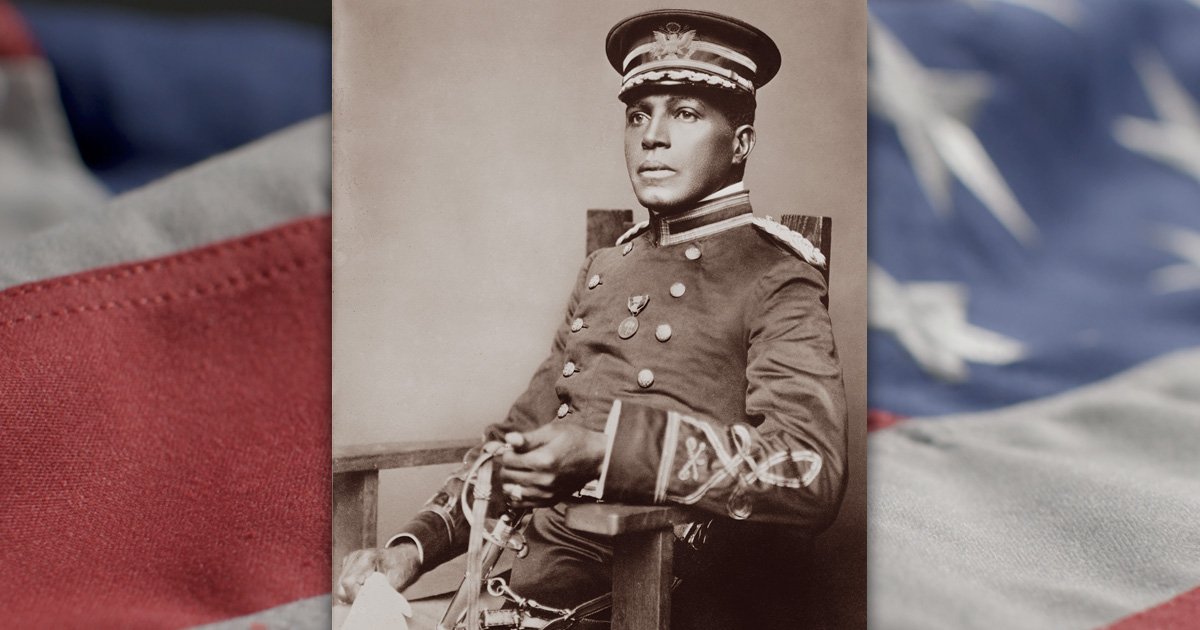
Charles Young was the third Black graduate of the United States Military Academy, class of 1889, in spite of the hatred, bigotry and discrimination he encountered as an undergraduate. Charles Young was born into slavery on March 12, 1864, in May's Lick, Kentucky, a small village near Maysville. As a youth, Charles Young attended the all-White high school in Ripley, Ohio, the only one available, shortly after his parents relocated from Kentucky. He graduated at age 16 at the top of his class. His father had escaped bondage to join the Union Army during the Civil War, and Young later followed in his father's military footsteps.
After encouragement from his father, Young took entrance exams for West Point but was not selected to attend despite having the second highest score. It wasn’t until a candidate dropped out the following year that Young received his acceptance letter. Young took a competitive examination for appointment as a cadet at United States Military Academy at West Point. He achieved the second highest score in the district in 1883 and reported to the academy in 1884. Young had a miserable time at West Point.
Charles Rhodes, a White cadet in Young’s class, remembered him as “a rather awkward, overgrown lad, large-boned and robust in physique, and of a nervous, impulsive temperament.” Rhodes recalled that Young’s “life was lonesome” at West Point––hardly a surprise, as most White cadets refused to associate with Blacks and subjected them to racial slurs, cruel slights and hostile treatment beyond the normal hazing. In 1889, he became the third Black graduate from the academy following Henry Ossian Flipper and John Hanks Alexander.
After graduating from the academy, it was three months before he received an assignment because at the time, Black officers were not allowed to command White troops. Young graduated in 1889. His first assignment after graduation was with the Buffalo Soldiers in the 10th Cavalry in Nebraska, and then in the 9th and 10th Cavalries in Fort Robinson, Nebraska, and Fort Duchesne, Utah. While stationed at Fort Duchesne, Utah, Young mentored Sergeant Major Benjamin O. Davis, Sr. who later became the first African American to attain the rank of General.
With the outbreak of the Spanish-American War, he was reassigned as Second Lieutenant to training duty at Camp Algers, Virginia. Between 1889 and 1907 Young served in western posts and rose to the rank of captain. In 1894 Lieutenant Young was assigned to Wilberforce College in Ohio, to lead the new military sciences department. Young organized the military training program which grew to over 100 cadets by the turn of the century. Few such programs existed at civilian colleges or universities and none at African-American institutions.
While at Wilberforce, Young befriended W.E.B. Du Bois, a classics professor who would become one of the leading Black American intellectuals of the early 20th century. After leaving Wilberforce, Du Bois and Young continued to correspond, and Du Bois considered Young one of the “talented tenth”—those individuals whom Du Bois and other prominent Black intellectuals believed would lead the struggle for racial justice in America. In 1903, Captain Young was in command of the 10th Cavalry, who were segregated at the Presidio of San Francisco.
He was assigned "Acting Superintendent" of Sequoia National Parks in California for the summer. He was the first Black military attaché, became the first military attaché to Haiti and the Dominican Republic on the island of Hispaniola in 1904. Charles Young was very valuable to America in foreign posts because of his excellent command of foreign languages. He spoke fluent French, German, and Spanish. Captain Charles Young was sent to the Philippines to join his 9th regiment and command a squadron of two troops in 1908. Returning to the United States in May 1909, he took command of 2nd Squadron, 9th Cavalry.
In 1912 Young was promoted to major and was once again selected for Military Attaché duty, this time to Liberia. He also taught military sciences and tactics at Wilberforce University in Ohio in between his military duties. In 1916, Major Young was awarded the National Association for the Advancement of Colored People's (NAACP) prestigious Spingarn Medal, in recognition of his "Services in organizing the Liberian Constabulary and roads in the Republic of Liberia." During the 1916 Pershing's Punitive Expedition into Mexico, Young was praised for his leadership in the pursuit of the bandit Pancho Villa, who had murdered American citizens.
Commanding a squadron of the 10th United States Cavalry, he led a cavalry pistol charge against the Villista forces, routing the opposing forces without losing a single man. The swift action saved the wounded General Beltran and his men, who had been outflanked. After the campaign, Young was promoted to Lieutenant Colonel, on July 1, 1916, the first African American to attain the rank or its equivalent. He was assigned as commander of Fort Huachuca, the base in Arizona of the Tenth Cavalry, nicknamed the "Buffalo Soldiers", until mid 1917.
The War Department instead removed Young from active duty, claiming it was due to his high blood pressure. Young was placed temporarily on the inactive list. In July 1917, Young was medically retired and promoted to a full Colonel in recognition of his distinguished Army service. He was the first Black man to achieve the rank of colonel in the United States Army, and highest-ranking Black officer in the Regular Army. Young and his supporters asked for reconsideration of his retirement. To his bitter disappointment – he was not permitted to serve in the field during World War I. Charles Young died in 1922 during a visit to Nigeria. W. E. B. Du Bois, who spoke at Young's eulogy, claimed that "the life of Charles Young was a triumph of tragedy."
Edward Lee Baker was born on December 28, 1865, in Platte River, Wyoming, near Fort Laramie. Edward enlisted in the US Army in July of 1882, at the age of 16 and served with the 9th Cavalry Regiment. Baker’s first re-enlistment came about a year, with the 10th U.S. Cavalry before the Spanish-American War began and later became a Sergeant Major of the Buffalo Soldiers.
His actions on the 1st of July 1898, during the Battle of San Juan Hill, would later earn him the Medal of Honor. The Spanish troops were entrenched on San Juan Hill and Kettle Hill firing down on the Tenth’s position. As Baker made his rounds, he saw a soldier struggling face down in the San Juan River. Ignoring the advice of other soldiers who told him it was too dangerous to try to save the soldier, Baker, while under fire, rescued the wounded soldier from drowning.
On September 9th 1899 he was promoted to captain of the 49th U.S Volunteer Infantry. He was re-commissioned as a Second Lieutenant with the Philippine Scouts on February 7th 1902 and was promoted to 1st lieutenant on 10 September 1906. He was promoted to the rank of captain on 12 September 1908. He retired in 1909 after nearly 28 years of service. At the time of his retirement he was one of the highest ranking Black officers in the U.S Army.
Fitz Lee joined the Army from Philadelphia, PA. in December 1889. By June 30, 1898, he was serving as a private in Troop M of the 10th Cavalry Regiment with the Buffalo Soldiers. On that day, American forces aboard the U.S.S Florida near Trinidad, Cuba, dispatched a landing party to provide reconnaissance on Spanish outposts in the area. The party was discovered by Spanish scouts and came under heavy fire.
The landing party boats were sunk by enemy cannon fire, leaving them stranded on shore. The men aboard the Florida launched several rescue attempts; the first four were forced to retreat under heavy fire. The fifth attempt, by Lee and three other privates of the 10th Cavalry under the command of Lieutenant George P. Ahern, was launched at night and successfully found and rescued the surviving members of the landing party.
One year later, on June 23, 1899, Fritz Lee, along with the other rescuers were awarded the Medal of Honor for their actions in what had come to be known as the Battle of Tayacoba. Lee received his Medal of Honor while he was in the hospital at Fort Bliss, Texas. His health declined quickly after the rescue mission. Lee was medically discharged from the Army on July 5, 1899, a few days after receiving the Medal of Honor. Lee moved to Leavenworth, Kansas, after discharge to live with fellow retired Buffalo Soldiers.