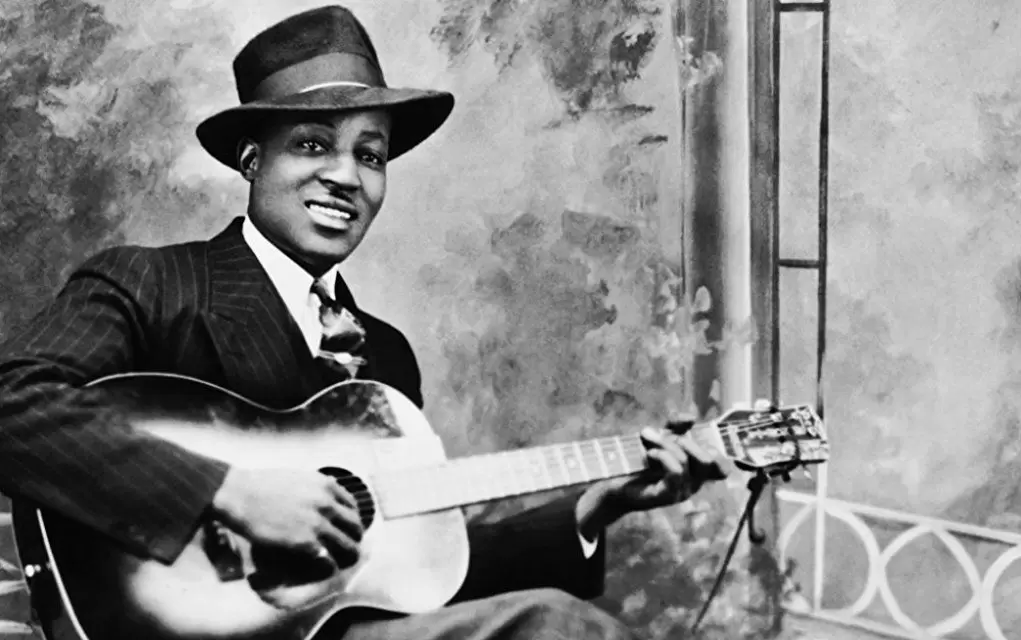
Big Bill Broonzy was born William Lee Conley, in 1903, in Scott, Mississippi, and raised in Pine Bluffs, Arkansas. He became involved in music at a very young age, playing spirituals and folk songs on a homemade violin. Broonzy got Papa Charlie Jackson, a popular blues singer, to teach him guitar. He began performing music at an early age, playing for social and church events on the fiddle, which he learned from his uncle, Jerry Belcher. In addition to odd jobs as a musician, Broonzy also served briefly as a pastor in the Pine Bluff area before 1918.
In 1920, after a spell in the army, he return to Mississippi, and later returned to Mississippi and ventured north to Chicago. He had some luck landing live performances for mostly Black crowds at Chicago nightclubs. Until this time, Broonzy played in the songster mode, spinning out reels and waltzes on his fiddle. Switching to the guitar, he learned the rudiments of the blues. Before long, Broonzy could fingerpick or flat-pick the blues with equal dexterity. In 1926 he made his first recording with Paramount Records, playing backup guitar for local blues artists Cripple Clarence Lofton and Bumble Bee Slim.
Influenced by musicians such as Jimmie Rodgers, Blind Blake, Son House, and Blind Lemon Jefferson, Broonzy developed an amalgamated form of the blues. By the early 1930s Broonzy was finally given the opportunity to record under his own name for the Melotone, Oriole, and Champion labels. At the end of the decade he was the top selling male blues vocalist. By this time Broonzy was no longer a solo performer. He began to play with small groups that incorporated the piano, trumpet, saxophone, and sometimes a rhythm section.
Through the 1930s and 1940s he successfully navigated a transition in style to a more urban blues sound popular with working-class Black audiences. By combining ragtime and hokum blues with country blues, he created a style that foreshadowed the post–World War II Chicago sound, which was later defined by such artists as Muddy Waters and Willie Dixon. Over the next two decades Broonzy wrote, performed, and recorded numerous blues songs.
He often used an urban blues style that showed both jazz and pop influences. They were closer to the music of cosmopolitan players such as Blind Blake and Lonnie Johnson rather than the Delta style of Robert Johnson or Charley Patton. By 1945 Black musical tastes were moving away from the blues toward jazz and popular music. Broonzy however, found and exploited the growing interest of Whites in blues. By the late 1940s a new generation of White blues lovers praised him for his spectacular performances.
He played with fellow blues and folk musicians Brownie McGhee, Pete Seeger, and Sonny Terry. In the 1950s a return to his traditional folk-blues roots made him one of the leading figures of the emerging American folk music revival and an international star. He rose to international prominence during the '50s while touring Europe, effectively reversing his ailing fortunes as an artist and further cementing his place in the annals of guitar history. His long and varied career marks him as one of the key figures in the development of blues music in the 20th century.